Cracked Garage Floor Repair: When to Fill, Level, or Pour New Concrete
If your garage floor has cracked, sunk, or pulled away from the house, you have three realistic paths: fill the cracks, lift and level the slab, or tear it out and pour new. Cracked garage floor repair is rarely one-size-fits-all, and in newer Des Moines-area subdivisions built on fill soil, the garage slab is often the first place settling shows up. This guide walks you through how to evaluate your own floor, step by step, so you can tell whether you need to fill, level, or replace the slab based on whether you need a tube of filler, a leveling crew, or a full replacement. If you are also trying to document the damage for an insurance or builder warranty claim, each step tells you what to photograph and record along the way.
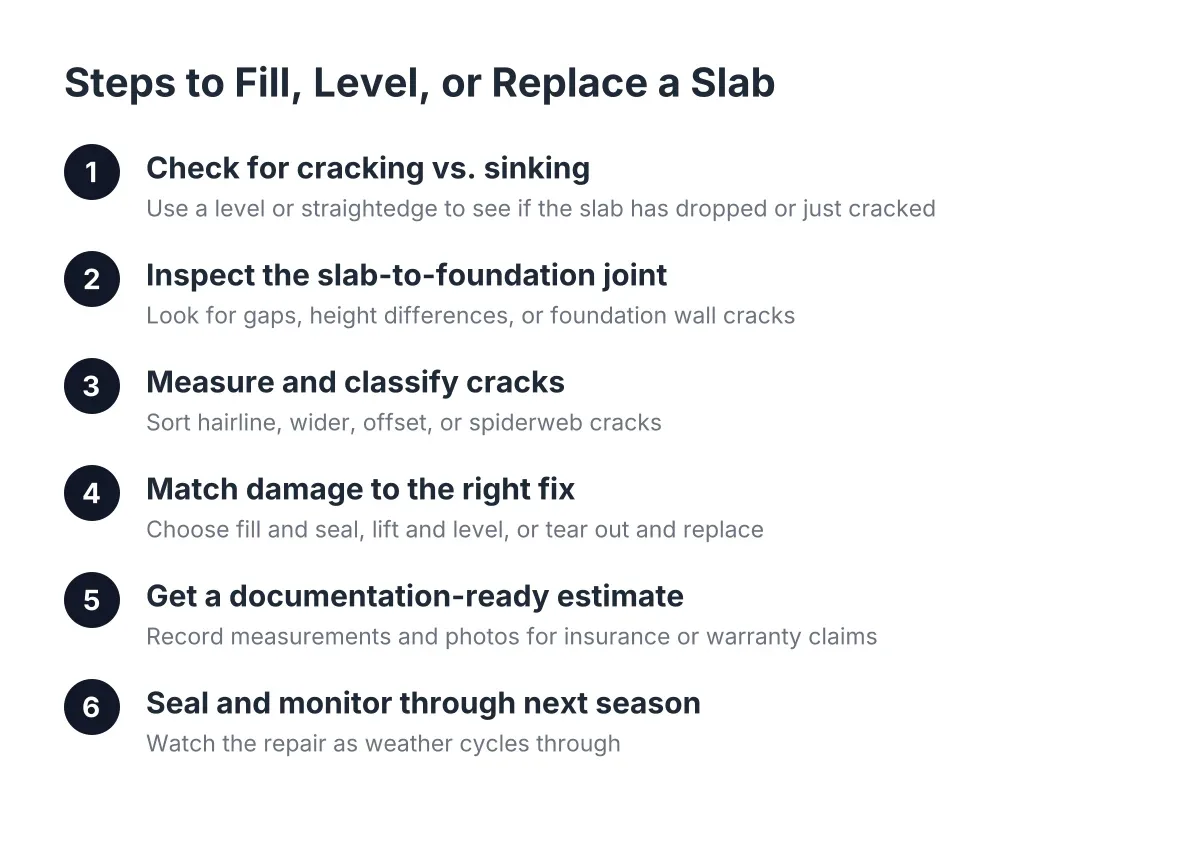
Step 1: Figure Out If the Slab Is Cracked, Sunken, or Both
Start by sorting what you are looking at. A crack by itself is a surface problem. A crack plus sinking is a soil problem, and that changes everything about the fix.
Grab a 4-foot level or a long straightedge and lay it across the floor in several spots. Check the crack itself: are both sides at the same height, or has one side dropped below the other? A height difference across a crack means the slab is settling, not just shrinking.
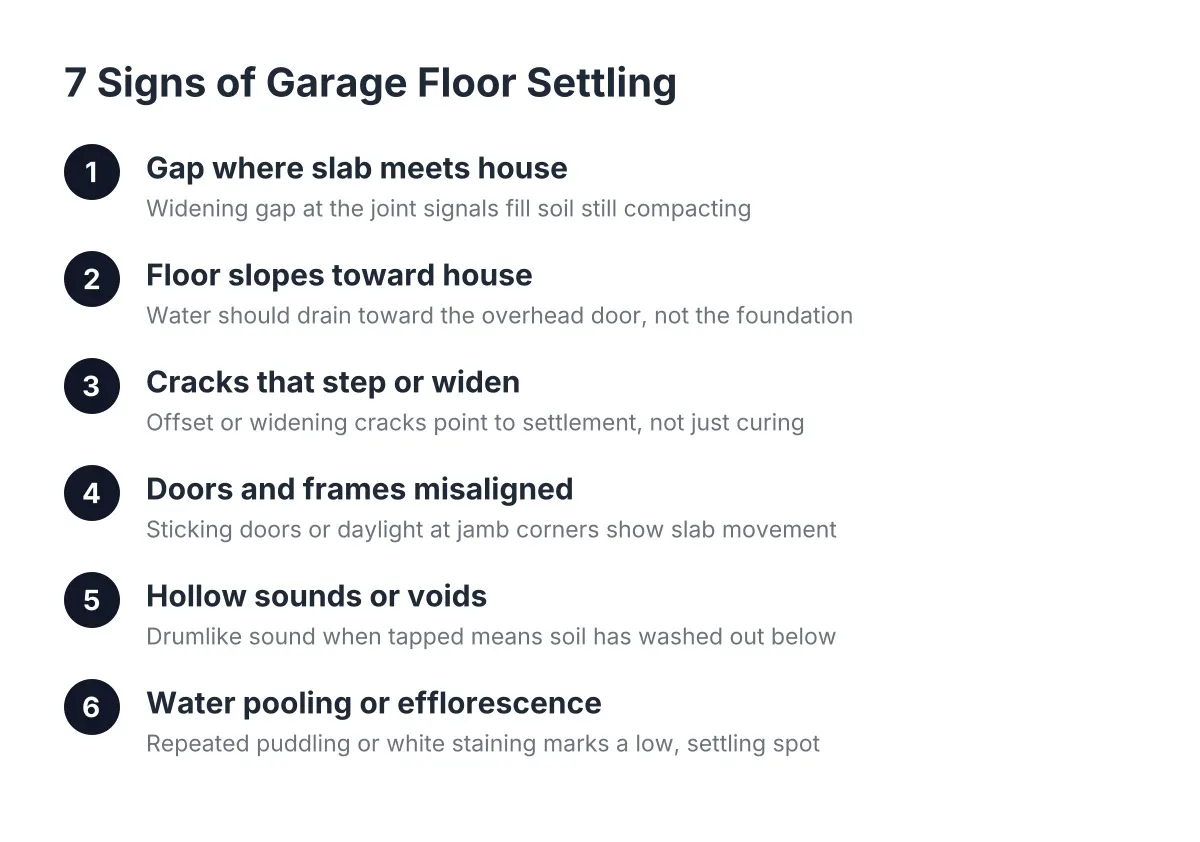
Next, look at the slope. Garage floors are poured with a slight pitch toward the door so water drains out. If your floor now slopes toward the house, or water pools in a corner after you pull in with a snowy car, the slab has moved. That matters for drainage and for deciding between leveling and replacement.
For claims purposes, photograph everything now, before any repair. Adjusters and builder warranty reps want to see the damage as found, with something for scale, like a tape measure laid across the crack.
Step 2: Check Where the Garage Slab Meets the House Foundation
This is the step most homeowners skip, and it is the one that matters most in central Iowa's newer subdivisions. Walk to the back wall of the garage, where the slab meets the home's foundation, and look at the joint.
In many Ankeny, Johnston, Clive, and Waukee-area homes built in the last three to eight years, the garage slab sits on fill soil that was placed during construction. The house foundation goes down to firmer ground; the garage slab does not. As that fill compacts over the first several years, the slab drops while the foundation stays put. The result is a widening gap, or a step down, right at the back of the garage.
Here is what to record:
- The width of the gap between slab and foundation, measured with a tape
- Any height difference, meaning the slab surface sits lower than it used to against the wall
- Cracks in the foundation wall itself, not just the slab
- Whether the garage door still closes evenly across the opening
A slab that has separated from the house but shows no foundation wall cracks is usually a leveling candidate. Sloping in the floor combined with visible cracking in the adjoining foundation wall points to a settlement problem that goes beyond the slab, and that calls for a structural evaluation before anyone pumps material under the concrete. Concrete leveling fixes sunken slabs; it does not fix a failing foundation, and an honest contractor will tell you which one you have.
Step 3: Measure and Classify the Cracks
Not every crack means trouble. Classify what you have so you can match it to the right repair.
- Hairline cracks, under about 1/8 inch wide, flat on both sides: normal shrinkage. Nearly every slab gets them. Crack filling handles these.
- Wider cracks, 1/8 to 1/2 inch, still flat: the slab may be moving seasonally. Crack repair with a flexible filler keeps water and road salt out.
- Offset cracks, where one side sits higher than the other: the slab has settled unevenly. This is a lifting job, not a filling job, and the offset is also a tripping hazard.
- Spiderweb or crushed areas with chipped, crumbling concrete: the slab surface is failing. Chipped garage floor repair with patching compound works for small spots, but widespread crumbling pushes you toward resurfacing or replacement.
Write down the length, width, and offset of each major crack. If you plan a sunken slab insurance claim, this measured list is exactly what an adjuster wants attached to the estimate. Most insurance policies treat gradual settling as excluded wear, but a documented timeline, especially damage that appeared after a specific heavy rain or freeze-thaw event, gives your claim its best footing. No contractor can promise coverage; good documentation is the only thing in your control.
Step 4: Match the Damage to the Right Fix
Now you can sort your floor into one of three buckets. Be honest with yourself here, because picking the cheap option on the wrong floor means paying twice.
Fill and Seal: For Stable Cracks
If the slab is level and the cracks are flat, crack filling is the whole job. A flexible polyurethane or silicone-based crack filler keeps water out, which matters in Des Moines because water in a crack freezes, expands, and widens the crack every winter. When deciding whether to fill, level, or replace your slab, a reasonable DIY project for hairline cracks is crack filler, or a small line item on a professional visit.
Lift and Level: For Sunken but Solid Slabs
If the slab has dropped, whether at the foundation joint, along a crack, or across a whole section, concrete leveling is usually the fix. The process is straightforward. According to Wikipedia, concrete leveling works by drilling holes in the sunken slab, pumping a lifting material beneath it to raise and stabilize the concrete, then patching the holes to blend with the original surface. Both mudjacking and polyurethane foam injection do this; which one fits depends on slab condition, the load it carries, cure time, and cost.
Leveling also addresses the slab-separating-from-house pattern. After the lift, the joint along the foundation gets sealed, and remaining cracks get filled so water cannot keep washing out the soil underneath. On price, HomeAdvisor reports mudjacking runs $3 to $6 per square foot and costs 25% to 50% less than replacing a slab entirely. Angi and HomeAdvisor data puts the national average concrete leveling cost at $1,174, with a typical range of $630 to $1,723. Expect a minimum charge of around $500 on small jobs, according to Angi, even when the sunken area is under 100 square feet.
Tear Out and Replace: For Broken Slabs on Failed Base
If the slab is cracked into multiple tilting pieces, crumbling through its thickness, or has dropped repeatedly after past repairs, the base under it has failed. Cracking plus ongoing sinking usually means the sub-base needs to be rebuilt, and no amount of lifting fixes bad base material for the long haul. Replacement costs several times more than leveling, but on a truly failed slab it is the only fix that lasts.
A quick word on self-leveling concrete: it is a legitimate product for smoothing an interior floor before flooring goes down, and the surface needs mechanical profiling first, according to the Lowe's Self-Leveler Plus installation guide. However, as a garage fix for settling, a thin topping poured over a moving slab tends to chip and crack off as the concrete expands and contracts through Iowa's freeze-thaw cycles. It treats the symptom, not the sinking.
Step 5: Get a Documentation-Ready Estimate for Cracked Garage Floor Repair
Suppose a homeowner in an Ankeny subdivision notices the garage slab has dropped about an inch at the foundation wall six years after the build, right after a wet spring. In that scenario, the builder warranty on flatwork has usually expired or excluded slab settling, so the next move is an independent written estimate, ideally one detailed enough to submit to insurance if a claim applies.
Ask any contractor you call for these items in writing:
- A description of the cause, such as settling of fill soil beneath the garage slab
- Measurements: square footage affected, inches of drop, crack widths
- The proposed method, whether mudjacking, polyurethane foam, crack repair, or replacement, and why that method fits your slab
- Photos taken during the inspection
- A line-item price, so an adjuster or warranty rep can see what each part of the garage floor leveling and crack repair work costs
That paperwork serves you two ways. It supports a claim if your policy covers the event, and it lets you compare bids on equal terms if you pay out of pocket. There is a consolation on the out-of-pocket side: Angi reports mudjacking and concrete leveling projects can recoup 70% to 90% of their cost in added home value.
Step 6: Seal the Repair and Watch the Floor Through the Next Season
Whichever fix you choose, finish the job. After a slab is lifted, the joint where it meets the foundation and any remaining cracks should be sealed with a flexible self-leveling concrete caulk. That seal is what stops meltwater from your car dripping into the joint, soaking the soil below, and restarting the settling cycle.
Then watch the floor through one full freeze-thaw season. Re-check your straightedge spots in spring. On fill-soil lots, some additional settling over the following years is common, and a small touch-up lift later is normal, not a sign the first repair failed. Keep your photos, measurements, and the written estimate filed together; if movement continues, that record shows the timeline to a contractor, an adjuster, or a buyer down the road.
The Bottom Line on Repairing a Cracked Garage Floor
Flat cracks get filled. Sunken but solid slabs get lifted and leveled, which handles the common garage-slab-separating-from-house pattern in Des Moines-area subdivisions built on fill. Broken-up slabs on a failed base get replaced. Work the steps in order, measure before you call anyone, and get every finding in writing. Done that way, cracked garage floor repair becomes a clear decision instead of a guess, and you only pay for the fix your floor actually needs.
If you need concrete leveling, Des Moines Concrete Leveling Pros can help.
Prefer to talk it through? Call +15155828701 — a quick call is usually the fastest way to get a straight answer for your situation.