Garage Floor Sinking? Why Central Iowa Clay Causes Settling and How to Fix It
If your garage floor is sinking, central Iowa's clay soil is usually the reason. In newer Des Moines-area subdivisions, garage slabs often sit on backfill that was never fully compacted, and over a few years the slab settles, cracks, and pulls away from the house foundation. If you're selling and an inspector just flagged it, the good news is this: most sunken garage slabs can be lifted and leveled in a day, without tearing anything out. A sinking garage floor is usually fixable through leveling rather than full replacement.
This guide walks you through fixing it step by step, in the order that gets you to closing without surprises.
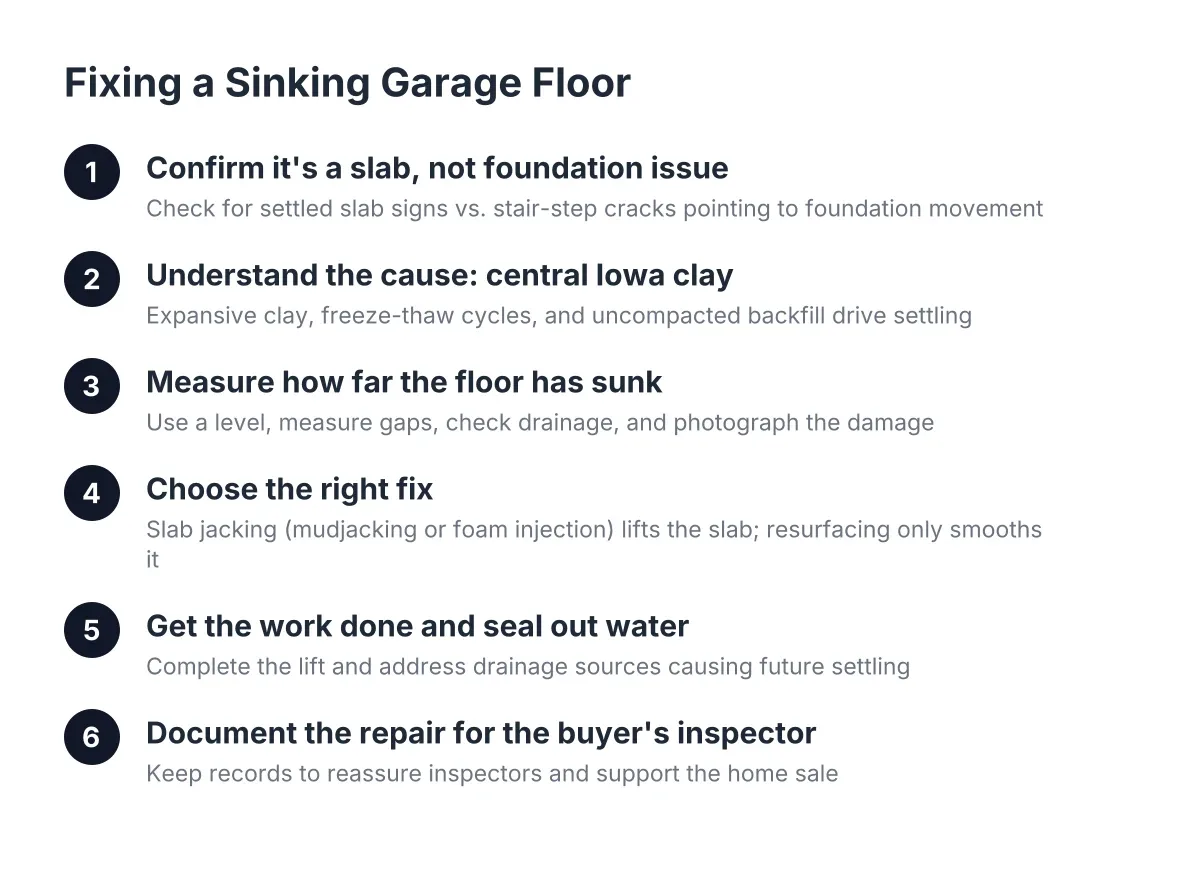
Step 1: Confirm It's a Sinking Slab, Not a Foundation Problem
Start by figuring out what actually moved. A garage floor is almost always a separate slab poured inside the foundation walls, not part of the foundation itself. That distinction decides whether this is a one-day leveling job or a bigger structural repair.
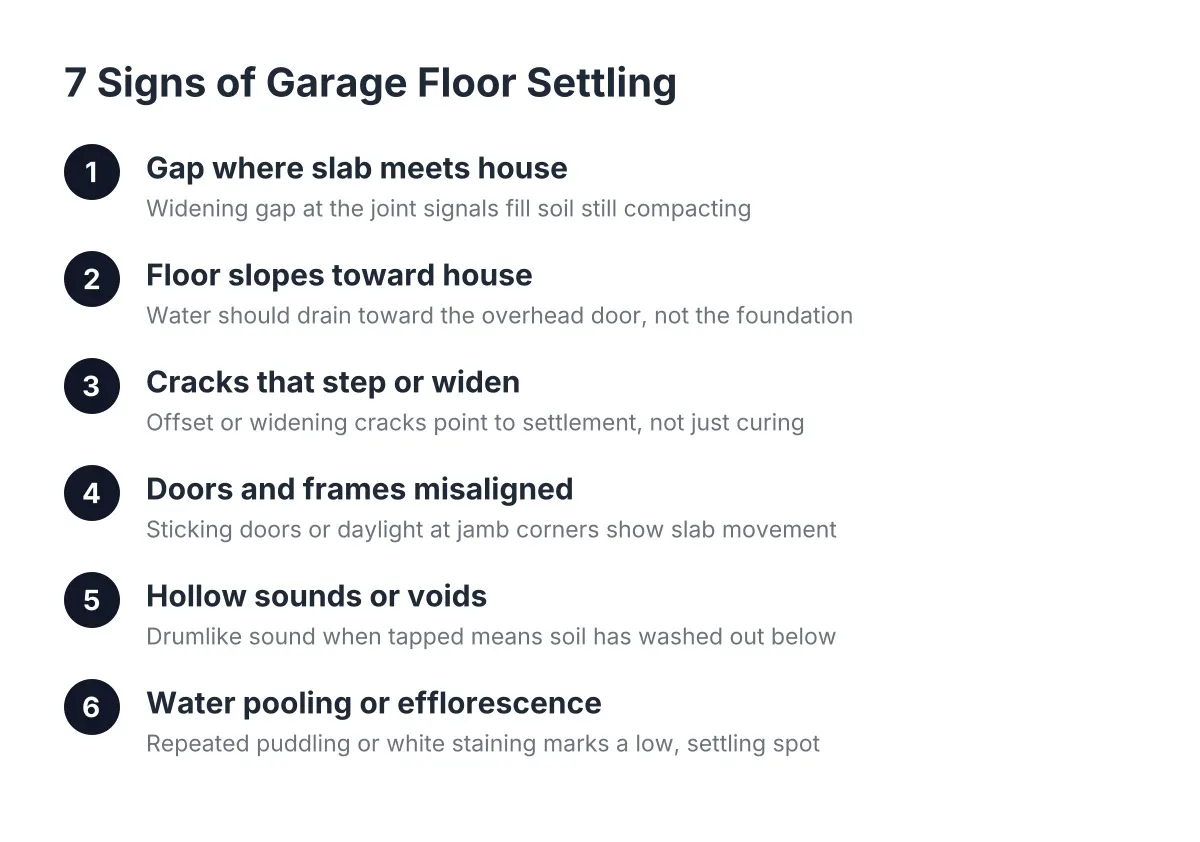
Walk the garage and look for these signs of a settled slab, which leveling can fix:
- The floor slopes toward the back or one side, and you can see a gap where the slab has dropped below the stem wall.
- A visible gap or crack has opened where the garage slab meets the house foundation, wider at the top of the slab edge.
- Cracks run across the floor and the two sides sit at different heights.
- The bottom of the garage door no longer seals evenly against the floor.
Now check the foundation walls themselves. Stair-step cracks in the block or brick, doors and windows inside the house that stick, or cracks in drywall above the garage point to foundation movement, not just a settled slab. A sloping floor combined with cracking in the adjoining foundation often means one settlement problem is driving both. In that case, get a structural evaluation before anyone lifts the slab; leveling the floor won't fix a moving foundation.
If the house checks out fine and only the slab dropped, you're in leveling territory. That's the common pattern in central Iowa.
Step 2: Understand Why Garage Floors Sink in Central Iowa
Garage floor sinking in central Iowa comes down to the soil under the slab. Most of the Des Moines metro sits on expansive clay that swells when wet and shrinks when dry. Add freeze-thaw cycles and the ground under a slab moves more here than in most of the country.
Newer subdivisions have an extra problem: fill soil. When a builder digs the basement, the excavated dirt often gets pushed back around the foundation, and the garage slab gets poured over it. That backfill keeps compacting for years after construction. The house sits on footings that reach solid ground, so it stays put. The garage slab sits on the fill, so it drops. That's why the slab separates from the house foundation instead of the whole structure moving together.
Water makes it worse. Downspouts that dump next to the garage, a driveway that slopes toward the slab, or a drought summer that shrinks the clay all speed up settling. Soil washing out or drying out under the slab is behind most of the sunken concrete we see across the metro.
One thing sellers should know: replacing the slab does not fix the soil. A brand-new pour over the same loose fill can settle again. Lifting the existing slab fills the voids underneath, which addresses the actual cause.
Step 3: Measure How Far the Garage Floor Has Sunk
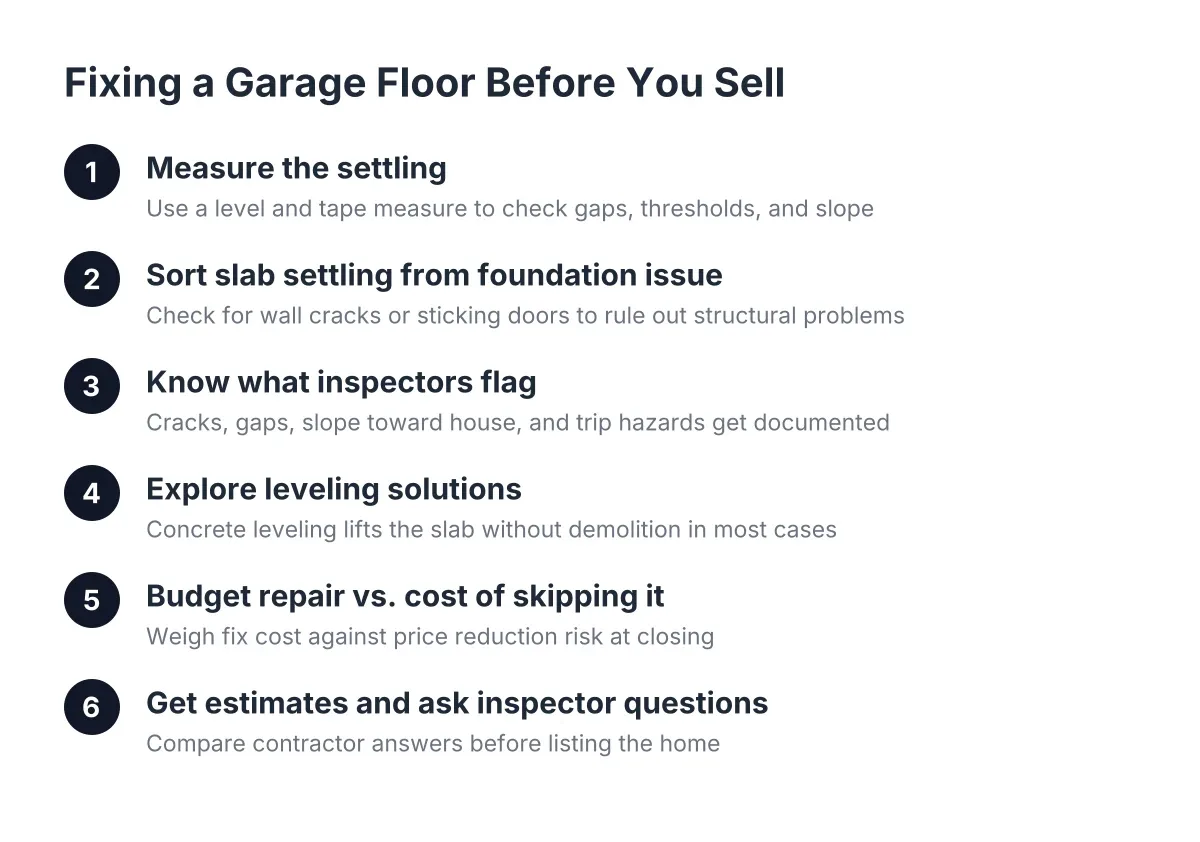
Before you call anyone, take ten minutes to document the settling. This helps you describe the job accurately, and it gives you a record for the buyer's inspector later.
- Lay a 4-foot level or a straight board across the low area and measure the gap underneath. Note the worst spot.
- Measure the gap where the slab meets the house foundation, both the width of the separation and any height difference.
- Check which way the floor drains. Pour a cup of water near the middle and watch where it goes.
- Photograph the cracks, the separation gap, and the level readings with a tape measure in frame.
That drainage check matters more than most people think. A garage floor should slope toward the door. If settling has tilted it so snowmelt off your car runs back toward the house foundation, water will keep feeding the soil problem and can damage the foundation over time. That's the kind of finding a buyer's inspector will write up in bold.
Catching this early keeps costs down. A slab that's an inch or two out of level is a straightforward lift. Wait until it's dropped four inches and broken into pieces, and your options shrink and your price climbs.
Step 4: Choose the Right Fix for a Sinking Garage Floor in Central Iowa
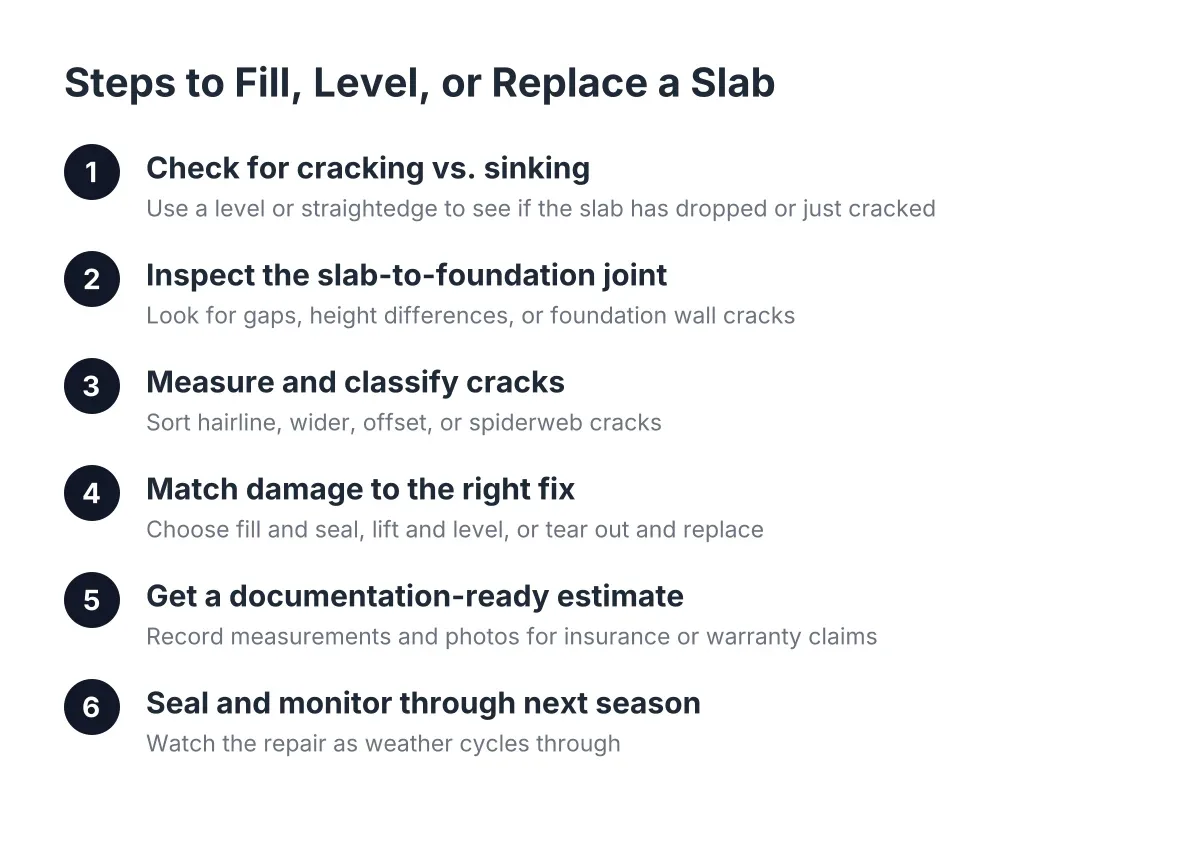
For a sunken garage floor in central Iowa, the right fix depends on how far the slab dropped, its condition, and your timeline. Slab jacking, either mudjacking or polyurethane foam injection, lifts the existing slab back into place and is the fastest, cheapest structural fix. Self-leveling concrete and resurfacing only smooth the surface; they don't stop settling.
Here's how the options compare:
Mudjacking or foam injection (slab jacking). A crew drills small holes in the slab, pumps material underneath to fill the voids and raise the slab, then patches the holes to closely match the original surface, according to Wikipedia. Mudjacking uses a cement slurry and handles heavy loads well. Polyurethane foam uses smaller holes and cures fast, which matters when your car needs to park on it that night. Either one typically wraps up in a few hours. According to HomeAdvisor, mudjacking costs 25% to 50% less than replacing a slab entirely.
Self-leveling concrete. This is a topping, not a lift. It can smooth a wavy or pitted floor after the slab has been raised, but poured over a still-settling slab, it will crack right along with it. If you go this route for finish work, know that it's fussier than the bag suggests. Manufacturer instructions typically require mechanically profiling the concrete surface first, according to Lowe's Self-Leveler Plus installation guide, and priming porous concrete reduces air bubbles rising into the compound, according to Ardex. Wear a respirator when mixing; the dry powder is hazardous to breathe, according to Sakrete.
Concrete resurfacer. A DIY concrete resurfacing product can freshen a stained, flaky surface for curb appeal. However, even the best concrete resurfacer is cosmetic. Concrete resurfacing DIY projects don't lift anything, and an inspector measuring slope will not be fooled.
Full replacement. Reserve this for slabs that are shattered, heaved, or have lost too much thickness. It costs several times more than leveling, takes days plus cure time, and still needs the soil problem fixed underneath.
For a pre-listing seller, slab jacking paired with crack filling is almost always the answer. It fixes the structural finding, closes the trip hazard, and fits a closing timeline.
Step 5: Get the Work Done and Seal Out Future Water
Once you've chosen leveling, the job itself moves fast. Say a homeowner in Waukee has a garage slab that dropped two inches at the back corner and pulled a half-inch gap open at the foundation, with closing set for five weeks out. In that scenario, a typical crew levels the slab in one morning, fills the cracks and the separation joint the same day, and the floor is back in service within hours if foam is used. For context on budget, the national average concrete leveling cost is $1,174, with a typical range of $630 to $1,723, according to Angi and HomeAdvisor data. Small jobs may carry a minimum charge of around $500, according to Angi. Your actual quote depends on how much material the voids swallow.
Two details protect the repair through inspection and beyond:
- Seal the joint between slab and foundation. After the lift, that separation gap gets filled with a flexible sealant so water can't run down into the soil and restart the settling.
- Fix the water source. Extend downspouts away from the garage, and check that grading beside the slab sheds water. Skip this and the clay under your slab keeps moving.
One honest limitation: leveling raises and stabilizes the slab, but badly shattered concrete or an actively failing foundation is beyond its scope. A good contractor will tell you that at the estimate, not after.
Step 6: Document the Repair for the Buyer's Inspector
Your inspector flagged the floor once; assume the buyer's inspector will check it again. Keep the invoice describing what was done, the material used, and the areas lifted. Pair it with your before photos from Step 3 and a couple of after photos showing the level readings.
A documented professional repair reads far better on a disclosure than an unexplained patch. It also holds its value. According to Angi, concrete leveling projects can recoup 70% to 90% of their cost in added home value, which is a strong return for a repair that also removes an inspection objection. Garage floor leveling done a few weeks before listing, with paperwork in hand, turns a red flag into a line item that's already handled.
The pattern behind garage floor sinking in central Iowa, clay soil plus uncompacted fill, isn't going anywhere. But a slab that's been lifted, sealed, and drained correctly is a solved problem, and that's exactly what a buyer wants to see.
If you need concrete leveling, Des Moines Concrete Leveling Pros can help.
Prefer to talk it through? Call +15155828701 — a quick call is usually the fastest way to get a straight answer for your situation.