Mudjacking vs. Foam: How to Choose the Right Concrete Slab Repair Method
If your sidewalk has become a tripping hazard or your driveway has pulled away from the garage, you have two main options for concrete slab repair: mudjacking and polyurethane foam injection. Both lift sunken concrete back into place without tearing it out. The right choice depends on your slab, your soil, and your budget. This guide walks you through the decision step by step, so when a contractor recommends one method, you will know whether it fits your situation or just fits their sales pitch.
Both methods work the same basic way. According to Wikipedia, concrete leveling works by drilling holes into the sunken slab, pumping a lifting material beneath it to raise and stabilize the slab, then patching the holes to match the original surface. Mudjacking pumps a heavy slurry of cement, sand, and soil under the slab. Foam injection pumps a two-part liquid that expands and hardens underneath. Same goal, different material. Here is how to pick.
Step 1: Confirm Your Slab Is a Candidate for Leveling
Before you compare methods, make sure lifting is the right fix at all. Concrete leveling raises a settled slab from underneath. It does not fix concrete that is crumbling, badly spalled, or broken into small pieces. A slab in that shape needs replacement or resurfacing, not lifting.
Walk your property and look at the problem areas. A sidewalk section that sank two inches at one end but is otherwise solid is a strong candidate. A porch step that has tilted but not cracked apart is a strong candidate. Additionally, a driveway that has shattered into a dozen chunks is not.
Also rule out a structural problem. If the slab that is moving connects to your foundation, or you see cracks in your basement walls too, get a foundation evaluation first. Concrete leveling companies fix slabs; they should tell you plainly when the problem is bigger than a slab. That distinction matters for newer homes in Ankeny, Waukee, Clive, and Johnston built on fill soil, where surface settling is common but usually not structural.
Step 2: Weigh the Slab's Condition and Load
Now look closer at the concrete itself, because slab condition is the first factor that splits the two methods.
Mudjacking requires drilling holes about the size of a soda can, roughly one and five-eighths inches to two inches across. Foam injection uses smaller holes, often around five-eighths of an inch. If your slab is thin, already cracked in several places, or decorative, the smaller foam holes put less stress on it and are easier to hide in the patch.
Weight matters too. Mudjacking slurry is a heavy cement-and-soil mix, and it adds real weight on top of soil that already failed once. Polyurethane foam is lightweight by comparison. On central Iowa's expansive clay and on the loose fill under many newer subdivisions, adding heavy material to weak soil can invite the slab to settle again. If your soil is the reason the slab sank, lighter material is the safer bet.
However, mudjacking still holds its own for solid, thick slabs like driveways and garage floors. The dense slurry fills large voids completely and supports heavy loads well. Foam does not always fill the entire void, so on a big driveway slab with a deep cavity, ask the contractor how they will confirm support across the whole slab, not just at the injection points.
Step 3: Compare Cure Time Against How You Use the Slab
Ask yourself one practical question: how soon do you need to walk or drive on this concrete?
Polyurethane foam cures fast. Most foam-lifted slabs can take foot traffic within an hour and vehicle traffic the same day. Mudjacking slurry needs time to set, typically a day or more before you should drive on it.
For a Safety-First homeowner, this is often the deciding factor. Suppose your front walkway is the only path to your door and your grandkids visit every weekend. A method that has the walk safe and usable by dinner beats one that keeps you stepping around cones for a day. For a back patio you rarely use, cure time barely matters, and the cheaper method may win.
Step 4: Comparing Costs for Concrete Slab Repair
Get a written quote for each method where both apply, because the price gap is real but so is the value gap.
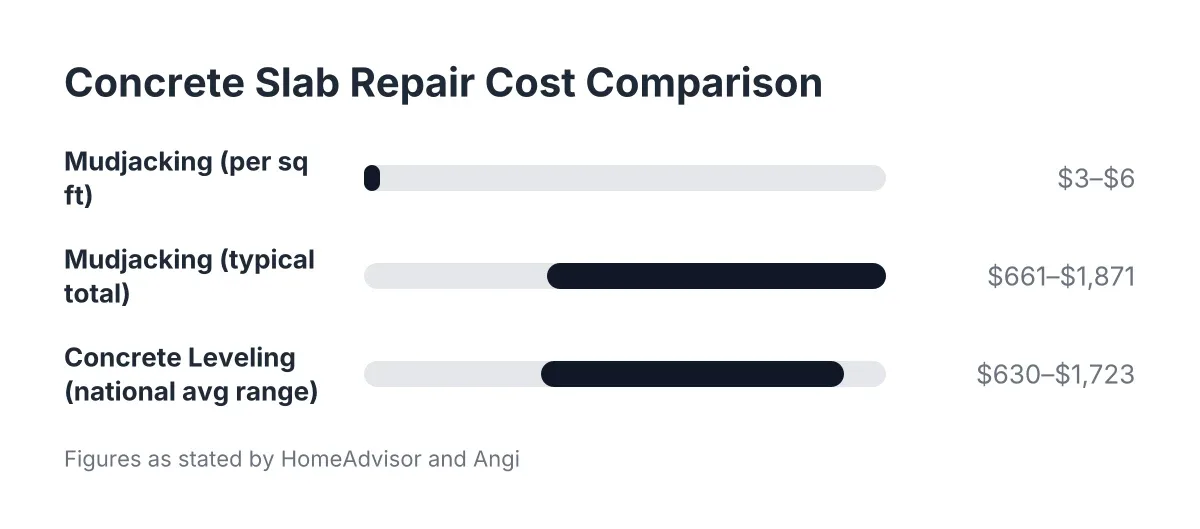
Mudjacking is usually the cheaper option per job. According to HomeAdvisor, mudjacking costs $3 to $6 per square foot and runs 25% to 50% less than replacing a concrete slab entirely. Angi puts the national average mudjacking cost between $661 and $1,871, with most homeowners paying around $1,232. Polyurethane foam typically costs more per square foot, though the smaller crew and faster work can narrow the gap on small jobs.
Either way, lifting beats replacement on price for a structurally sound slab. According to Angi and HomeAdvisor data, the national average concrete leveling cost is $1,174, with a typical range of $630 to $1,723. Compare that to full concrete slab replacement, which means demolition, hauling, new pour, and weeks of cure time. Angi also reports that concrete leveling projects can recoup 70% to 90% of their cost in added home value.
For a fixed income, here is the honest trade-off: mudjacking costs less today, but on bad soil it may need to be redone sooner. Foam costs more today and is lighter on weak soil. Before choosing a concrete slab repair method, ask each bidder to explain which risk applies to your yard, not to yards in general.
Step 5: Ask Each Contractor These Vetting Questions
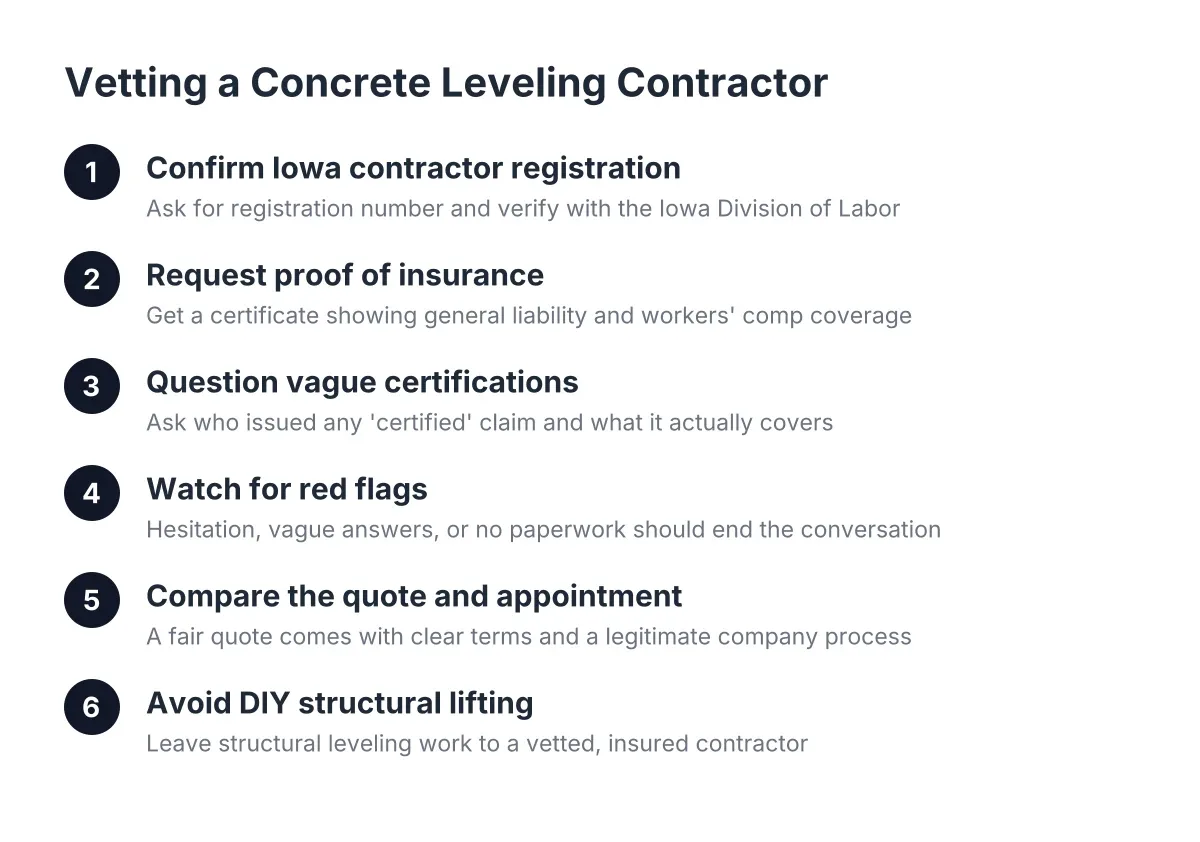
You are not just choosing a material. You are choosing the person who stands behind it. When you start hiring a concrete leveling contractor, ask every bidder the same short list and compare answers side by side:
- Which method do you recommend for my slab, and why this one instead of the other?
- Do you offer both mudjacking and foam, or only one? A one-method company recommends its one method.
- How will you find and fill the voids under the slab, not just lift the edges?
- What size holes will you drill, and how will the patches look?
- How soon can I walk and drive on it?
- What does your warranty cover, for how long, and is it in writing?
- Is this settling likely to continue, and what happens if the slab sinks again?
Listen for plain answers. A good contractor in Des Moines will talk about your specific soil, your slab's thickness, and where the water is coming from. Watch for red flags: pressure to sign today, a quote given over the phone without seeing the slab, no written scope, or scare talk about your foundation when the problem is a sunken sidewalk panel. Reviews help too; read recent concrete leveling reviews from Des Moines area homeowners rather than national franchise pages, since template sites tell you little about the local crew.
Step 6: Match the Method to Your Specific Slab
Pull it together with a simple rule of thumb. Choose foam when the slab is near living space, the soil is suspect, or you need it back in service fast. Choose mudjacking when the slab is thick and solid, the voids are large, and budget is the tightest constraint.
For example, say a retired couple in Beaverdale has a front walkway where one panel sank an inch and a half after last winter's freeze-thaw cycles, and the grandkids catch a toe on it every visit. In that scenario, foam injection makes sense: small holes, a light material on clay soil, and a walkway safe to use the same afternoon. Now suppose a homeowner in a five-year-old Ankeny subdivision has a builder-poured driveway slab that dropped where the fill soil settled, with a large void underneath. There, mudjacking's dense slurry may fill that cavity more completely at a lower cost, as long as the contractor addresses drainage so the soil stops washing out.
One caution on the DIY route. Bagged self-leveling concrete from a home center fixes shallow surface dips indoors, not a sunken exterior slab. It also has real prep requirements; manufacturer instructions typically require the concrete surface to be mechanically profiled before the leveler goes down, according to Lowe's installation guidance, and Sakrete notes you should wear a respirator when mixing because the dry powder is hazardous to breathe. General-purpose insulating foam from a can will not lift concrete either; slab lifting requires dense two-part foam made for the job. Searching for concrete contractors near me will surface general flatwork companies, so confirm the bidder actually specializes in leveling and lifting, not just pouring.
Step 7: Get the Plan in Writing Before Work Starts
Once you have chosen a method and a contractor, put the whole plan on paper before anyone drills a hole. The written scope should name the method, the slabs being lifted, the target height, how holes will be patched, the cure time before use, the total price, and the warranty terms.
Expect the appointment itself to be low-disruption. A typical crew for either method finishes a residential sidewalk or driveway job in a few hours, works from a truck or trailer in the street or driveway, and does not dig up your yard. That matters if a big construction project on your property worries you; this is not one.
Finally, ask what happens after the lift. On expansive clay or settling fill, crack filling and caulting the joints helps keep water from washing out the soil again. A contractor who explains maintenance in plain terms, rather than promising the slab will never move, is the one giving you the straight story. That plainness, more than any brochure, is the best sign you chose well.
If you need concrete leveling, Des Moines Concrete Leveling Pros can help.
Prefer to talk it through? Call +15155828701 — a quick call is usually the fastest way to get a straight answer for your situation.