Concrete Leveling Contractor License, Insurance, and Credentials: What to Check in Des Moines
You have decided to get your sunken sidewalk or settling driveway fixed. Now you want to be sure the person you hire is legitimate. The first thing many Des Moines homeowners search for is a concrete leveling contractor, and they want to verify that the contractor has the proper license and insurance. The right instinct is to check the contractor's license and insurance along with a handful of simple checks—these are the difference between a job done right and a stranger with a truck who disappears when something goes wrong. This guide walks through exactly what paperwork to ask for, how Iowa handles contractor registration, and the vetting steps that let you sign a contract with a clear head.
Nobody wants a construction project that drags on, and nobody wants to hand money to someone they cannot verify. Whether you are fixing a tripping hazard before the grandkids visit or getting a cracked walkway leveled before your home hits the market this spring, the checks below take less than an hour. They cost nothing, and they protect you from the worst outcomes.
What a Concrete Leveling Contractor License Means in Iowa
Iowa does not issue a specialty license just for concrete leveling. Instead, the state requires construction contractors who earn above a modest annual threshold to register with the Iowa Division of Labor. So when you hear someone in Des Moines say they are "licensed," what they usually mean is that they hold a current Iowa contractor registration.
That distinction matters. Some states, like California with its C-8 concrete classification, require a trade-specific license with an exam. Iowa takes a registration approach instead. The registration confirms the contractor is on file with the state, carries workers' compensation coverage where required, and has posted any required bond if they are an out-of-state contractor.
Here is the practical takeaway. When you ask a company about their concrete leveling contractor license, you are really asking two questions. First, are they registered with the Iowa Division of Labor as a contractor? Second, do they carry the insurance that registration implies? A legitimate residential concrete contractor in the Des Moines metro can answer both without hesitation and give you their registration number to verify yourself.
You can check a contractor's registration through the Iowa Division of Labor's public search. It takes a couple of minutes. If a company hesitates when you ask for their registration number, or gives you a vague answer about being "fully licensed and certified," treat that as your first red flag. Vague credential language is a common cover for having no credentials at all.
How Contractor License and Insurance Verification Filters Out the Wrong Companies
The registration itself is not hard to get. That is exactly why refusing to show it tells you so much. A contractor who cannot produce basic state registration is telling you they either work under the table or do not plan to be around long. Either way, that is not who you want drilling holes in your driveway.
For a homeowner on a fixed income, or one prepping a house for sale on a tight timeline, the stakes are real. If an unregistered contractor botches the lift, cracks your slab, or damages a buried line, you have little recourse. The few minutes spent verifying a contractor's license and insurance are the cheapest protection you will ever buy.
Insurance Matters More Than the License Itself
Registration proves a company exists on paper. Insurance protects you when something goes wrong on your property. For concrete leveling, ask about two specific policies before anyone sets foot on your walkway.
First, general liability insurance. This covers damage to your property. Concrete lifting involves drilling holes in a slab and pumping material underneath it, according to Wikipedia's description of the process. Done wrong, that can crack the slab, heave it too high, or push material where it should not go. General liability coverage means the contractor's insurer pays for that damage, not you.
Second, workers' compensation insurance. This covers the crew if someone gets hurt on your property. Without it, an injured worker can pursue a claim against you as the homeowner. That risk alone should end any conversation with an uninsured contractor.
Do not settle for a verbal "yes, we're insured." Ask for a certificate of insurance, sent directly from the contractor's insurance agent if you want the strongest verification. A legitimate company handles this request routinely and will not act offended. The certificate shows the policy is active, names the insurer, and lists coverage limits. Two minutes of reading tells you whether the protection is real.
Certifications, Training, and What "Certified" Actually Means
Concrete leveling has no state-issued certification in Iowa. When a company calls itself "certified," ask certified by whom. Sometimes the answer is a manufacturer training program for polyurethane foam equipment, which has some value. Sometimes the answer is nothing at all, just a word chosen because it sounds official.
Here is a fair way to weigh what you hear:
- Manufacturer or equipment training: Reasonable to mention. It shows the crew learned to run their lifting equipment properly. It is not a government credential.
- Trade association membership: Fine, but it is a membership, not a qualification. Anyone can pay dues.
- "Licensed, bonded, and insured": Ask for specifics on all three. Registration number, bond details if applicable, and a certificate of insurance.
- Invented-sounding titles: "Master certified leveling technician" and similar phrases with no issuing body behind them are marketing, not credentials.
In addition, franchise branding is not a credential either. A national name on the truck tells you about the marketing budget, not about the crew showing up at your house. The person doing the estimate and the crew doing the lift matter more than the logo. Ask who will actually be on site and how long they have been doing this work.
Vetting Steps Before You Sign Anything
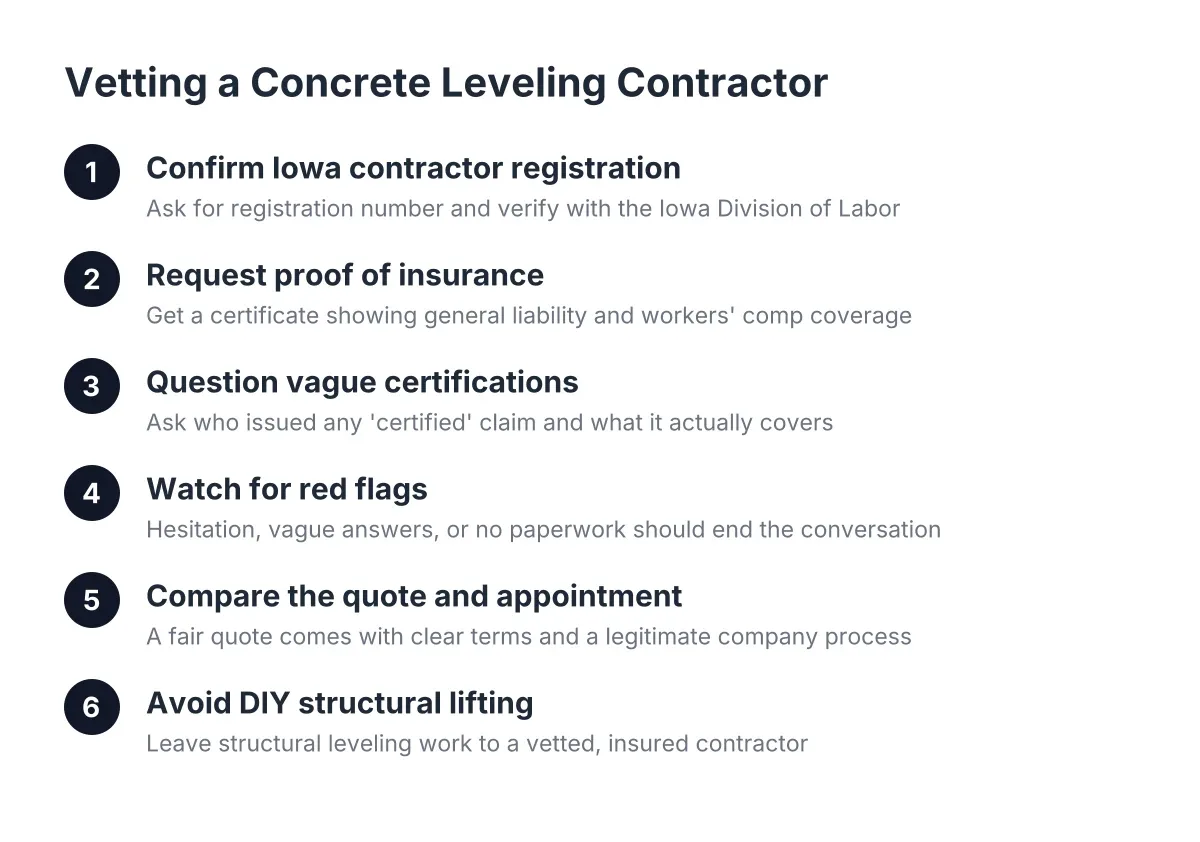
Once the paperwork checks out, shift to the practical vetting. This is where you separate a solid local company from one that just passed the minimum bar. Work through these steps in order:
- Verify the Iowa contractor registration. Search the Iowa Division of Labor database using the number the company gives you. Confirm it is active and matches the business name on the estimate.
- Get the certificate of insurance. Confirm general liability and workers' compensation are both current.
- Read recent reviews from Des Moines area customers. Look for patterns, not perfection. Do reviewers mention the crew showed up when promised, explained the work, and left the site clean? Responsiveness and good standing matter more than a flawless score.
- Ask to see completed projects. Photos of driveway leveling, sidewalk leveling, or step repair jobs similar to yours tell you the company has done this exact work before, not just poured patios.
- Get at least two or three written estimates. Comparing quotes is not about chasing the lowest number. It shows you the realistic range and exposes anyone quoting wildly high or suspiciously low.
- Confirm they will call for utility locates. In Iowa, that means Iowa One Call before any drilling. A contractor who shrugs this off is a contractor to avoid.
For example, suppose a grandmother in Beaverdale nearly trips on a porch step that has sunk an inch since last winter. She wants it fixed before her grandkids visit next month, but she is wary of letting unfamiliar workers on the property. Working through this list, she can confirm the company is registered and insured before anyone knocks on her door, read what her neighbors said about the crew, and compare two quotes side by side. In that scenario, the whole vetting process takes an afternoon, and she signs with confidence instead of crossed fingers.
Red Flags That Should End the Conversation
Some warning signs deserve an immediate no, regardless of price or schedule. Watch for these:
- No registration number, or excuses about why they cannot provide one. Every legitimate Iowa contractor above the earnings threshold has this.
- Cash-only pricing or demands for full payment upfront. A deposit can be normal. Full payment before work starts is not.
- Pressure to sign today. "This price is only good right now" is a sales tactic, not a business practice. Sunken concrete has been sinking for months; it can wait three more days while you verify credentials.
- No written estimate. Everything should be on paper: scope, method, price, and what happens if the slab does not respond as expected.
- A quote given without looking at the slab. Central Iowa's expansive clay soils and freeze-thaw cycles cause settling for different reasons at different homes. A price quoted over the phone without seeing your concrete is a guess, and probably a bad one.
- Claims that concrete leveling fixes everything. An honest contractor will tell you when a slab is too far gone for lifting. Badly shattered concrete, or settling driven by an active drainage problem, may need replacement or drainage work first, and a leveling company should say so.
One trade-off worth naming honestly: concrete leveling raises and stabilizes a slab, but it does not make old concrete look new. Cracks can be filled and the surface resurfaced, but the slab keeps its age. A contractor who promises a like-new driveway from leveling alone is overselling.
What a Fair Quote and Appointment Look Like
Knowing what a legitimate estimate visit looks like helps you judge everyone who shows up. Expect the estimator to walk the slab, check where it meets adjoining concrete, look at drainage and downspouts, and ask what you have noticed and when. They should measure how far the concrete has dropped and explain what is under it in plain terms.
A good estimate also explains the method. In the Des Moines market, that usually means mudjacking or polyurethane foam injection. Each fits different situations depending on slab condition, load, cure time, and cost, and the contractor should explain which one fits yours and why, without pushing the pricier option by default. If the answer to every question is "foam, because it's better," ask them to explain when mudjacking would be the right call. A specialist can answer that; a script cannot.
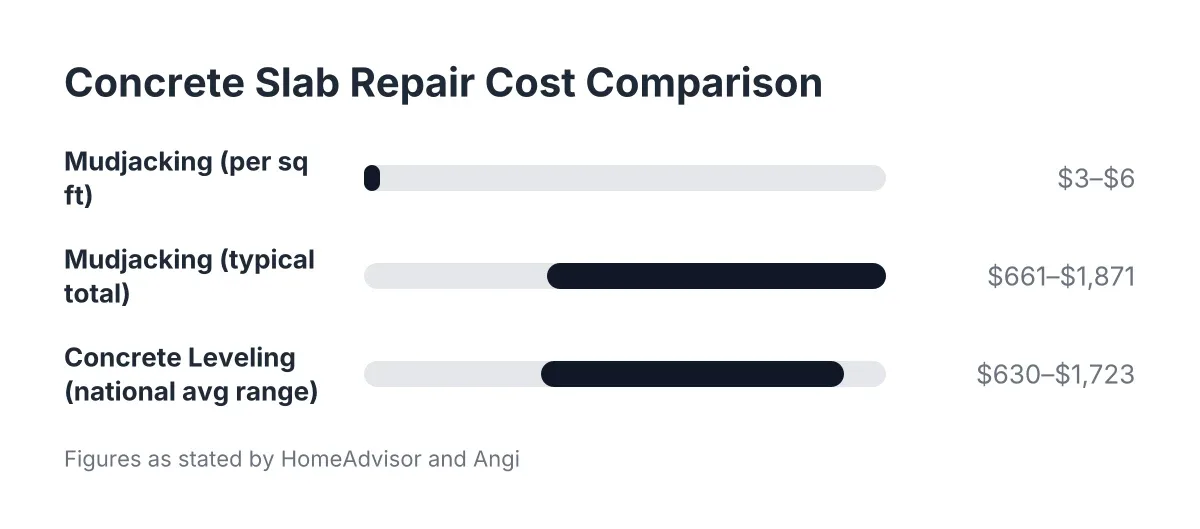
On cost, national data gives you a sanity check for 2026 comparisons. The national average concrete leveling cost is $1,174, with a typical range of $630 to $1,723, according to Angi and HomeAdvisor data. HomeAdvisor also notes that mudjacking runs 25% to 50% less than replacing a slab entirely. If a quote lands far outside those ranges, ask why. There can be honest reasons; access is a common one. Equipment usually stages in one spot, often the street or driveway, and running hoses across a yard or around a house to reach a back patio adds work. Obstacles like fences, buried drainage lines, or adjoining slabs can also raise the price, and add-ons like crack filling and joint sealing stack on top of the base lift.
For sellers, the numbers cut the other way in your favor. Angi reports that concrete leveling projects can recoup 70% to 90% of their cost in added home value. If your realtor flagged a sunken walkway or an uneven patio before listing, a leveling job that costs a fraction of replacement and returns most of that at sale is one of the easier pre-listing decisions you will make.
Questions to Ask About Contractor License and Insurance
Bring this short list to every estimate. The answers, and how comfortably they are given, will tell you most of what you need to know before hiring a concrete leveling contractor for your home:
- What is your Iowa contractor registration number?
- Can your insurance agent send me a certificate of insurance?
- Which leveling method do you recommend for my slab, and why that one instead of the other?
- Will you call Iowa One Call for utility locates before drilling?
- What does your warranty cover, for how long, and is it in writing?
- What happens if the slab cracks during the lift or settles again within a year?
- Who exactly will be on my property, and how long will the job take?
On warranties, read the actual terms rather than the headline. A concrete leveling warranty typically covers re-settling of the lifted slab for a set period. It usually does not cover new settling caused by drainage changes, tree roots, or slabs the crew never touched. A shorter warranty with clear terms from a company you can verify beats a "lifetime guarantee" from a company with no registration number.
Skip the DIY Shortcut on Structural Lifting
Some homeowners consider renting equipment or pouring self-leveling concrete themselves to save money. For interior floors, self-leveling compound has legitimate uses, but it is fussier than the bag suggests. Manufacturer instructions typically require the concrete surface to be mechanically profiled before the leveler goes down, according to Lowe's Self-Leveler Plus installation guide. Priming matters too; Ardex notes that primer on porous concrete reduces air bubbles rising into the compound. Even mixing carries risk, since the dry powder is hazardous to breathe and calls for a respirator, according to Sakrete.
More importantly, self-leveling compound only smooths a surface. It cannot lift a sunken slab, and it does nothing about the void underneath that caused the settling. A failed DIY attempt can also damage the slab enough that professional leveling becomes harder or impossible, forcing full replacement instead of a repair. If your sidewalk, steps, or driveway have dropped, that is a job for a registered, insured professional. If the settling is severe or paired with foundation movement or water problems, bring in a structural engineer or drainage specialist before any leveling work; lifting a slab does not fix the reason it sank.
The Bottom Line for Des Moines Homeowners
The credential check for concrete work in Iowa comes down to three verifiable items: an active Iowa contractor registration, current general liability insurance, and workers' compensation coverage. Everything beyond that, the reviews, the completed project photos, and the quality of the estimate visit, tells you whether the company behind the paperwork actually does good work.
Searching "concrete repair near me" will surface plenty of options in the Des Moines metro, from national franchises to one-truck operations. The contractor license and insurance questions in this guide cut through the marketing on both ends. A registered, insured local specialist who explains your options plainly, puts everything in writing, and does not pressure you to sign today is the one who deserves the job, whether you are making the walkway safe for grandkids or getting the driveway level before the sign goes up in the yard.
Prefer to talk it through? Call +15155828701 — a quick call is usually the fastest way to get a straight answer for your situation.