
Hiring a Concrete Leveling Contractor — Complete Guide
When your driveway sinks or your front walk becomes a tripping hazard, your first move is usually a quick search for concrete leveling near me. The results flood in with franchise landing pages and templated ads, and none of them tell you how to separate a skilled local contractor from a slick sales operation. That gap matters, because concrete leveling is a trust purchase: you cannot see the material going under your slab, and you rely on the contractor to tell you the truth about what your concrete needs. This guide walks you through vetting credentials, reading quotes, spotting red flags, and knowing exactly what happens on appointment day. By the end, you will know how to hire with confidence instead of crossed fingers.
What You'll Find in This Guide
- Concrete Leveling Contractor License, Insurance, and Credentials: What to Check in Des Moines
- How Much Does Hiring a Concrete Leveling Contractor Cost?
- Hiring a Concrete Leveling Contractor Terms Explained: A Plain-English Glossary
- Mudjacking vs. Foam: How to Choose the Right Concrete Slab Repair Method
Why Concrete Leveling Near Me Results Need a Second Look
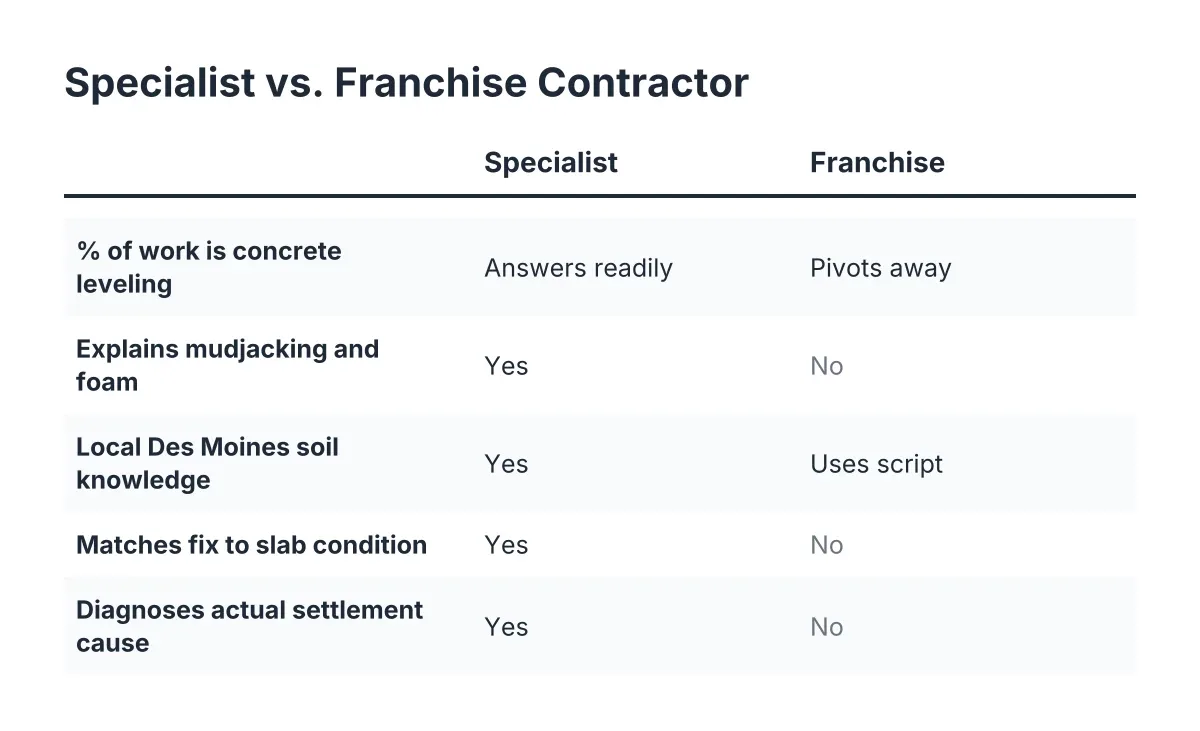
Search results reward marketing budgets, not workmanship. As a result, the top listings for concrete leveling in Des Moines often belong to national franchise networks whose local pages are templates. The company name changes, the photos change, but the content stays identical from Omaha to Cleveland. That does not automatically make them bad at the work. However, it means the listing tells you nothing about whether the crew understands central Iowa conditions.
Local knowledge matters more here than in most trades. Central Iowa sits on expansive clay soils that swell when wet and shrink when dry. Add our freeze-thaw cycles, and slabs move in patterns a contractor from a different soil region may misjudge. For example, a contractor who has lifted hundreds of Des Moines driveways knows which failures come from poor downspout drainage and which come from soil washout under the slab edge. That diagnosis changes the fix, and it changes whether the repair lasts.
So before you call anyone, do three quick checks. First, verify the company actually operates locally rather than dispatching crews from a regional hub. Second, look for reviews from Des Moines addresses, not a national aggregate score. Third, confirm the basics: Iowa contractor registration, general liability insurance, and workers' compensation coverage. You can verify registration yourself through the Iowa Division of Labor, and any contractor who hesitates to share a certificate of insurance has told you everything you need to know. Our full guide to license, insurance, and credential checks for Des Moines contractors covers exactly what each document should say and how to spot a fake.
Red Flags That Should End the Conversation
Some warning signs deserve an immediate no. Watch for door-to-door solicitation after a storm, demands for full payment upfront, and quotes delivered over the phone without anyone inspecting your slab. Additionally, be wary of high-pressure tactics like "this price expires today." Concrete settlement developed over years. It will not get dramatically worse in the week you spend collecting a second opinion, and a contractor who claims otherwise is selling urgency, not repair.
How to Read a Concrete Leveling Quote Like a Contractor
Most homeowners collect two or three quotes, line up the bottom numbers, and pick the middle one. That approach feels safe, but it misses the details that actually predict a good outcome. Instead, read each quote for what it includes, what method it proposes, and what it promises after the crew leaves.
Start with the price itself. For context, the national average concrete leveling cost is $1,174, with a typical range of $630 to $1,723, according to Angi and HomeAdvisor data. Your job may land outside that range for good reasons: a badly sunken garage floor costs more than a single dropped sidewalk panel. However, a quote that lands far below every competitor usually signals thin material coverage or a crew that plans to lift the slab partway and call it done. Our cost guide for hiring a concrete leveling contractor breaks down what drives the number, so you can tell a fair price from a padded one.
Next, check which method the quote specifies. Mudjacking pumps a cement slurry under the slab, while polyurethane foam injection lifts with expanding foam through smaller holes. Each has real strengths, and an honest contractor explains which fits your slab's condition, load, and timeline rather than pushing whichever one they sell. For instance, Angi reports national mudjacking costs ranging from $661 to $1,871, with most homeowners paying around $1,232, while foam typically runs higher per job. If a quote never names the method or the material, ask. Our comparison of mudjacking versus foam for slab repair gives you the questions to raise.
Compare Concrete Leveling Against Replacement Too
Beyond that, weigh leveling against tearing out the slab. HomeAdvisor data shows mudjacking runs 25% to 50% less than full slab replacement, which is why leveling makes sense whenever the concrete itself is still sound. Additionally, Angi estimates that leveling projects can recoup 70% to 90% of their cost in added home value. That said, a badly crumbled or shattered slab cannot be saved by lifting it. To put it simply, a trustworthy contractor will tell you when replacement is the better answer, even though it means losing the sale.
What to Expect From First Call to Final Warranty
Wary first-time customers often skip getting quotes because they dread the sales pitch. Knowing the normal process removes that anxiety, and it helps you spot the companies that deviate from it. In practice, a professional concrete leveling appointment in Des Moines follows a predictable rhythm.
It starts with an on-site inspection. The estimator measures how far the slab has settled, checks for voids under the edges, and looks at drainage around the concrete. This visit should take real time, usually twenty to forty minutes, because the diagnosis drives everything else. Consequently, anyone who glances at your driveway from the truck and hands you a number has not diagnosed anything. You should also expect plain answers to plain questions. Ask what caused the settlement, whether it will recur, and what happens if the slab resettles within a year.
Then comes the written estimate. It should itemize the areas being lifted, name the method and material, state the expected cure time before you can drive or walk on the slab, and spell out the warranty in writing. If the paperwork is full of jargon like "slabjacking," "void fill," or "hydraulic lift points," keep our plain-English glossary of contractor terms open while you read. Sharper questions come from understanding every line, and estimators treat informed customers differently.
Warranties, Reviews, and the Final Gut Check
A concrete leveling warranty is only as good as its terms. Ask three things: how long it lasts, whether it covers resettlement or only workmanship, and whether it transfers if you sell the property. That last point matters especially for small landlords, since a transferable warranty adds value at sale. Meanwhile, read local reviews with a critical eye. Look for Des Moines reviews that mention specifics, like a named crew member or a follow-up visit, because vague five-star praise is easy to manufacture. Finally, trust the pattern across every interaction. A company that shows up on time for the estimate, answers questions without pressure, and puts everything in writing will usually run the job the same way. If your search for concrete leveling near me turns up a contractor who does all of that, you have found a good one, franchise or not.
Questions Worth Asking Before You Sign Anything
Even after checking credentials and comparing quotes, a short conversation reveals more than any document. Put these questions to every mudjacking or foam contractor on your shortlist and listen for confident, specific answers.
Ask who actually performs the work. Some companies subcontract the labor, which muddies accountability if something goes wrong. Ask how many holes they'll drill, what size, and how they patch them—this shows how carefully they treat your driveway or patio. Ask what happens if the slab doesn't reach full height on the first lift and whether a return visit costs extra. Honest contractors have a ready answer, because partial lifts happen occasionally.
Ask about scheduling and cure time. Mudjacking typically needs a day or more before the slab takes vehicle weight, while foam cures within hours. For a landlord coordinating tenant parking or an owner-occupant who needs the garage back by evening, that difference can decide the method. Ask how weather affects the schedule. Central Iowa's freeze-thaw window limits when material sets properly, and a contractor who books leveling work in mid-January without hesitation deserves skepticism.
Finally, ask why your slab sank. This is your best filter question. A weak answer sounds like "concrete just settles over time." A strong answer names a specific cause: a downspout dumping water at the slab edge, backfill that never compacted, or clay soil shrinking through drought. The strong answer usually comes with a prevention recommendation too, like extending a downspout or sealing a joint. That's the difference between someone who lifts concrete and someone who solves settlement. When your search for concrete leveling near me ends with the second kind of contractor, the repair holds.
Ready to Get Started?
If your Des Moines driveway, walkway, or patio has settled, get answers before the problem grows and the tripping hazard gets worse. Des Moines Concrete Leveling Pros offers no-pressure inspections, plain explanations of whether mudjacking or foam fits your slab, and written quotes you can compare with confidence. Reach out today and get a straight assessment from a local specialist who levels concrete for a living.