
Patio Leveling — Complete Guide
If your patio has sunk, cracked, or tilted toward the house, patio leveling can restore it without the cost and mess of full replacement. This matters whether you worry about a trip hazard near the back door or a listing photo that makes your backyard look neglected. In this guide, you will learn why Des Moines patios settle, how the two main lifting methods compare, and what drives the cost of the repair. You will also find links to in-depth articles on each subtopic, from DIY options to frost heave damage. By the end, you should know whether leveling fits your slab and what to ask before you hire anyone.
What You'll Find in This Guide
- DIY Patio Leveling: When to Level It Yourself vs. Hire a Pro in Des Moines, IA
- Mudjacking vs. Polyurethane Foam Injection: Which Fits Your Patio?
- Why Patios Sink Uneven on Expansive Clay Soil, and How to Level Yours
- Frost Heave Damage to Patios: Why Iowa Winters Wreck Concrete and How to Fix It
- How Much Does Patio Leveling Cost?
- Patio Leveling Terms Explained: A Plain-English Glossary
Why Patios Sink and Crack in Des Moines
A patio does not sink because the concrete failed. It sinks because the ground underneath it moved. In central Iowa, two forces do most of that moving: expansive clay soil and the freeze-thaw cycle. Understanding both helps you judge whether your slab needs a lift, a crack repair, or something more.
Expansive Clay Soil Under Your Slab
Much of the Des Moines metro sits on clay-heavy soil that swells when wet and shrinks when dry. As a result, the ground under your patio rises and falls with the seasons. Over the years, that movement opens voids beneath the slab. Eventually one corner loses support and drops, which is why patios so often settle unevenly rather than sinking as a whole. If you want the full picture of this process, read our article on why patios sink unevenly on expansive clay soil. You can also look up the soil composition on your own lot through the USDA's Web Soil Survey, a free tool that maps soil types by address.
Frost Heave and Iowa Winters
Winter adds a second force. When water in the soil freezes, it expands and pushes the slab upward. Then spring thaw releases that pressure unevenly, and the slab settles back into a different position than it started. This cycle explains why many homeowners notice new cracks or a raised corner in March that was not there in October. Our guide to frost heave damage to patios covers how to tell frost heave apart from ordinary settling.
What the Damage Looks Like
Watch for a few telltale signs. Water pooling in one spot after rain usually means a low corner. A widening gap between the patio and the house means the slab is pulling away or tilting. Additionally, cracks that catch a chair leg or a toe signal that two sections of slab now sit at different heights. None of these problems fix themselves, and each tends to worsen with every wet season and every winter. However, catching them early usually means a simpler, smaller repair.
How Patio Leveling Works: Mudjacking vs. Foam Injection
Patio leveling lifts a sunken slab back to its original position by filling the voids underneath it. Instead of tearing out the concrete and pouring new, a contractor drills small holes through the slab and pumps material below it. The material fills the empty space, and continued pressure raises the slab until it sits level again. To put it simply, you keep your existing concrete and fix the ground problem that caused it to sink.
The Two Main Methods
Two materials dominate this work. Mudjacking pumps a slurry of soil, water, and cement under the slab. Polyurethane foam injection pumps an expanding foam through smaller holes instead. Each method has real strengths, and the right choice depends on your slab's condition, the load it carries, how fast you need to use the patio, and your budget. For example, a heavily cracked slab may respond differently to slurry than to foam. Our detailed comparison of mudjacking vs. polyurethane foam injection walks through those tradeoffs so you can ask informed questions during an estimate.
Leveling, Resurfacing, or Crack Repair?
Homeowners often confuse leveling with resurfacing, but they solve different problems. Leveling fixes the position of the slab. Resurfacing fixes the appearance of its surface, covering spalling, pitting, or stains with a new finish layer. Meanwhile, crack filling seals gaps to keep water out of the soil below. In practice, many patios need a combination: a lift to restore the level, then crack repair to close the seams, and sometimes resurfacing for a clean final look. If a contractor's estimate mixes these terms, our plain-English glossary of patio leveling terms can help you decode exactly what you are paying for.
When Leveling Is Not the Answer
That said, leveling is not right for every slab. Concrete that has crumbled into many small pieces, or a patio poured badly from the start, may need replacement. A good contractor will tell you which category your patio falls into before any work begins. Ask them to explain why, and ask what happens to the soil problem if you simply pour a new slab on the same ground.
What Patio Leveling Costs and What It Returns
Cost is usually the first question, and the honest answer is that it depends on your specific slab. Three factors drive most of the price: how far the patio has sunk, how large the slab is, and which lifting method fits the job. Beyond that, access matters too. A patio tucked behind a fence with a narrow gate takes more effort to reach than one open to the driveway.
What Published Figures Show
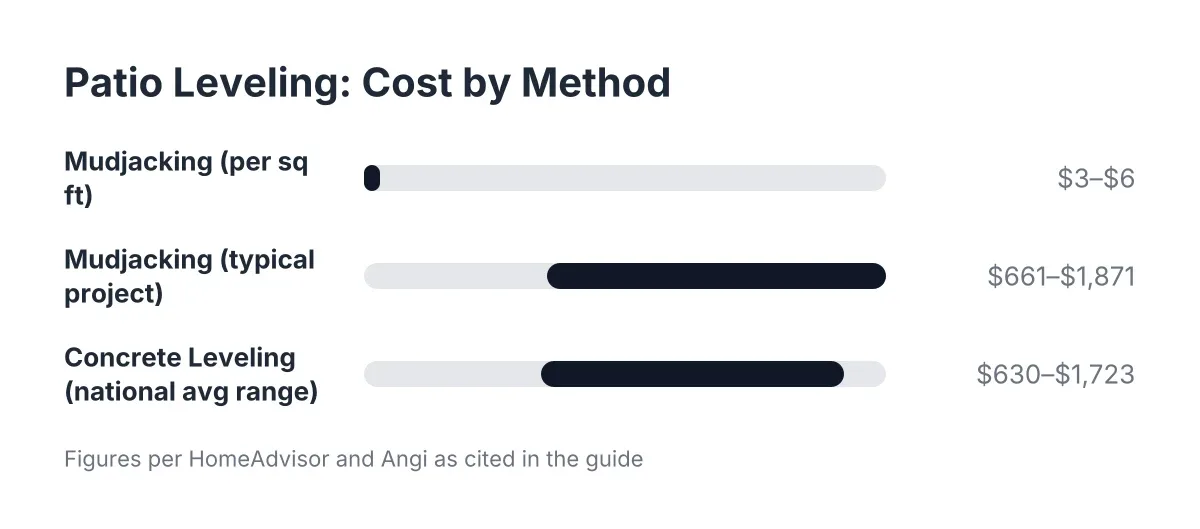
National data gives you a rough frame of reference. According to Angi and HomeAdvisor, the national average concrete leveling cost is $1,174, with a typical range of $630 to $1,723. For small jobs, Angi notes that mudjacking work may carry a minimum charge of around $500, even when the affected area is under 100 square feet. Your actual quote will reflect local conditions, so treat these numbers as context rather than a promise. Our full patio leveling cost guide breaks down each cost driver and explains how estimates are typically structured.
Leveling vs. Replacement
The comparison that matters most is leveling against full replacement. According to HomeAdvisor, mudjacking runs 25% to 50% less than replacing a concrete slab entirely. Replacement also means demolition, hauling, new concrete, and days of cure time before you can use the space. By contrast, leveling reuses the slab you already have and typically finishes in a fraction of the time. For a structurally sound patio that has simply settled, replacement usually solves a problem you do not have at a price you do not need to pay.
The Resale and Safety Payoff
For sellers, the math gets more interesting. Angi reports that concrete leveling projects can recoup 70% to 90% of their cost in added home value. A level patio photographs well, reads as "maintained" to buyers, and removes an easy flag from a pre-listing inspection. For owner-occupiers, the payoff is safety and daily use: no pooled water breeding mosquitoes, no wobbly grill, no raised edge waiting for a guest's toe. If you are weighing whether to tackle any of this yourself first, our article on DIY patio leveling vs. hiring a pro lays out where the DIY path makes sense and where it falls short. Whichever route you choose, get written estimates, ask contractors to explain their method choice, and confirm they carry insurance before work starts.
Ready to Get Started?
Des Moines Concrete Leveling Pros lifts and levels sunken patios across Des Moines and its immediate surrounding communities, using both mudjacking and polyurethane foam injection. We look at your slab's condition, explain plainly which method fits and why, and walk you through what the work involves. Call us or send a request, and we will talk through your patio and what leveling would look like for it.