Frost Heave Damage to Patios: Why Iowa Winters Wreck Concrete and How to Fix It
Every spring in Des Moines, homeowners walk out to their patio and find something changed over the winter. A corner sits higher than it did in October. A crack that was hairline in the fall is now wide enough to catch a chair leg. Frost heave damage to patios is one of the most common reasons central Iowa homeowners call about uneven concrete, and it catches a lot of people off guard, especially in newer subdivisions where the slab looked perfect three years ago. This guide explains what frost heave actually is, why our clay soils make it worse, what your insurance will and will not say about it, and how a heaved or sunken patio gets fixed without tearing the whole thing out. Whether you're dealing with a single raised joint or progressive settling across multiple slabs, frost heave patio repair is often possible without full replacement.
The short version: your patio is not falling apart because the concrete was bad. It is moving because the ground under it moves, and the ground moves because of water and cold. Fix the movement, and you fix the patio.
What Frost Heave Actually Does to a Patio
Frost heave happens when water in the soil under your patio freezes and expands. Frozen water takes up more space than liquid water, so as the frost line pushes down through wet soil, the ice pushes up on whatever sits above it. Your patio slab rides that movement like a boat on a slow wave.
One freeze would not matter much. The problem is repetition. A Des Moines winter can swing from 40 degrees to below zero and back a dozen times or more. Each freeze lifts the slab; each thaw drops it. The slab rarely lands back exactly where it started. Soil shifts, water carries fine particles away, and small voids open up underneath.
Over a few winters, that cycle produces the damage homeowners actually see:
- A slab edge lifted higher than the one next to it, creating a tripping hazard
- Cracks that widen every year as water gets in, freezes, and pries them apart
- Corners that sink after thaw because the soil underneath washed out or compressed
- A patio that tilts back toward the house, sending meltwater at your foundation
- Surface scaling or flaking where moisture froze inside the concrete itself
That last point matters. Freeze-thaw cycles do not just move the slab; they can attack the concrete surface. Water soaks into the pores of the concrete, freezes, and expands. Repeat that enough times and the surface starts to scale and flake. Movement problems and surface problems get fixed differently, which is why it helps to know which one you have.
Why Central Iowa Winters Are Hard on Patio Slabs
Two local facts stack the deck against your patio. First, central Iowa sits on expansive clay soil. Clay holds water like a sponge, swells when wet, and shrinks when dry. That means the ground under your patio is already moving with the seasons before frost ever enters the picture.
Second, our winters deliver a lot of freeze-thaw cycles, not just one long deep freeze. A place that freezes in November and thaws in March gets one cycle. Des Moines gets warm spells in January, ice storms in March, and wet snow in April. Every one of those swings works the soil and the slab.
Now add the situation many newer homeowners face. If your house went up in the last three to eight years in a growth area like Ankeny, Waukee, Clive, or Johnston, your patio probably sits on fill soil. Builders move a lot of dirt to grade a subdivision, and that fill keeps compacting for years after the concrete gets poured. Fill soil plus clay plus freeze-thaw is the trifecta. It is why a patio can look flawless at closing and sit two inches out of level by year four.
Suppose a homeowner in Ankeny bought new construction in 2021. By the winter of 2025 into 2026, the patio slab nearest the house has dropped an inch where downspout water soaks the fill, while the outer slab heaved upward at the joint. Neither slab is broken. The concrete is fine. The ground under it just is not doing its job anymore. That pattern shows up all over the metro, and it is fixable without replacement.
Is Frost Heave Damage to Patios Covered by Insurance?
In most cases, no. Standard homeowners policies treat frost heave and soil settling as gradual earth movement, and gradual earth movement is a common exclusion. Insurance is built for sudden events like a tree through the roof, not slow seasonal soil movement. However, every policy reads differently, so check yours and ask your agent directly before assuming anything.
This surprises a lot of people, and it is worth understanding why. From the insurer's view, frost heave is predictable and preventable, more like maintenance than like a storm. Your adjuster may also draw a line between damage from a specific covered event, say a burst pipe washing out soil under the slab, and ordinary settling or heave. The first might be covered. The second usually is not.
That said, do not give up on documentation. If your patio damage followed a specific event, a plumbing leak, a sudden washout during a heavy rain, or damage tied to another covered loss, your claim may look different. Here is what helps regardless of how the claim goes:
- Photograph the patio now, with dates, from several angles. Include close-ups of cracks and wide shots showing the slope.
- Note when you first saw the change and what the weather did around that time.
- Get a written repair estimate that describes the cause in plain terms, whether it is frost heave, soil settling, or washout, along with the fix.
- Ask your adjuster in writing what documentation they need, so nothing gets lost in a phone call.
A clear written estimate that names the problem and the repair method gives your adjuster something concrete to rule on. Even if the claim gets denied, that same estimate tells you exactly what you are dealing with and what it costs to fix. You have lost nothing by asking.
One more angle for newer homes: check your builder warranty before paying anyone. Some warranties cover slab settling within a set window, and some exclude flatwork like patios and driveways entirely. If your patio is still inside an active warranty that covers it, pursue the builder first. If the warranty has expired or excludes slab settling, which is common, an independent repair is usually faster than fighting about it.
How Frost Heave Patio Repair Works Without Full Replacement
A patio damaged by frost heave usually does not need to be torn out. If the slabs are structurally sound, meaning cracked in a few places but not crumbled, concrete leveling can raise sunken sections back to grade and stabilize the soil beneath them. The concrete you already paid for stays in place; only the ground under it gets corrected.
Here is how concrete leveling works, according to Wikipedia: crews drill small holes into the sunken slab, pump a lifting material beneath it to raise and stabilize the slab, then patch the holes to closely match the original surface. In practice there are two common lifting materials, and each has a fit.
Mudjacking pumps a sand and cement slurry under the slab. It is the traditional method, it fills large voids well, and it tends to cost less. Polyurethane foam injection uses smaller holes and a lightweight expanding foam that cures fast, often within hours. Foam adds less weight to soil that is already struggling, which matters on fill. Slab condition, void size, load, cure time, and budget decide which one fits a given patio; a straight answer on that trade-off is something any honest concrete leveling company should give you before you sign. When you are evaluating frost heave patio repair options, comparing these two methods helps you choose the best fit for your situation.
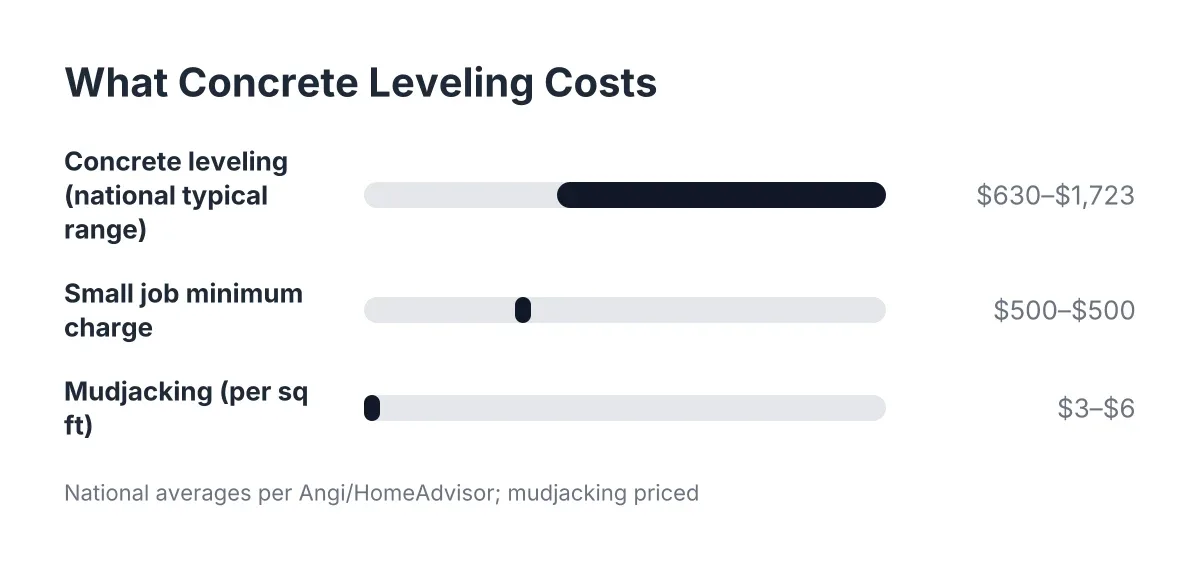
Cost is the next question, and the honest answer is that patio leveling almost always beats replacement on price. According to HomeAdvisor, mudjacking runs $3 to $6 per square foot and costs 25% to 50% less than replacing a concrete slab entirely. Angi puts the national average mudjacking cost between $661 and $1,871, with most homeowners paying around $1,232, and notes small jobs may carry a minimum charge of about $500. If you plan to sell, there is a resale case too: Angi reports that concrete leveling projects can recoup 70% to 90% of their cost in added home value.
That resale point deserves a beat. A heaved patio is a safety issue first, a tripping hazard at every raised joint. But it is also the first thing a buyer sees when they step into the backyard, and it is the difference between a patio you set a table on and one where every chair wobbles. Fixing it buys back both.
What Frost Heave and Patio Settling Cannot Fix
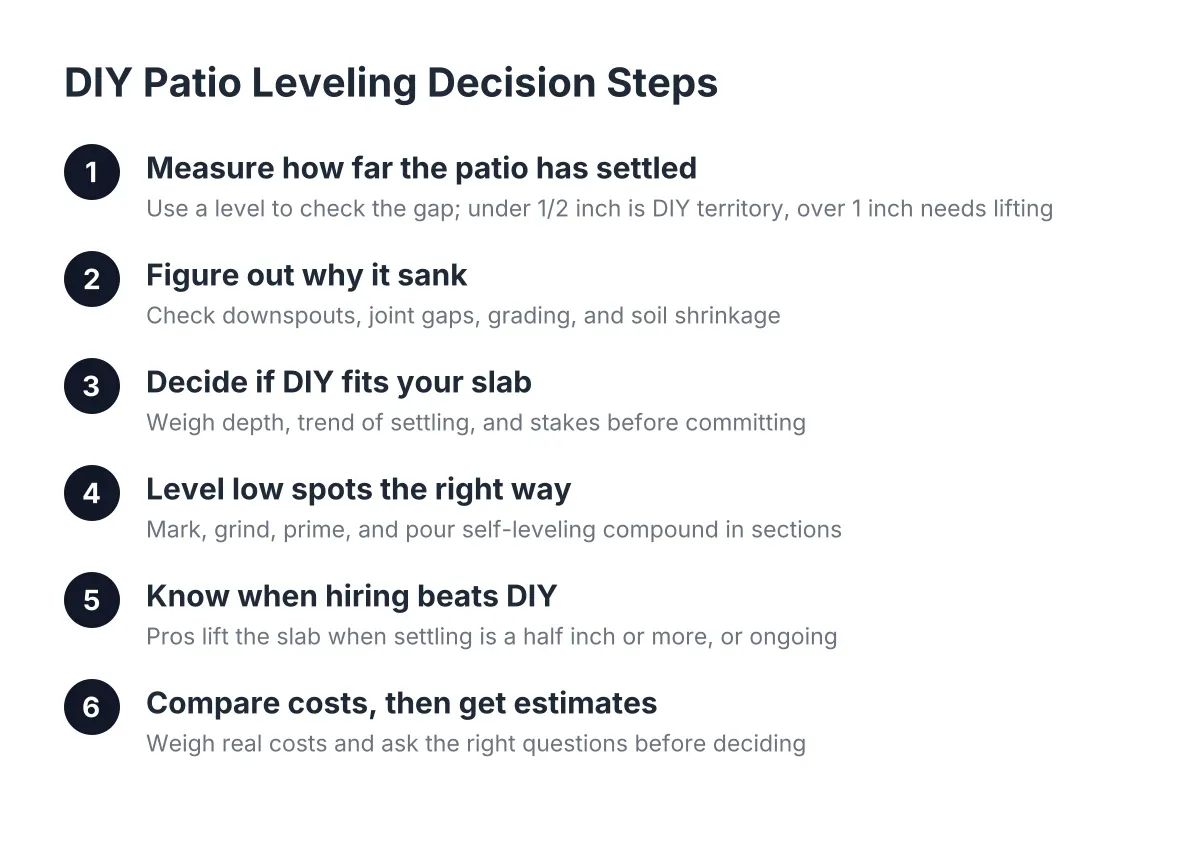
Concrete leveling raises sunken slabs. It does not push a heaved slab back down, and it cannot rebuild concrete that has crumbled. If a slab heaved upward and stayed up after thaw, the fix may involve grinding the high edge, leveling the neighboring slabs up to meet it, or replacing that one section. If the surface is scaling badly from freeze-thaw damage inside the concrete, resurfacing can restore the top, but only after the slab is stable underneath.
One warning on shortcuts. Pouring self-leveling concrete or a patch product over an outdoor low spot sounds cheap, and it is, but outdoor slabs absorb moisture and keep expanding and contracting through every freeze-thaw cycle. A thin overlay tends to chip and crack off within a few seasons. Self-leveling compound also demands real prep; manufacturer instructions typically require the concrete surface to be mechanically profiled first, according to Lowe's, and Sakrete advises a respirator when mixing because the dry powder is hazardous to breathe. Indoors, on a garage floor, self-leveling products have their place. On a Des Moines patio, they are usually money spent twice.
Finally, know when the problem is bigger than the patio. If the cracks run into your foundation, if doors inside the house stick, or if a slab drops repeatedly after leveling, get a structural evaluation. Concrete leveling fixes surface settling; it is not a substitute for foundation repair when the house itself is moving.
Keeping Frost Heave From Coming Back Next Winter
You cannot cancel an Iowa winter, but you can control the water, and water is the fuel frost heave runs on. Dry soil does not heave. Most of the prevention work is simple drainage housekeeping you can do in an afternoon.
- Extend downspouts at least five feet past the patio so roof water does not soak the soil beside it.
- Fill patio cracks and joints before winter. Crack filling keeps water out of the one place it does the most damage, since water in a crack freezes, expands, and widens the gap every cycle.
- Check the slope. A patio should shed water away from the house; if leveling restored that pitch, keep gutters and grading working with it.
- Avoid piling snow on the patio edge where meltwater will soak straight down along the slab.
Paver patios play by slightly different rules, and it is worth knowing them even if your patio is poured concrete. If you are figuring out how to level patio pavers that frost pushed around, the fix is usually to pull the affected pavers, re-screed the sand bed, and reset them; heave rarely breaks pavers, it just rearranges them. Joint sand matters too. If you have wondered about polymeric sand and how to use it, the short version is to sweep it into dry joints, then mist it so it hardens and locks water out. And on new installs, skip any advice about how to install pavers over dirt alone; without a compacted gravel base below the frost influence, central Iowa clay will heave those pavers by the second winter.
For poured concrete, the pattern to watch is the annual creep. Frost heave damage on patios rarely arrives all at once. It shows up a quarter inch at a time, and each winter's water finds the cracks the last winter opened. Sealing cracks in the fall of 2026 costs a fraction of leveling a slab in the spring of 2028.
What to Do This Season
Start by walking your patio and writing down what you see: raised edges, widening cracks, slabs tilting toward the house, or corners that dropped after thaw. Photograph everything with dates. If you suspect a covered event caused it, call your agent and ask specifically how your policy treats earth movement and frost heave; get the answer in writing.
Next, if the damage traces back to ordinary settling or freeze-thaw cycles, which it usually does here, get a written estimate from a concrete leveling specialist who will tell you which slabs can be lifted, which need grinding or crack repair, and which, if any, need replacement. A good estimate names the cause and the method, which serves you whether it goes to an adjuster, a builder warranty file, or straight to your own budget.
The reassuring part is this: frost heave damage to a patio looks alarming in April, but it is one of the more fixable problems a homeowner faces. The concrete is usually fine. Additionally, the ground failed it. Lift the slabs, fill the cracks, move the water, and the patio you already own goes back to being the flat, safe, usable space you paid for.
If you need concrete leveling, Des Moines Concrete Leveling Pros can help.
Prefer to talk it through? Call +15155828701 — a quick call is usually the fastest way to get a straight answer for your situation.