Cracked Concrete Steps: Structural Damage or Surface Crack? How to Tell Before Someone Falls
A crack in your front steps is more than an eyesore when grandkids run up them or your own balance is not what it used to be. The good news: most cracks are not emergencies. The real question with cracked concrete steps is structural damage versus a surface flaw, because that answer decides whether you need a simple patch, a leveling job, or a bigger repair. This guide walks you through how to tell the difference, step by step, and what to do next so nobody takes a fall on the way to your door.
Here is the short version. Hairline cracks with no height difference are usually cosmetic. Cracks with an offset, steps pulling away from the house, or steps that lean and sink point to settling underneath. Settled steps in Des Moines are common because central Iowa's clay soil swells when wet and shrinks when dry, and freeze-thaw cycles make it worse every winter.
Follow these steps in order. Most take a few minutes, and none require tools beyond a tape measure, a flashlight, and a level.
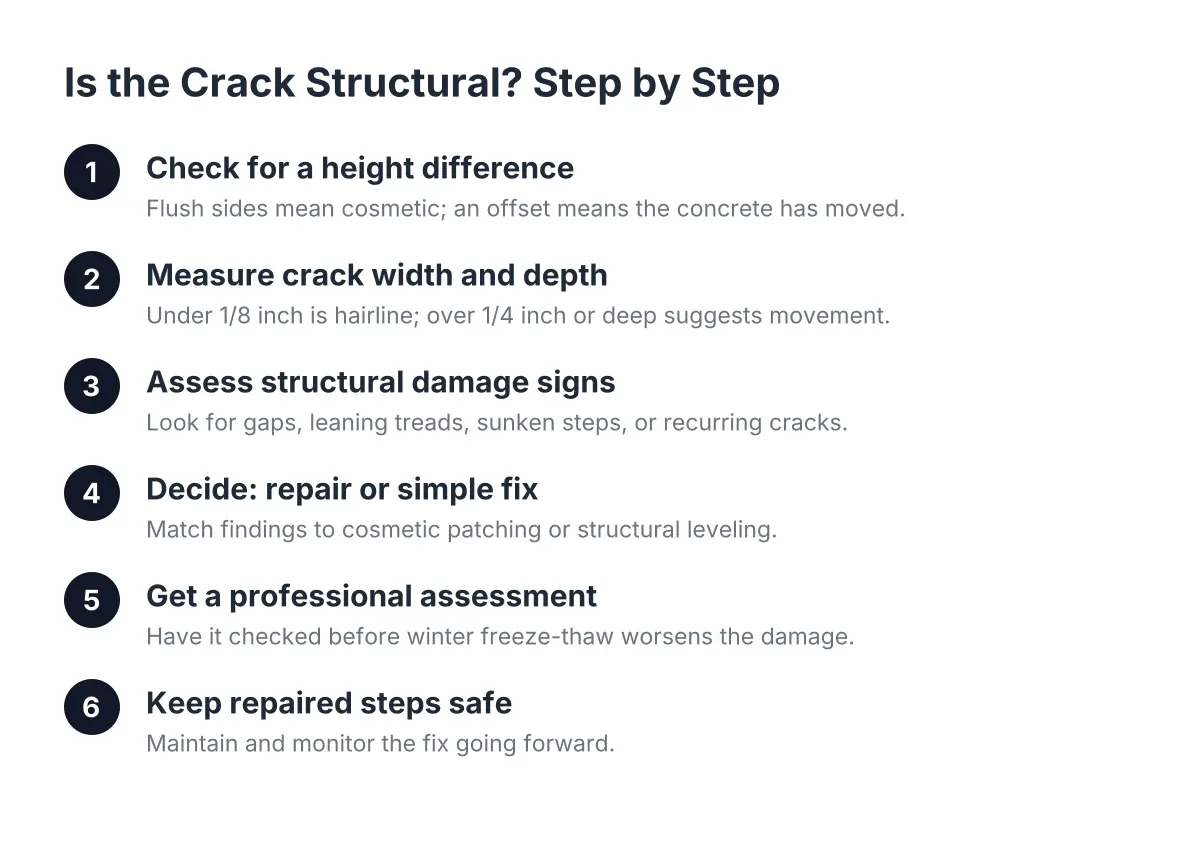
Step 1: Check the Crack for a Height Difference
Run your hand across the crack. If both sides are flush, you are likely looking at a shrinkage crack, which is common and mostly cosmetic. If one side sits higher than the other, even by a quarter inch, treat it as a tripping hazard and a sign the concrete has moved.
A height difference matters more than a crack's length. A long, thin crack with no offset is far less dangerous than a short crack where one edge sticks up. For a grandparent or anyone with limited mobility, that raised edge is exactly the kind of thing a shoe catches on.
Use a tape measure and note the offset at the widest point. Write it down. You will want that number when you talk to a concrete step repair contractor, and it helps you track whether the crack is getting worse.
Step 2: Measure the Crack's Width and Depth
Width tells you a lot. Use these rough guidelines:
- Under 1/8 inch, hairline: Usually surface shrinkage. Crack filling handles it.
- 1/8 to 1/4 inch: Worth watching. Fill it to keep water out, and check it again after winter.
- Over 1/4 inch, or widening over time: This points to movement underneath. Filling alone will not fix the cause.
- Deep cracks that run through the step: These suggest settlement or overstressing, not normal aging.
Shine a flashlight into the crack. A shallow surface fissure stops within the top layer. A crack you cannot see the bottom of, especially one that runs clean through a step or tread, extends deeper and behaves differently. Deep cracks are how water reaches the soil under your steps, and in Des Moines that water freezes, expands, and pries the crack wider every year.
Step 3: Assessing Structural Damage in Cracked Concrete Steps
Structural damage in cracked concrete steps shows up as movement, not just cracking. The step is no longer sitting where it was poured, and the crack is a symptom of that shift. Look for these signs together, because one alone rarely tells the whole story.
- The steps have pulled away from the house, leaving a gap at the foundation.
- One side of the steps sits lower than the other, so the treads lean.
- A crack has an offset you can feel underfoot.
- The bottom step has sunk into the ground or tilted forward.
- Cracks keep coming back after you patch them.
In addition, check the wall behind the steps. Stair-step cracking in brick or block, where the mortar joints separate in a staircase pattern, is a recognized sign of foundation movement that a professional should evaluate. That is a bigger issue than the steps themselves.
Many homeowners write off a leaning step or a returning crack as the house just getting old. Often it is not age. It is the soil under the steps no longer supporting them evenly, and it will not improve on its own.
Step 4: Decide Whether Cracked Concrete Steps With Structural Concerns Need Repair or a Simple Fix
Cracked concrete steps need structural repair when the concrete has settled, tilted, or separated from the house; they only need cosmetic repair when the crack is hairline, flush, and stable. Match what you found in Steps 1 through 3 to the right fix, and do not pay for more repair than the problem calls for.
Cosmetic cracks: filling and patching
Hairline cracks with no offset get crack filling or crack repair with a step repair cement or patching compound. This seals out water, which matters in Iowa because water in a crack becomes ice in January. A tube of concrete crack filler and an afternoon handles most of these. Chipped corners and worn edges fall in the same bucket; they can be patched or the surface can be redone with resurfacing.
Settled or separated steps: leveling
However, if the steps have sunk, tilted, or pulled away from the house, patching the crack treats the symptom and ignores the cause. The fix is concrete leveling, also called slab jacking or mudjacking. Crews drill small holes in the sunken concrete, pump a lifting material underneath to raise and stabilize it, then patch the holes to blend with the surface, according to Wikipedia. The steps go back to level without demolition, without a concrete truck, and usually within a day.
This matters for the safety-minded homeowner on a budget. Mudjacking typically runs 25% to 50% less than replacing the concrete entirely, according to HomeAdvisor. Nationally, concrete leveling averages $1,174, with a typical range of $630 to $1,723, according to Angi and HomeAdvisor data. Small step jobs often land at the lower end. As of 2026, that price gap between leveling and replacement is one of the main reasons homeowners choose lifting over tearing out and repouring.
Crumbling or broken concrete: beyond leveling
One honest limitation: leveling cannot rebuild concrete that is falling apart. If the steps are crumbling through, spalling badly, or broken into loose pieces, lifting them will not hold. An old crack running clear through a section can also mean the concrete underneath has broken off, and that section may not rise evenly when lifted. In those cases replacement or partial rebuilding is the right call, and a straightforward contractor will tell you so during the inspection.
Step 5: Get a Professional Assessment Before Winter
Structural repairs such as lifting settled concrete or fixing deep cracks are risky to attempt yourself, and a botched attempt often costs more to correct than doing it right the first time. When you search for concrete step repair near me, look for a concrete step leveling specialist rather than a general handyman. Ask each contractor these questions:
- Is this crack cosmetic or a sign of settling? Ask them to show you why.
- Will you lift the steps with mudjacking or polyurethane foam, and why does that method fit my steps?
- How long before I can walk on the steps again?
- What can leveling not fix on my steps, and what happens to those spots?
- Do you patch and fill the cracks after lifting, or is that separate?
A contractor who answers plainly, without pressure, is the one to trust on your property. Timing matters too. Suppose a homeowner on Des Moines's south side notices in October that the bottom step has dropped an inch and the top landing has pulled a half inch away from the house. Fixed before the ground freezes, that is a routine half-day leveling job. Left until spring, freeze-thaw cycles can widen the gap, let more water under the steps, and turn a modest repair into a larger one, or worse, send a visiting grandchild or mail carrier tumbling in the meantime.
Step 6: Keep the Repaired Steps Safe
After the repair, a little upkeep protects the work. First, seal any new hairline cracks as they appear so water stays out. Next, keep downspouts pointed away from the steps, since roof water dumping beside them softens the clay soil that caused the settling. Finally, walk the steps each fall and spring and feel for new offsets. Catching a quarter-inch shift early keeps it a quick fix instead of a fall risk.
There is a financial upside too. Concrete leveling projects can recoup 70% to 90% of their cost in added home value, according to Angi. But for most grandparents, the real return is simpler: family walks up to the door, and you are not holding your breath watching them do it.
The Bottom Line on Cracked Concrete Steps With Structural Concerns
A flush hairline crack is a weekend patch job. A crack with an offset, a sinking step, or steps separating from the house means the soil underneath has failed, and that calls for leveling, not just filler. Sort out which one you have using the steps above, get a plain-spoken assessment, and fix it before winter makes it worse. Level steps are not a luxury; they are how you stop worrying every time someone reaches for your front door.
If you need concrete leveling, Des Moines Concrete Leveling Pros can help.
Prefer to talk it through? Call +15155828701 — a quick call is usually the fastest way to get a straight answer for your situation.