What Home Inspectors Look for in Concrete: Sunken Slabs, Cracks, and Uneven Surfaces
If a home inspection just flagged your sidewalk, driveway, or patio, you are on the clock. Knowing what home inspectors look for in concrete helps you fix the right things fast and pass re-inspection without blowing your closing date. The good news: most flagged concrete problems in Des Moines are settling issues, and concrete leveling before closing fixes them in a day or two, not weeks. This guide walks through exactly what inspectors flag, why they flag it, and how to get it resolved before the buyer's deadline.
This matters whether you are selling your own home, getting a rental ready for a new tenant, or simply worried that the uneven walkway to your front door is going to hurt someone. An inspector's eyes and a grandparent's eyes are looking for the same thing: a surface someone can walk on without tripping.
Why Home Inspectors Look at Concrete So Closely
Home inspectors look at concrete closely because it tells two stories at once. First, uneven concrete is a safety hazard on its own; a raised slab edge is a tripping hazard for anyone, and a serious fall risk for older visitors and kids. Second, sunken or cracked concrete can hint at what the soil is doing under the whole property.
Central Iowa sits on expansive clay soil. That clay swells when it gets wet and shrinks when it dries out. Add our freeze-thaw winters, and slabs poured on that soil move. A sidewalk panel that was flat five years ago can drop an inch or more after a few bad seasons. Inspectors here see it constantly, and they write it up constantly.
Inspectors also flag concrete because of liability. If a buyer moves in and someone trips on a raised sidewalk joint the inspector never mentioned, that is a problem for the inspector. So they err on the side of noting everything: cracks, height differences, slabs that slope toward the house, and steps that have pulled away from the porch.
For a small landlord, the same logic applies without a sale attached. A tenant who reports a sunken walkway has put you on notice. Fixing it before someone falls costs far less than dealing with an injury claim.
The Specific Concrete Problems That Get Flagged
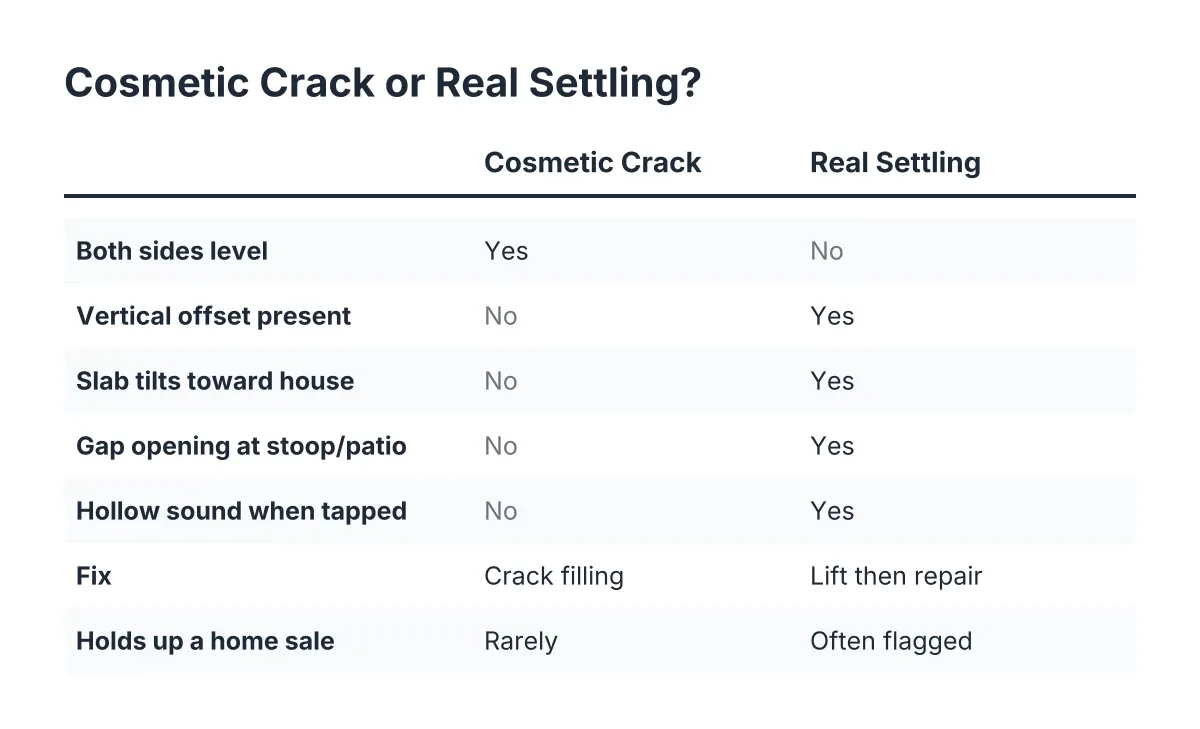
Not every crack ends up in an inspection report. Inspectors are trained to separate cosmetic wear from conditions that affect safety or drainage. Here is what typically makes the report, roughly in order of how often it shows up in Des Moines:
- Trip hazards at slab joints. Any vertical offset between two panels, usually anything you can catch a toe on. Sidewalks and front walkways are the most common spot.
- Sunken driveway slabs. Panels that have dropped near the garage or the street, often with a visible step where the driveway meets the garage floor.
- Concrete sloping toward the foundation. This is a drainage flag. Water running toward the house instead of away from it can lead to basement moisture problems.
- Settled or tilted steps. Front porch steps that have sunk or pulled away from the stoop. These get flagged hard because steps are where falls happen.
- Wide or offset cracks. Hairline cracks are normal. Cracks wide enough to fit a coin, or cracks where one side sits higher than the other, signal movement underneath.
- Sunken patio or garage slabs. Less urgent than a front walkway, but still noted, especially if the settling is recent or ongoing.
Notice the pattern. Inspectors are less worried about how the concrete looks and more worried about where it sits. A stained but flat driveway sails through. A clean driveway with a two-inch drop at the garage gets written up.
What the Inspection Report Language Actually Means
Inspection reports use careful wording, and it helps to translate it. "Trip hazard noted at front walkway" means a buyer's agent will probably ask for a repair or a credit. "Evidence of settlement" means the inspector saw slabs that have dropped but is not claiming to know why. "Recommend evaluation by a qualified contractor" means the inspector wants someone who does this work to look at it, which is standard language, not a sign of disaster.
Here is the part that eases most sellers' minds: a flagged sidewalk or driveway slab is almost never a foundation problem. Exterior flatwork, meaning sidewalks, driveways, patios, and steps, sits on soil, not on footings. It settles independently of the house. Inspectors know this, and buyers' agents generally do too.
However, there is one exception worth respecting. If the report flags settling in the concrete and cracking in the foundation walls, or doors inside the house that stick, get a structural evaluation before assuming leveling alone will resolve it. Concrete leveling fixes slabs; it does not fix a moving foundation. An honest contractor will tell you which problem you have.
How Concrete Leveling Resolves an Inspection Flag
Concrete leveling raises a sunken slab back to its original height by pumping material underneath it. According to Wikipedia, the process works by drilling holes into the sunken slab, pumping a lifting material beneath it to raise and stabilize the slab, then patching the holes to closely match the original surface. The slab you already have gets lifted back into place, which is why this is the fastest way to clear a flagged trip hazard.
Two methods do this work, and the difference matters for your timeline.
Mudjacking: Concrete Leveling Before Closing
Mudjacking, also called slab jacking, pumps a cement-based slurry under the slab through drilled holes. It suits heavier slabs and larger voids, and it costs less per job in most cases. The trade-off is cure time; the slurry needs time to firm up before the slab takes heavy loads like a parked car.
Polyurethane Foam Lifting for Concrete Leveling Before Closing
Foam lifting concrete uses expanding polyurethane injected through smaller holes. It cures fast, often within hours, which makes it attractive when a closing date is close and the driveway needs to hold a moving truck. Foam typically costs more than mudjacking for the same lift. This rapid curing method can complete concrete leveling before closing, making it ideal for time-sensitive sales.
A specialist will look at the slab condition, the load it carries, how fast you need it back in service, and your budget, then recommend one or the other. Neither method is always right. That is the honest answer, and any contractor who pushes one method for every job is selling what they have, not what you need.
One method to rule out here: self-leveling concrete. It is a thin compound for smoothing shallow dips on indoor floors before new flooring goes down. It does not lift a sunken slab, it is not for outdoor use, and it will not clear an inspection flag on a walkway or driveway. If you do use it indoors, take the prep seriously; manufacturer instructions typically require the concrete surface to be mechanically profiled first, according to the Lowe's Self-Leveler Plus installation guide, and Sakrete notes you should wear a respirator when mixing because the dry powder is hazardous to breathe.
Will Mudjacking Pass Inspection?
Yes, mudjacking passes inspection when the finished slab is level, stable, and free of the trip hazard that was flagged. Inspectors evaluate the condition of the concrete, not the repair method used. A re-inspection checks whether the offset is gone and whether water drains away from the house, and a properly leveled slab satisfies both.
What inspectors and buyers want to see after the repair is simple. The height difference between panels is gone or reduced to a safe transition. The slab no longer slopes toward the foundation. Additionally, the patched injection holes are filled and tidy. Cracks have been filled so water and ice cannot keep working them open.
That last point matters more than sellers expect. Leveling stops the settling problem, but crack filling finishes the job in the report's eyes. A lifted slab with open cracks can still draw a note about future water intrusion. Ask for crack repair as part of the same visit; it adds little time and closes the loop.
Keep your paperwork. A written invoice describing what was lifted, the method used, and the date gives the buyer's agent something concrete to show their client. For a landlord, that same invoice is your documentation that a reported hazard was fixed promptly, which is worth keeping in the property file.
A Realistic Timeline When Home Inspectors Flag Concrete
When home inspectors flag concrete during a sale, most sellers have 7 to 14 days before the repair negotiation deadline. Concrete leveling fits inside that window comfortably. The assessment takes under an hour, the work itself usually takes half a day to a day, and foam-lifted slabs can carry traffic the same day.
Here is how the sequence typically runs for a seller on deadline:
- Get the report and photos. Pull the exact pages that mention concrete so the contractor sees what the inspector saw.
- Schedule an assessment. A proper assessment maps the affected slabs, measures the drop at each joint, marks cracks, and notes anything in the way. Expect the estimator to measure, not just eyeball it.
- Get the estimate in writing. It should list which slabs get lifted, the method, the cure time, and what happens if a slab is too cracked to lift cleanly.
- Do the work. Half a day to a full day for most residential jobs. No excavation, no demolition, no dumpster in the driveway.
- Document it. Photos of the finished surface plus the invoice go to your agent for the buyer's file or the re-inspection.
Suppose a seller in Beaverdale gets a report on a Friday flagging a one-inch drop where the front walkway meets the porch step, plus a sunken driveway panel. In that scenario, an assessment early the next week, leveling by midweek, and photos to the buyer's agent by Thursday is a realistic pace. The whole thing resolves inside one negotiation window.
Weather is the main variable in Des Moines. Deep winter cold can delay exterior leveling because frozen ground behaves differently, so a January closing may need more schedule flexibility than a June one.
What This Costs, and What Buyers Ask For Instead
Concrete leveling is the budget-friendly path through an inspection flag, which is exactly why it works in a negotiation. According to Angi and HomeAdvisor data, the national average concrete leveling cost is $1,174, with a typical range of $630 to $1,723. HomeAdvisor also reports mudjacking runs $3 to $6 per square foot and costs 25% to 50% less than replacing a slab entirely.
Compare that to the alternative the buyer's agent will propose: a repair credit sized for full replacement, which can run several times the concrete lifting cost for the same slabs. Sellers who fix the flagged slabs before the negotiation usually come out ahead of sellers who hand over a replacement-sized credit. Angi data shows concrete leveling projects can recoup 70% to 90% of their cost in added home value, which makes it one of the few pre-closing repairs that mostly pays for itself.
Two cautions on estimating your own cost. First, you cannot price the job from surface area alone; the depth of settling, the number of panels involved, and the size of the hidden void underneath all vary independently, so two identical-looking sidewalks can cost different amounts to lift. Second, a settlement repair often needs to include the adjoining panels, because lifting only the obviously sunken slab can create a new offset where it meets its neighbor. A good estimate accounts for both, which is why searching for concrete lifting near me and getting two or three written estimates beats guessing from a photo.
Getting the Work Done Without Disruption
For a grandparent worried about a walkway, or a landlord who cannot displace a tenant, the low-disruption nature of this work is the point. There is no jackhammering, no torn-up yard, and no week of curing behind caution tape. A typical crew drills a pattern of holes, lifts the slab in stages while checking level, patches the holes, and cleans up the same day.
A few things make the visit smoother:
- Clear the slabs. Move planters, hoses, vehicles, and anything sitting on the concrete being lifted.
- Point out what you have noticed. The spot where you caught your toe last fall, or the panel that puddles after rain, helps the crew confirm what the measurements show.
- Ask about cure time before the crew leaves. Foam-lifted slabs often take foot traffic within hours; mudjacked driveways need longer before a car parks on them.
- For rentals, tell the tenant the schedule. The work is quiet compared to demolition, but the walkway or driveway is out of service for part of the day.
This is also where concrete leveling for home inspections differs from a generic repair call. The contractor should be working from the inspection report, lifting to the standard the report describes, and leaving you documentation aimed at the re-inspection or the buyer's file, not just a receipt.
When Leveling Is Not the Right Answer
Concrete leveling has honest limits, and knowing them protects you from paying twice. A slab that is shattered into small pieces cannot be lifted as a unit; badly deteriorated concrete may need replacement. Leveling raises slabs, but it does not resurface them, so heavy spalling or scaling may call for resurfacing after the lift, or replacement instead.
In addition, leveling treats the symptom of soil movement, not the cause. If a downspout dumps water next to the slab, fix the drainage too, or the settling can return. And if the inspection flags both flatwork settling and signs of foundation movement, bring in a structural professional before deciding; that is a different problem with a different fix, and a concrete leveling specialist should be the first to say so.
For most flagged sidewalks, driveways, steps, and patios in the Des Moines metro, though, the story ends well. Home inspectors look at concrete for offsets, slopes, and settling, and concrete leveling before closing addresses each of those directly, quickly, and at a fraction of replacement cost. Get the assessment scheduled early in your negotiation window, fix the slabs the report names, and walk into re-inspection with photos and an invoice instead of an open repair credit.
If you need concrete leveling, Des Moines Concrete Leveling Pros can help.
Prefer to talk it through? Call +15155828701 — a quick call is usually the fastest way to get a straight answer for your situation.