
Concrete Leveling for Home Inspections — Complete Guide
If a home inspection just flagged sunken slabs, cracked walkways, or a settling driveway, the clock on your closing date is already running. This guide covers concrete leveling for home inspections: what inspectors flag, how fast repairs actually happen in the Des Moines metro, and how to prove the fix to a buyer or re-inspector. You will learn which issues matter to buyers, how mudjacking and polyurethane foam compare on timeline and cure time, and what the repair should cost. By the end, you will know exactly how to clear a concrete flag without blowing your sale.
What You'll Find in This Guide
- What Home Inspectors Look for in Concrete: Sunken Slabs, Cracks, and Uneven Surfaces
- Concrete Leveling for Home Inspections Terms Explained: A Plain-English Glossary
- How Much Does Concrete Leveling for Home Inspections Cost?
- Home Inspector's Checklist: Spotting Concrete Settling Before You Buy or Sell
Why Inspectors Flag Sunken Concrete and What Buyers Do With It
Home inspectors flag concrete because uneven slabs create trip hazards, sloped surfaces drain water toward the foundation, and wide cracks suggest ongoing settlement. In central Iowa, expansive clay soils and freeze-thaw cycles make settling common, so Des Moines inspection reports mention concrete more often than sellers expect. For details on flagged conditions, see what home inspectors look for in concrete.
Most inspectors follow standards like the InterNACHI Standards of Practice, which require reporting conditions affecting safety or drainage. A sidewalk panel raised half an inch is a trip hazard. A driveway sloping toward the garage is a water-management concern.Additionally, a patio pulling from the house hints at soil movement. None usually means structural trouble, but all end up in the report.
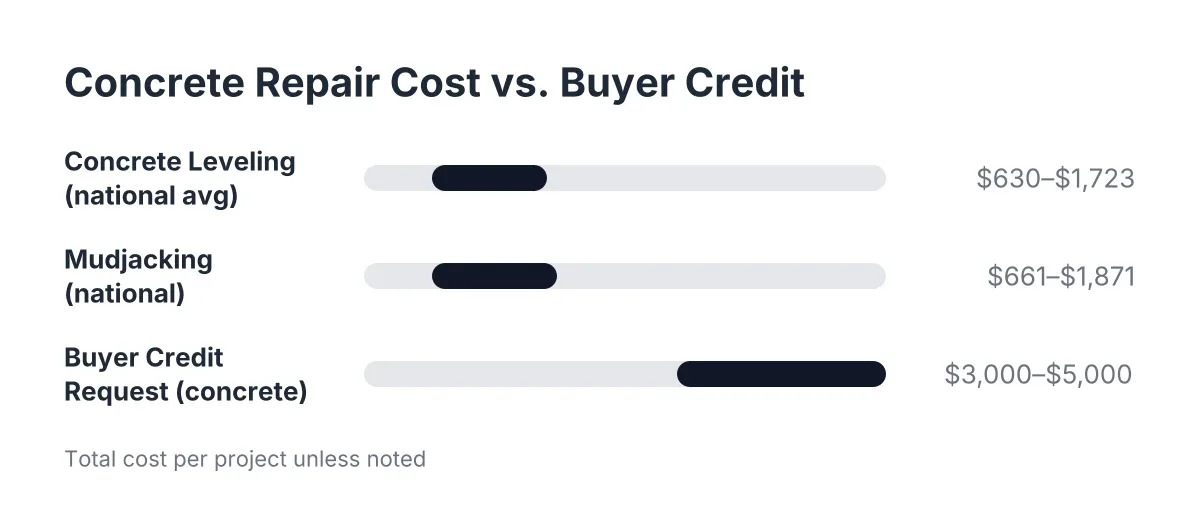
Once flagged, your buyer has leverage and typically responds three ways: request a credit at closing, ask you to complete repairs before closing, or walk. Credits often inflate because buyers price replacement, not leveling—a $1,200 leveling job can become a $6,000 credit request.
Fixing concrete before re-inspection is often cheaper. You control the contractor, method, and price. A completed repair with documentation removes the negotiation point and prevents haggling. If not yet listed, walk your property with the same checklist inspectors use and fix issues before showing. Pre-listing repairs never appear in reports and never become bargaining chips.
Concrete Leveling and Home Inspections: Timelines That Fit Your Closing Date
The question we hear most from Des Moines sellers is not about price. It is about time. You have a re-inspection scheduled, or a closing date thirty days out, and you need to know whether the repair fits inside that window. The honest answer: almost always yes, and usually with room to spare.
Concrete leveling is fast because nothing gets demolished. We drill small holes in the sunken slab, pump material underneath, and the slab rises back to grade. Most residential jobs, a driveway plus a sidewalk run, for example, finish in two to five hours. Compare that to full replacement, which involves demolition, hauling, forming, pouring, and a 7-day minimum cure before you can drive on it. Replacement rarely fits a closing timeline. Leveling almost always does.
Mudjacking vs. Foam: What Cure Time Means for Your Deadline
The two methods differ mainly in material and cure time. Mudjacking pumps a cement slurry under the slab. It handles heavy loads well and costs less per job, but the slurry needs 24 to 72 hours before full traffic, and drill holes run about the size of a coffee cup. Polyurethane foam injection uses smaller, dime-sized holes and cures in 15 to 30 minutes. This means a buyer's re-inspector could walk the repaired sidewalk the same afternoon.
However, faster is not automatically better. Slab condition, load, and soil moisture all factor into which method fits your property, and central Iowa's clay soils behave differently than the generic soil assumptions franchise templates lean on. A specialist should explain the tradeoff plainly rather than default to one method. If the terminology in quotes starts piling up, slurry, void fill, lift points, cure time, our plain-English glossary of inspection and leveling terms sorts it out quickly.
With this in mind, here is a realistic pre-listing timeline for the Des Moines metro. Estimate within a day or two of your call. Repair scheduled within the same week in most seasons. Work completed in an afternoon. Documentation in your hands the same day. Even with a re-inspection scheduled ten days out, you have margin.
Cost, Negotiation Leverage, and Passing Re-Inspection
Price matters twice in an inspection scenario. First, you pay for the repair. Second, and just as important, the repair cost becomes your counter-number in negotiation. Knowing real figures keeps a buyer's inflated credit request from costing you thousands.
Start with the national baselines. The average concrete leveling job runs $1,174, with a typical range of $630 to $1,723, according to Angi and HomeAdvisor data. Mudjacking specifically ranges from $661 to $1,871 nationally, with most homeowners paying around $1,232, according to Angi. Meanwhile, HomeAdvisor puts mudjacking at $3 to $6 per square foot, which works out to 25% to 50% less than replacing the slab entirely. Your exact number depends on how many slabs sank, how far they dropped, and which method fits. For the full breakdown, read how much concrete leveling for home inspections costs.
Those numbers change the negotiation math. For example, if a buyer requests a $5,000 credit for "driveway repair," a written leveling quote for $1,400 resets the conversation immediately. Better yet, completing the repair removes the line item entirely. Beyond the deal at hand, the work tends to hold its value: Angi reports that concrete leveling projects can recoup 70% to 90% of their cost in added home value.
What Satisfies the Re-Inspection
Will the repair actually pass? In our experience across the Des Moines metro, yes, when three things are true. The slab sits back at grade with trip-hazard offsets eliminated. Surface water drains away from the house instead of toward it. Additionally, cracks get filled and sealed so the report cannot cite them as open defects. Inspectors evaluate current condition, not repair history, so a properly leveled slab reads as sound concrete.
That said, documentation seals it. Keep your invoice, before-and-after photos, and a written description of the method used. Buyers and their agents respond well to paper. A one-page summary showing the flagged item, the repair, and the date often ends the conversation before the re-inspector arrives.
Ready to Get Started?
If an inspection report just put your closing date at risk, you do not need a franchise call center reading from a template. Des Moines Concrete Leveling Pros will look at your flagged slabs, tell you plainly whether mudjacking or foam fits, and give you a firm price and timeline that beats your re-inspection date. Call us today and turn that inspection flag into a closed line item.