Home Inspector’s Checklist: Spotting Concrete Settling Before You Buy or Sell
If a home inspection flagged sunken concrete, or you want to catch settling before an inspector does, this guide walks you through the same checklist inspectors use, then explains how mudjacking and other leveling methods fix what they find. Whether you are selling on a deadline or worried about a walkway that could send someone to the ground, knowing what inspectors look for puts you ahead of the problem instead of behind it.
Here in Des Moines, settled concrete is common. Central Iowa sits on expansive clay soil that swells when wet and shrinks when dry. Add freeze and thaw cycles every winter, and slabs move. The good news is that most settled slabs can be lifted and leveled in a day, without tearing anything out.
Why Inspectors Flag Sunken Concrete in the First Place
Home inspectors flag settled concrete for two main reasons: safety and what it might signal. A raised slab edge is a tripping hazard, and inspectors are required to note fall risks on walkways, steps, and driveways. Beyond safety, sunken concrete near the house can point to drainage problems or soil settlement that a buyer will want explained.
For a buyer, an inspection report that lists "uneven concrete, trip hazard at front walk" is a negotiation point. Buyers routinely ask for a credit or a repair before closing. For a seller, that line item can cost more in concessions than the actual fix would cost, which is why many sellers handle it before listing.
For a homeowner staying put, the inspector's logic still applies. If a paid professional would flag your walkway as a fall risk, it is a fall risk. That matters double if grandkids run up your sidewalk or if your own footing is not as steady as it once was. A raised slab lip of half an inch is enough to catch a toe.
The Inspector's Checklist: What They Look For and Where
You can walk your own property with the same eye an inspector brings. Here is what they check, roughly in the order they check it.
Walkways and Sidewalks
Inspectors look for vertical offsets where one slab section sits higher than its neighbor. Many cities, including communities around Des Moines, treat offsets of about half an inch or more as a defect on public sidewalks, and inspectors apply similar judgment to private walks. They also note slabs that tilt toward the house, because that sends rainwater at your foundation instead of away from it.
Steps and Stoops
A settled front stoop is one of the most commonly flagged items in older Des Moines neighborhoods. Inspectors check whether the top step has sunk, leaving an uneven rise between the last step and the porch. Uneven step heights are a leading cause of falls at home entries. If the stoop has pulled away from the house, they note the gap, since it lets water run down against the foundation.
Driveways
On driveways, inspectors watch for sunken slab sections near the garage, cracks wider than about a quarter inch, and panels that pitch toward the garage door. A driveway that drains toward the garage floor gets written up because water intrusion follows. Cracked and sunken driveway panels also raise the question of whether the soil underneath washed out.
Garage and Basement Floors
Inside, inspectors check the garage floor for settling near the apron and for cracks that step up or down across the crack line. A flat crack is usually cosmetic. A crack where one side sits lower than the other means the soil under that side gave way. Basement floor slabs get the same look.
Patios
A patio that has sunk and now slopes back toward the house gets flagged for drainage. One that has dropped an inch below the door threshold gets flagged as a trip hazard at the exit.
Signs an inspector reads as soil settlement
- Stair-step cracking or offset cracks where one side is lower
- Slabs pitched toward the foundation instead of away
- Gaps opening between a stoop or patio and the house
- Hollow sound when a slab is tapped, suggesting a void underneath
- Soil erosion or washout visible at slab edges after rain
If you spot two or more of these on your own walk-around, assume an inspector will too.
Cosmetic Crack or Real Settling: How to Tell the Difference
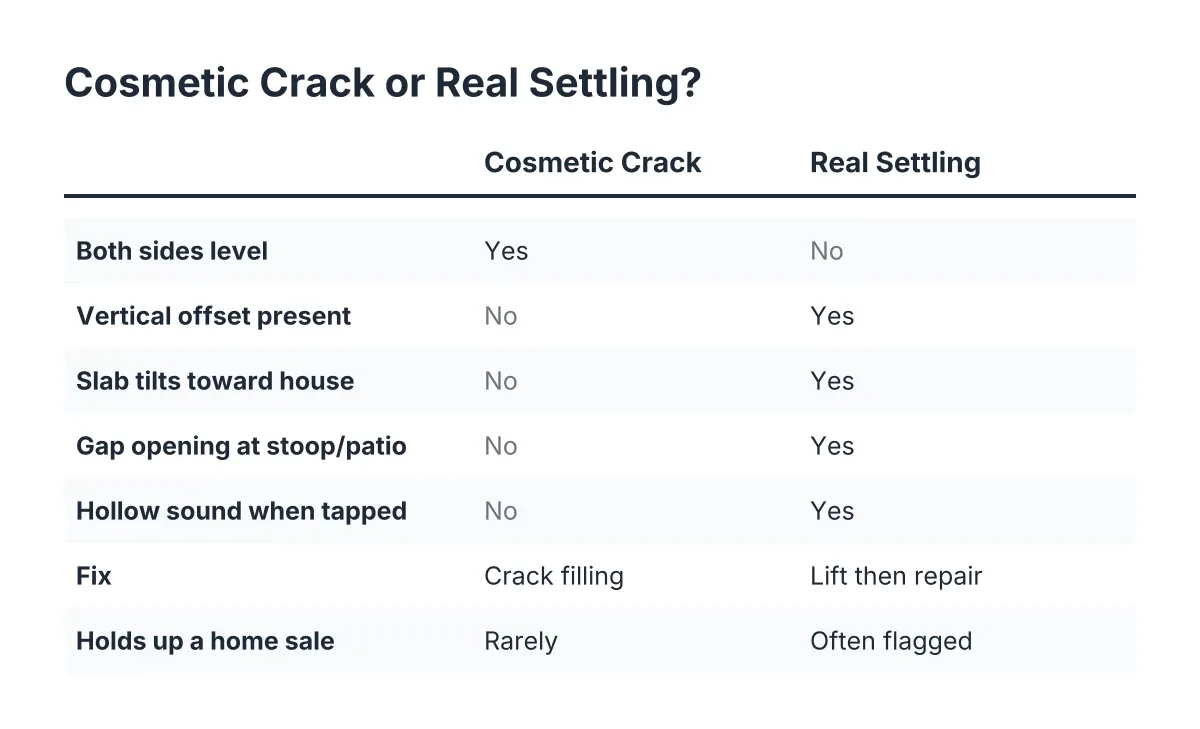
The single most useful skill on this checklist is telling a surface crack from a settlement problem. Hairline cracks with both sides level are normal concrete behavior. Concrete shrinks as it cures and moves a little with temperature, and thin, flat cracks are the result. Crack filling and crack repair handle these, and they rarely hold up a sale.
Settlement looks different. The tells are vertical offset, tilt, and sinking. Lay a straight board across the crack; if one side is lower, the soil underneath has moved. A slab corner that has dropped, a walkway section noticeably below its neighbors, or a stoop that leans are all settlement, not cosmetics.
Why does this matter for an inspection? Because the fix is different. Filling a crack in a sunken slab without lifting the slab is painting over the problem, and a decent inspector at re-inspection will notice the slab is still low. Leveling concrete first, then repairing the cracks, is the order that satisfies a second look.
How Mudjacking Fixes What the Inspector Flagged
Mudjacking, also called slab jacking, lifts sunken concrete back to level by pumping material underneath it. According to Wikipedia, concrete leveling works by drilling holes into the sunken slab, pumping a lifting material beneath it to raise and stabilize the slab, then patching the holes to closely match the original surface. The slab you have is the slab you keep; it just sits where it should again.
The traditional slab-jacking mix is a slurry of sand, soil, and often Portland cement, pumped under pressure through the drilled holes. As the slurry fills the void, it lifts the slab in small, controlled increments. The crew checks level as they go, then patches the holes.
For an inspection-driven repair, the process has three advantages. First, it is fast; a typical sunken walkway or stoop is lifted in a few hours. Second, it is far less disruptive than tearing out and repouring, which matters if you are living in the house through a sale, or if you would rather not have a week of construction outside your front door. Third, it costs less than replacement. According to HomeAdvisor, mudjacking runs $3 to $6 per square foot and is 25% to 50% less expensive than replacing a concrete slab entirely.
Cost matters when you are on a fixed income or watching every dollar ahead of a closing. According to Angi, the national average cost of a slab lift ranges from $661 to $1,871, with most homeowners paying around $1,232. Most single walkway, stoop, or driveway panel jobs land in that band, and pricing scales by square footage, so a small front step repair costs less than a full driveway.
Slurry, Foam, or Self-Leveling Concrete: Choosing the Right Fix
No single method fits every flagged slab, so it helps to know the three main options and where each one belongs. Professional concrete lifting generally uses one of three materials: traditional sand-and-cement slurry, stone slurry grout made from pulverized limestone and water, or polyurethane foam injected as a two-part mix that expands under the slab.
Mudjacking tends to make sense when the area is large and budget is the main concern. The material is inexpensive, so lifting a long stretch of sidewalk or several driveway panels stays affordable. The trade-offs are larger drill holes and a heavier fill material, and the slurry needs time to set before heavy loads roll over it.
Polyurethane foam uses smaller holes, cures fast, and adds little weight to the soil below. It often fits driveway slabs that need to carry a car the same day, or slabs over soil that is already struggling under load. It typically costs more per job than a slurry lift, so on a large area the math can favor the slurry.
Self-leveling concrete is a different tool for a different problem. It is a pourable compound for smoothing an uneven interior floor surface, such as a wavy basement or garage floor, not for lifting a sunken exterior slab. It also demands prep; according to Lowe's, manufacturer instructions typically require the concrete surface to be mechanically profiled before the leveler goes down, and according to Sakrete, a respirator mask should be worn when mixing it because the dry powder is hazardous to breathe. That is one reason it is rarely a weekend project for a retiree.
A fair contractor should explain which method fits your slab and why, based on slab condition, load, cure time, and cost. If someone pushes one method for every situation without looking at your concrete, get another estimate. Getting two or three estimates and asking each contractor to justify the method is the single best protection you have.
Will a Slab Lift Pass a Re-Inspection?
Slab jacking satisfies inspectors when it removes the condition that got flagged: the trip hazard, the negative slope, or the sunken section. Inspectors do not grade the repair method; they grade the result. A walkway lifted back to level with offsets eliminated, cracks filled, and drainage pitched away from the house addresses the report item directly.
That said, set expectations honestly. The drill holes are patched to blend with the surface, but they remain visible on close inspection, and existing cracks do not disappear; they are filled and sealed, not erased. If a buyer expects concrete that looks brand new, leveling plus crack repair delivers safe and functional, not showroom. Resurfacing can improve the appearance afterward if looks matter for the listing.
One honest limitation: leveled concrete can settle again. Even after a proper repair, natural soil movement or unseen conditions below can cause new settling over time, and Des Moines clay is active soil. No one can promise a slab will never move again, and you should be wary of anyone who does. Also, if the settling connects to foundation movement, wall cracks, or doors that no longer close, that is beyond what concrete leveling addresses; bring in a structural engineer before any repair.
Documentation helps at re-inspection. Keep the invoice describing what was lifted and by how much, and take before and after photos yourself. Buyers and their agents respond well to a paper trail.
A Realistic Pre-Listing Timeline for Sellers on a Deadline
Suppose a seller in Beaverdale gets an inspection report back on a Monday. The buyer's inspector flagged a sunken front walkway with a one-inch offset and a stoop that pitches toward the foundation, and the buyer wants it resolved before closing in three weeks. Here is how that scenario typically plays out.
- Days 1 to 3: Estimates. The seller calls two or three concrete leveling companies. Most can look at a walkway and stoop within a few days and quote by the square foot.
- Days 4 to 10: Scheduling and the repair. A typical crew lifts a walkway and stoop in a single morning. Slurry needs time to firm up before heavy loads, though foot traffic usually resumes the same day; foam cures within minutes to hours.
- Days 10 to 14: Crack filling and cleanup. With the slabs level, crack repair and sealing finish the job. Photos and the invoice go to the buyer's agent.
- Before closing: Re-inspection or walkthrough. The offset is gone, the stoop drains away from the house, and the report item is closed.
In that scenario, the seller resolves the flag with roughly two weeks to spare. The pinch point is scheduling, not the work itself, so calling for estimates the week the report arrives matters more than anything else. This is why concrete leveling for home inspections tends to be a deadline-friendly repair; the work itself is measured in hours, not weeks.
There is also a value argument for fixing it rather than crediting it. According to Angi, concrete leveling projects can recoup 70% to 90% of their cost in added home value. A leveled, safe walkway shows better at every showing after the repair, while a repair credit only settles one negotiation.
For the Homeowner Staying Put: The Same Checklist, a Different Deadline
Not everyone reading an inspector's checklist is selling. If you are a grandparent whose deadline is the next family visit rather than a closing date, the same checklist applies; your inspector is your own two feet.
Walk your property after the next rain. Check the front walk for offsets you can catch a shoe on. Check the stoop for a sunken top step, because an uneven rise is where falls happen. Additionally, check the driveway where the grandkids ride bikes. If your mobility is not what it used to be, ask a family member to do the walk with you and lay a straightedge across anything suspicious.
The repair is the same either way, and it is not a big construction project. No jackhammers, no torn-up yard, no week of strangers on the property. A crew arrives, drills, lifts, patches, and leaves the same day in most cases. For someone who wants the sidewalk safe before the next winter freeze makes it worse, that is usually the whole story.
Questions to Ask Before You Hire Anyone
Whether an inspection report or a near-fall brought you here, ask the same questions of every estimate you get:
- Which method do you recommend for my slab, and why does it fit better than the alternatives?
- How much lift is needed, and how will you measure that the slab is back to level?
- What happens to the existing cracks after the lift?
- How long before I can walk or drive on it?
- What does the written estimate include, and is pricing by the square foot?
- What can this repair not fix, and when would you tell me to call an engineer instead?
A contractor who answers those plainly, without pressure, is the kind you want on your property. Settled concrete is one of the more fixable problems a home inspection can turn up. Catch it with the checklist, match the method to the slab, and the trip hazard that worried you, or worried your buyer, is gone by the end of a workday.
If you need concrete leveling, Des Moines Concrete Leveling Pros can help.
Prefer to talk it through? Call +15155828701 — a quick call is usually the fastest way to get a straight answer for your situation.