How Much Does Concrete Step Leveling Cost?
How much does concrete step leveling cost? The honest answer: it depends, and anyone who quotes you a firm number before seeing your steps is guessing. Your concrete step repair cost hinges mostly on three things: how far the steps have sunk, whether the concrete itself is still solid, and which repair method fits the job. We will not invent an average price here, because those numbers are usually made up. Instead, this guide walks you through what actually drives the price in Des Moines and how to get a real quote you can trust by the end.
What Drives the Cost of Concrete Step Leveling
Every set of sunken steps is a little different. Here are the factors an estimator looks at when pricing your job, and how each one pushes the number up or down.
How far the steps have settled
A set of steps that dropped a half inch needs less lifting material and less labor than one that sank three inches. More settling means more material pumped under the slab, and material is a big share of the bill. When evaluating concrete step repair costs, grab a level or a straight board and lay it across the steps. If the gap at one end is small, you are on the cheaper side. If the steps have pulled away from the house or lean hard to one side, expect the price to climb.
The condition of the concrete itself
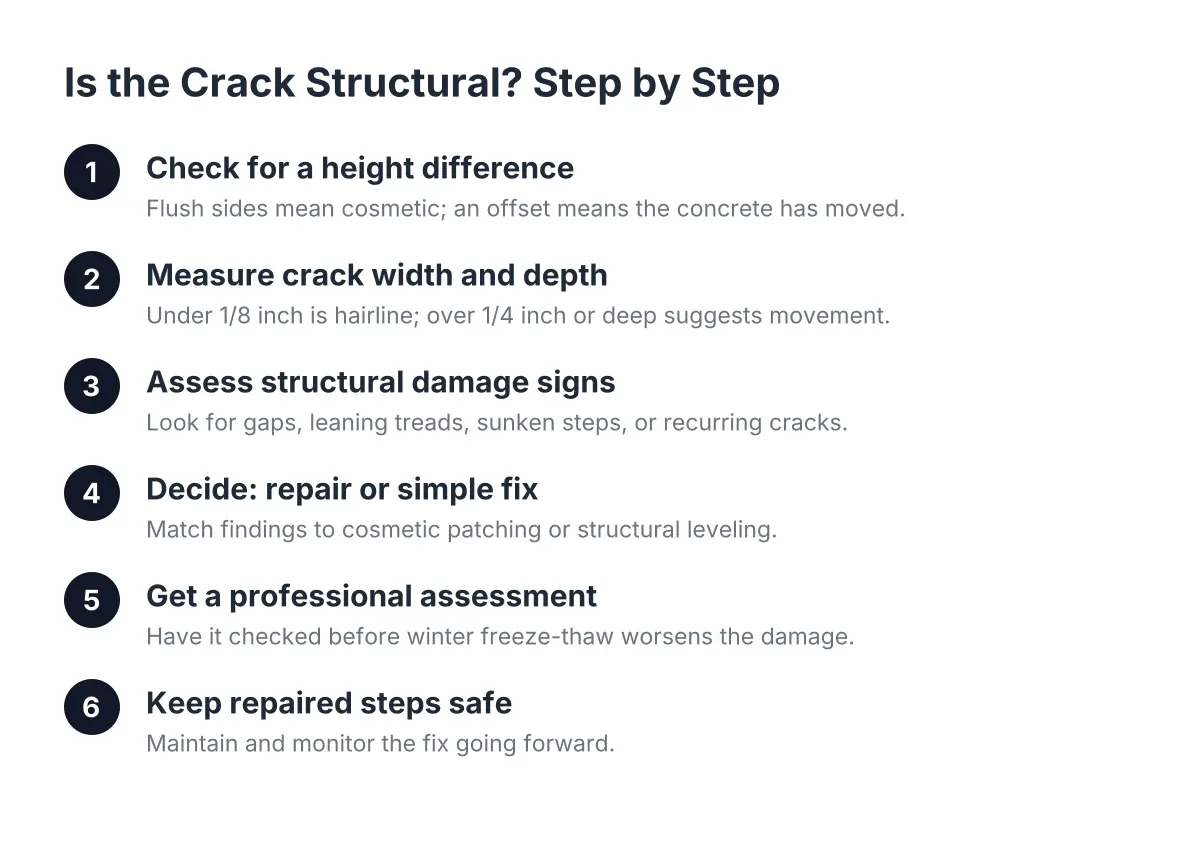
Leveling works by lifting the existing concrete back into place. That only makes sense if the concrete is worth lifting. Solid steps with a few hairline cracks are good candidates, and crack filling can be added for a modest amount. Steps that are crumbling, spalling, or broken into several pieces may need resurfacing or partial replacement instead, which costs more. Look at the surface and the edges. Chips and surface wear are usually fine. Deep cracks that go all the way through, or chunks you can wiggle by hand, change the conversation.
Mudjacking versus polyurethane foam
We lift concrete two ways: mudjacking, which pumps a cement slurry under the slab, and polyurethane foam injection. Mudjacking usually costs less per job but uses larger holes and heavier material. Foam costs more up front, cures fast, and adds less weight to soil that is already settling. Central Iowa's expansive clay swells when wet and shrinks when dry, so the right method depends on what your soil is doing under those steps. A good estimator explains which fits your situation and why, not just which one they happen to sell.
Access to the work area
Steps tucked behind a fence, up against landscaping, or in a tight side yard take longer to reach with equipment and hoses. Longer setup means more labor time on the invoice. Front steps with a clear driveway nearby are the easy case. Walk the path from the street to your steps. If a crew can park close and roll equipment straight to the work, you are on the lower end.
What caused the settling
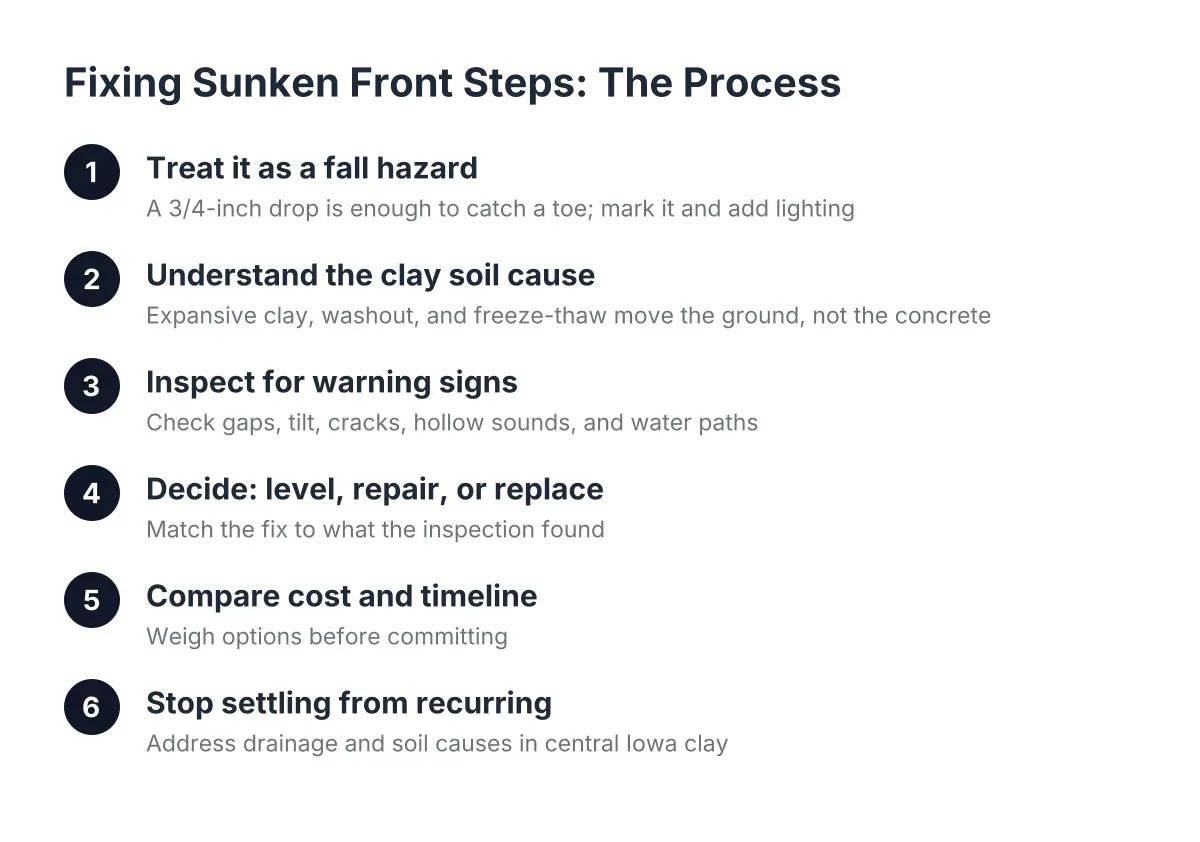
Steps sink for a reason. Sometimes it is simple: the fill dirt under them compacted over the years, which is common with poured stoops. Sometimes water is the culprit, from a downspout dumping next to the steps or grading that sends runoff under the slab. If the cause is still active, a smart quote includes fixing it, or at least tells you to. That adds cost now but keeps you from paying to lift the same steps again in a few years.
Whether nearby concrete needs work too
Sunken steps often keep company with a settled sidewalk, a tilted stoop, or an uneven walkway leading to them. Bundling that work into one visit usually costs less than two separate service calls, because the crew and equipment are already there. It raises the total, but lowers the price per square foot of concrete fixed.
Cost Factor Table
| Factor | Pushes the price down when… | Pushes it up when… |
|---|---|---|
| Amount of settling | The steps dropped a small amount and sit close to level | The steps sank several inches or lean sharply |
| Concrete condition | The concrete is solid with only hairline cracks | The steps are crumbling, broken, or need resurfacing |
| Repair method | Mudjacking fits the job and the slab can handle it | Foam injection or partial replacement is the better fit |
| Access | The crew can park close and reach the steps easily | Fences, landscaping, or tight spaces slow the work |
| Cause of settling | The soil simply compacted and has stabilized | Active water problems or drainage issues need fixing too |
| Scope of the job | Only the steps need lifting | Sidewalks, stoops, or walkways need leveling at the same time |
How to Get an Accurate Concrete Step Repair Cost Estimate
The fastest way to a real number is a quick on-site look, and you can make that visit count by having a few things ready:
- Photos or notes on the settling. How far have the steps dropped? When did you first notice it?
- Water clues. Where do your downspouts drain? Does water pool near the steps after rain?
- The age of the concrete, even a rough guess. Older concrete may need crack repair alongside the lift.
- Any related problem spots, like a sunken sidewalk or uneven walkway, so the estimator can price them together.
A good quote should spell out the method (mudjacking or foam), what is included (crack filling, sealing, cleanup), how long the fix takes to cure before you can use the steps, and what happens if the concrete does not respond as expected. If a quote is a single number on a card with no explanation, keep asking questions.
Estimates differ between providers for real reasons. Companies price materials differently, some carry franchise overhead that shows up in your quote, and some default to one method for every job whether it fits or not. That is why two or three quotes on the same steps can vary a lot. Compare what each one includes, not just the bottom line.
Ways to Keep the Cost Down
You cannot haggle concrete, but you can make smart choices that shrink the bill.
- Fix it early. A half inch of settling is a small lift. Wait two more freeze-thaw seasons in Iowa and that same gap can grow, cracks can spread, and the job can shift from leveling to replacement. Leveling is nearly always the cheaper path when the concrete is still sound.
- Deal with the water. Extending a downspout or regrading a small area next to the steps costs little and removes the force that sank them. Skipping this step is how homeowners end up paying for the same repair twice.
- Bundle nearby work. If your walkway or stoop is also settling, price it all in one visit. One mobilization beats two.
- Get two or three quotes. Not to nickel-and-dime anyone, but to see which method each company recommends and why. If everyone says mudjacking and one outfit insists on a bigger job, ask them to explain.
- Ask about the smaller fix. Sometimes crack filling and sealing now, with leveling later, is the right sequence for your budget. An honest company will tell you when waiting is safe and when it is not.
Cost Questions People Ask
Is concrete step repair cheaper than replacing the steps?
Usually, yes, and often by a wide margin. Leveling reuses your existing concrete, so you skip demolition, hauling, forming, and a new pour. Replacement only wins when the concrete itself is too far gone to lift, which is why the condition check matters so much in your quote.
Does mudjacking cost less than foam for steps?
Mudjacking is generally the lower-cost option per job, while polyurethane foam costs more but cures faster and weighs less on the soil underneath. For steps on central Iowa's clay soils, the right answer depends on the slab, the load, and how the ground drains. Ask each estimator to price both if both are workable.
Why did I get such different quotes for the same steps?
Different methods, different overhead, and different scope. One company may quote a bare lift, another may include crack repair, sealing, and drainage fixes. When comparing concrete step repair costs across quotes, line them up side by side and compare what each includes before you compare the totals.
Will homeowners insurance cover sunken concrete steps?
In most cases, no. Standard policies treat settling as normal wear, not a covered event. Check your policy or ask your agent, but plan to pay out of pocket, and budget for the leveling plus any drainage fix that prevents a repeat.
The Bottom Line
Your cost comes down to how far the steps have settled, whether the concrete is still solid, and which lifting method fits your soil and slab. Leveling almost always beats replacement on price when the concrete is worth saving. Get two or three written quotes from local companies who will look at your actual steps, compare what each includes, and pick the one that explains the job in plain terms.
If you need concrete leveling, Des Moines Concrete Leveling Pros can help.
Prefer to talk it through? Call +15155828701 — a quick call is usually the fastest way to get a straight answer for your situation.