Concrete Driveway Resurfacing vs. Leveling: How to Choose the Right Fix
Your driveway has settled, cracked, or worn down, and now you have a choice to make. Concrete driveway resurfacing can renew a rough or pitted surface for a fraction of what a new pour costs. But if the slab has actually sunk, resurfacing alone will not fix it; you need concrete leveling first, or in bad cases, full replacement. This guide walks you through how to figure out which fix your driveway needs, what each one costs, and how long each one lasts, with real numbers Des Moines homeowners can plan around in 2026.
Here is the short version: resurfacing fixes surface damage, leveling fixes sunken slabs, and replacement is for slabs too broken to save. Most driveways in central Iowa need one of the first two, not the third. The steps below show you how to tell them apart.
Step 1: Figure Out Whether Your Driveway Sank or Just Wore Out
Start by looking at the problem itself, not the ugly surface. A worn driveway and a sunken driveway look similar from the street, but they need different fixes and cost different amounts.
Surface problems include pitting, flaking, spalling, hairline cracks, and a rough or stained finish. The slab is still flat and sits where it should. These are candidates for resurfacing or an overlay to restore concrete driveway appearance.
Settling problems look different. One slab section sits lower than its neighbor. A gap opens between the driveway and the garage floor. Water pools in a low spot after rain, or the whole apron tilts toward the house. These are structural position problems, and no coating fixes them. They need driveway leveling to raise the slab back to grade.
Grab a tape measure and check three things:
- Height difference at joints. More than a quarter inch of offset between slab sections means settling, not wear. Anything near an inch is a tripping hazard and a leveling job.
- Gap at the garage or foundation. If the driveway has pulled away or dropped below the garage floor, the soil under it has moved.
- Drainage direction. Set a level on the slab. A driveway that slopes toward the house is pushing water at your foundation and needs its pitch corrected, which resurfacing cannot do.
This matters for newer homes especially. If your house went up in the last three to eight years in a growth area like Ankeny, Waukee, Clive, or Johnston, your driveway likely sits on fill soil that is still compacting. That produces settling, not surface wear, and it points you toward leveling.
Step 2: Rule Out Problems That Disqualify Both Options
Next, check for the conditions where neither resurfacing nor leveling makes sense. This step saves you from paying twice.
Resurfacing and leveling both reuse your existing slab. That only works if the slab is worth reusing. Walk the driveway and look for:
- Crumbling or shattered concrete. A slab broken into many small pieces cannot be lifted in one piece, and an overlay poured over rubble will crack along the same lines.
- Cracks wider than a half inch that keep growing. Wide, active cracks usually mean the slab has lost its structural integrity.
- Repeated freeze-thaw damage through the full depth. Central Iowa winters cycle water into cracks, freeze it, and pry the concrete apart. If damage goes all the way through, patching the top will not hold.
However, do not confuse cosmetic cracks with structural failure. A slab with a few clean cracks that has sunk as a unit is a normal leveling candidate. Crack filling and crack repair handle the seams once the slab is back in position.
One more check for insurance-minded homeowners: settling from soil compaction is gradual earth movement, and most homeowner policies treat it differently than sudden storm damage. If your driveway dropped after a specific event, like heavy rain washing out soil under the slab, document it with dated photos before any work starts. Ask any contractor for a written estimate that names the cause and the repair method in plain terms. An adjuster can work with "sunken slab, soil washout under northwest corner, lifted by slab jacking" far better than a vague line item. No contractor can promise your claim gets approved, so plan your budget as if you are paying out of pocket and treat reimbursement as a bonus.
Step 3: Price the Three Fixes Side by Side
Now put numbers next to each option. Costs vary by driveway size and condition, but the gaps between the three approaches are large enough to steer the decision.
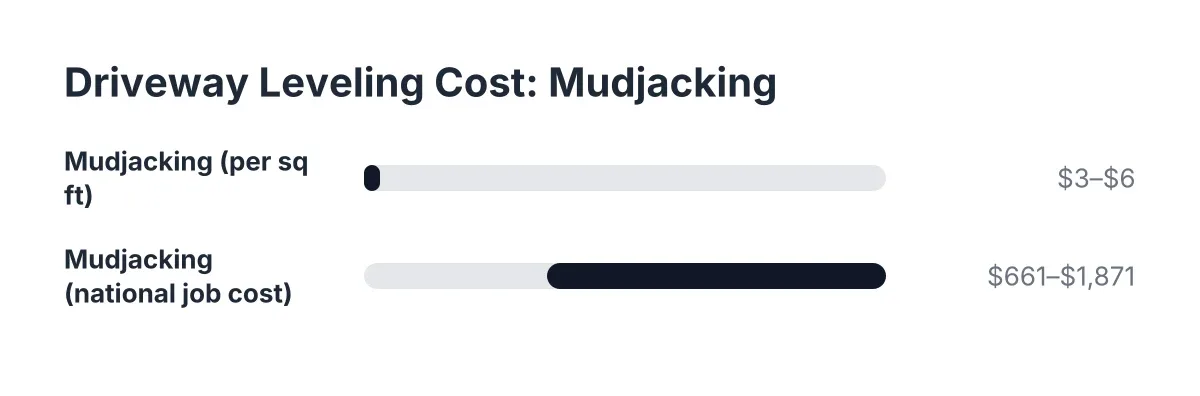
Concrete leveling. The national average concrete leveling cost is $1,174, with a typical range of $630 to $1,723, according to Angi and HomeAdvisor data. For mudjacking specifically, HomeAdvisor puts the cost at $3 to $6 per square foot, which runs 25% to 50% less than replacing a concrete slab entirely. Small jobs often carry a minimum charge of around $500 even when the affected area is under 100 square feet, according to Angi. Ancillary work like joint sealing and crack repair can push the total above the base lifting price, so ask for those line items in writing.
Driveway Resurfacing or Overlay. Resurfacing sits below leveling on most jobs because it is surface work: cleaning, grinding, and applying a new wear layer. Driveway resurfacing cost scales with square footage and the product used, from basic cement-based resurfacer to decorative overlays. As an illustrative estimate, a plain resurfacer on a standard two-car driveway usually lands in the high hundreds to low thousands, while decorative finishes cost more.
Full replacement. Tear-out and repour is the most expensive path by a wide margin, and it is the slowest. Concrete driveway replacement cost includes demolition, hauling, base preparation, and new concrete, plus roughly a week of cure time before you can park on it. Two driveways that look identical from the curb can carry very different replacement bids; one may need only new concrete while the other needs excavation, slope correction, or reinforcement.
Leveling has one more number worth knowing: Angi reports that mudjacking and concrete leveling projects can recoup 70% to 90% of their cost in added home value. For a pre-listing seller, that math usually favors leveling over living with a sunken driveway or paying for a full repour.
Step 4: Match the Fix to Your Driveway's Problem
At this point you know what is wrong and what each fix costs. Here is the decision logic.
Choose leveling when the slab has moved but is still sound. Concrete leveling works by drilling holes into the sunken slab, pumping a lifting material beneath it to raise and stabilize it, then patching the holes to closely match the original surface, according to Wikipedia. Mudjacking and polyurethane foam injection are the two main methods, and each fits different slab conditions, loads, and cure-time needs. Either way, the job typically starts and finishes the same day, and you keep your existing concrete instead of paying for new.
Choose resurfacing when the slab is flat but ugly. An overlay renews a worn or pitted surface without the cost of replacement. Done right, a self-leveling overlay can smooth pitted, uneven concrete so thoroughly that no dimples or level differences remain visible after curing. The catch is preparation. Manufacturer instructions for self-leveling compound require the concrete to be mechanically profiled, meaning ground or roughened, before the leveler goes on, per the Lowe's Self-Leveler Plus installation guide. Skip that step and the overlay peels.
Combine them when a slab is both sunken and rough. Lift first, resurface second. Resurfacing over a sunken slab locks the bad slope in place under a fresh coat, which is money wasted.
Choose replacement only when Step 2 disqualified the slab. If the concrete is crumbling through its full depth or shattered into pieces, replacement is the honest answer, and a good concrete leveling contractor will tell you so instead of lifting a slab that cannot hold.
Suppose a homeowner in Ankeny bought a house built in 2020, and the builder warranty has expired. The driveway's middle section dropped about an inch where fill soil settled, and the surface near the street is pitted from five winters of deicer. In that scenario, resurfacing alone hides the pitting but leaves the trip edge and the drainage problem. Leveling the middle section, sealing the joints, and resurfacing the pitted apron fixes both problems for far less than the replacement bid, and the driveway is usable the same day.
Step 5: DIY Concrete Driveway Resurfacing Versus Professional Help
Small resurfacing jobs are within reach for a careful DIYer. Repairing a limited patch of damaged concrete with primer and self-leveling compound is a low-skill, low-cost project. Two safety and prep notes matter here: wear a respirator when mixing the compound because the dry powder is hazardous to breathe, according to Sakrete, and prime porous concrete first, which also reduces air bubbles rising from the slab into the leveler, according to Ardex.
Leveling is a different story. Lifting a multi-ton slab takes pumping equipment and judgment about how much material to inject and where. A botched DIY lift can crack the slab, and a damaged slab makes professional leveling harder later, sometimes forcing a full replacement that the original problem never required. If your driveway has sunk, get a professional evaluation before anyone drills a hole.
Also know the limits of every option here. Neither resurfacing nor leveling fixes a driveway sitting on soil that is actively washing out; the drainage problem has to be handled too, or the slab settles again. If the settling connects to foundation movement rather than surface soil, you need a foundation evaluation, not a driveway fix.
Step 6: Get Estimates That Document the Job Properly
Finally, collect written estimates, and make them work for you beyond the price.
Ask each contractor to spell out:
- The diagnosis: what caused the settling or wear, in plain language.
- The method: mudjacking, foam injection, resurfacing product, or replacement, and why that method fits your slab.
- The scope: square footage, number of slab sections, crack repair, and joint sealing, each as its own line.
- What the fix does not cover, such as future settling if fill soil keeps compacting.
This paper trail matters twice. If you are filing an insurance or warranty claim, a specific written estimate is what the adjuster actually needs. And if your home sits on fill soil that is still settling, a documented first repair makes any future work easier to scope.
One last expectation to set: how long the fix lasts depends on the soil, not just the work. A leveled slab over stable soil can hold for many years. A slab over fill that is still compacting may need a touch-up lift down the road, which is normal in newer Des Moines-area subdivisions and still cheaper than a repour. Resurfacing lifespan depends on prep quality and how many freeze-thaw cycles central Iowa throws at it. Ask every bidder how their fix handles our clay soils and winters. A contractor who answers that question specifically is the one worth hiring.
If you need concrete leveling, Des Moines Concrete Leveling Pros can help.
Prefer to talk it through? Call +15155828701 — a quick call is usually the fastest way to get a straight answer for your situation.