
Driveway Leveling — Complete Guide
If your driveway has sunk at the garage, tilted toward your foundation, or cracked along the joints, this guide gives you everything you need to decide what to do next. Driveway leveling lifts your existing concrete back into place, and for most Des Moines homeowners it is the most practical fix for a settling slab. Below you will find straight answers on driveway repair cost, why central Iowa soil causes so much settling, how the leveling process works, and when replacement genuinely makes more sense. Whether your driveway dropped in a newer subdivision or you are getting a home ready to list, each section helps you move from worry to a clear plan.
What You'll Find in This Guide
- How to Fix Driveway Settling From Expansive Clay: A Des Moines Homeowner's Guide
- Driveway Leveling in Des Moines, IA
- Driveway Leveling Terms Explained: A Plain-English Glossary
- How Much Does Driveway Leveling Cost?
- Concrete Driveway Resurfacing vs. Leveling: How to Choose the Right Fix
Prefer to have a pro handle it? Driveway leveling is one call away.
Why Des Moines Driveways Sink in the First Place
Most driveway settling in the Des Moines metro traces back to the ground, not the concrete. Central Iowa sits on expansive clay soil that swells when it absorbs water and shrinks when it dries. Your driveway slab rides on top of that constant movement. Over several seasons, the soil under one corner or one panel compresses or washes out, and the concrete above it drops to follow. Add Iowa's freeze-thaw cycles, which pump water into every joint and crack, and you have the recipe for a driveway that no longer meets the garage floor.
Water management plays a bigger role than most homeowners expect. For example, a downspout that dumps roof runoff next to the driveway edge can saturate the clay below and accelerate settling on that side. Similarly, a slab that already tilts toward the house channels water back toward the soil at your foundation, which makes the problem feed itself. Our guide on fixing driveway settling from expansive clay covers these soil mechanics in detail, including the warning signs that tell you movement is active rather than finished.
If you want to see what you are actually built on, the USDA Web Soil Survey lets you look up the mapped soil types under your own lot for free.
New Construction Settling Is Normal, Not a Defect
If you bought a newly built home and the driveway dropped within a few years, you are not alone. Builders backfill around foundations and utility trenches, and that disturbed soil rarely gets compacted to the same density as untouched ground. As a result, the fill keeps consolidating long after you move in, and the driveway panels poured over it sink with it. This does not usually mean the concrete itself failed. In practice, the slab is often in good shape and simply needs to be lifted back to where it started, which is exactly the situation leveling handles best. That said, check your builder warranty paperwork before you pay for anything, because some new-construction warranties address flatwork settling in the first year or two.
Understanding Driveway Repair Cost Factors
Driveway leveling is the highest-ticket concrete leveling job most homeowners ever face, so the pricing deserves a clear explanation. Three factors drive the number on your quote: how large the sunken area is, how far the slab has dropped, and which lifting method fits your concrete. A single settled panel at the garage apron sits at the low end. A full driveway that has tilted toward the house, with multiple panels to lift, sits at the high end.
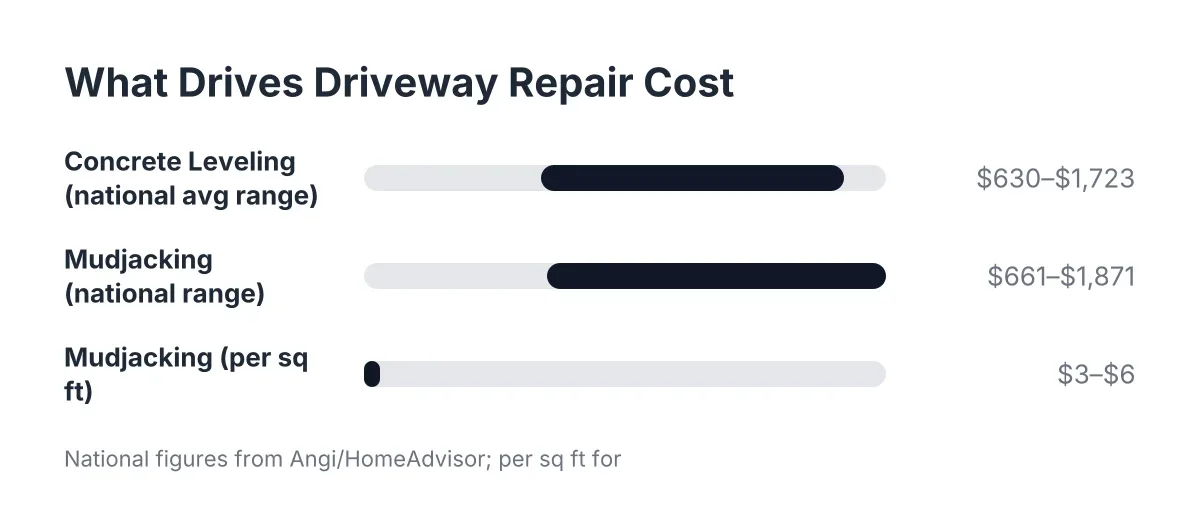
For national context, the average concrete leveling project runs $1,174, with a typical range of $630 to $1,723, according to Angi and HomeAdvisor data. Additionally, Angi notes that small jobs may carry a minimum charge of around $500 even when the affected area covers less than 100 square feet. Your actual driveway repair cost in Des Moines depends on your specific slab, which is why our driveway leveling cost guide walks through each pricing factor one by one so you can read any quote with confidence.
Why Leveling Usually Beats Replacement on Price
The comparison that matters most is leveling versus tear-out. According to HomeAdvisor, mudjacking runs $3 to $6 per square foot and costs 25% to 50% less than replacing a concrete slab entirely. Beyond the per-foot savings, replacement adds demolition, hauling, new concrete, and days of cure time before you can park on it. Leveling reuses the slab you already own, which is where most of the savings come from.
How the Lifting Method Affects the Quote
We lift driveways with two methods: mudjacking, which pumps a cement-based slurry under the slab, and polyurethane foam injection, which uses expanding foam through smaller holes. Each fits different situations depending on slab condition, the loads the driveway carries, and how quickly you need to drive on it. However, the right choice is not always the cheaper one, so ask any contractor to explain why they recommend one method for your slab. If the terminology on a quote gets confusing, our plain-English driveway leveling glossary decodes the terms you will see.
Leveling vs. Replacing a Driveway: Making the Call
Leveling is not the right answer for every driveway, and an honest assessment starts with the condition of the concrete itself. A slab that has settled but remains structurally sound is a strong leveling candidate, because the problem lives in the soil, not the concrete. On the other hand, a driveway that has crumbled, spalled deeply, or cracked into many small pieces may not survive lifting. In that case, replacement or a different repair gives you better value, and a trustworthy contractor should tell you that plainly during the estimate.
Surface condition and elevation are separate questions, and homeowners often mix them up. For instance, a driveway can sit perfectly level while looking rough and pitted, or it can look nearly new while sloping toward your foundation. Our comparison of concrete driveway resurfacing vs. leveling sorts out which fix addresses which problem, and when it makes sense to combine them.
Questions Pre-Listing Sellers Should Ask
If you are preparing a home for sale, a sunken driveway is one of the first flaws buyers and inspectors notice from the curb. Trip hazards at the garage apron and panels that drain toward the foundation both show up in inspection reports. The economics tend to favor fixing it before listing: according to Angi, concrete leveling projects can recoup 70% to 90% of their cost in added home value. With this in mind, get the repair documented in writing so you can show buyers exactly what was done and when. Ask any contractor how they will fill the lift holes, whether joints get sealed afterward, and what the driveway will look like when they finish.
How Long Does Driveway Leveling Last?
Lifespan depends less on the lifting material and more on what happens to the soil afterward. A leveled slab stays level as long as the ground beneath it stays stable. Consequently, the biggest things you control are drainage and joint maintenance. Extend downspouts away from the driveway edge, keep expansion joints and cracks sealed so water cannot wash soil out from under the slab, and watch grading along the sides. If the original settling came from poorly compacted construction fill, the lift itself often fills the voids that caused the movement. However, if active erosion or a drainage problem keeps feeding the settling, no repair holds until you address the water. A good estimate should identify that root cause, not just quote the lift. Our driveway leveling service page explains how we evaluate a slab before recommending any work.
Ready to Get Started?
Des Moines Concrete Leveling Pros lifts and levels sunken, cracked, and settling driveways for homeowners in Des Moines and the immediate surrounding communities, using both mudjacking and polyurethane foam injection. We look at your slab, explain which method fits and why, and give you a written quote you can actually understand. Call us or send a request, and we will set up a time to take a look at your driveway.