Uneven Sidewalk Trip Hazards: How to Fix Them Fast Before You Sell
An uneven sidewalk is more than an eyesore. A raised slab edge is a tripping hazard, and if someone falls on it, the liability can land on you. If you are getting ready to list your house in Des Moines and the inspector flagged sunken concrete, or your realtor said the walkway is hurting curb appeal, you need a fix that is fast, affordable, and solid enough to hold up when the buyer's inspector walks the property. This guide walks you through exactly how to handle it, step by step.
Step 1: Measure the Lip and Judge the Trip Hazard
Start with a tape measure and walk your sidewalk. Look for any spot where one slab sits higher than the one next to it. That raised edge is what catches a shoe.
Many cities treat a vertical lip of about half an inch or more as a trip hazard that needs repair. You do not need to memorize a code number. If your toe can catch it, a mail carrier's toe can catch it, and a buyer's inspector will write it up.
While you measure, note these warning signs:
- A slab that has sunk lower than its neighbor, leaving a stepped edge
- Cracks running through a panel, especially with one side dropped
- Water pooling on the walkway after rain, which points to an unstable base underneath
- A tilted slab that slopes toward the house, sending water at your foundation
- Sunken concrete at entry points, like where the walkway meets the porch or driveway
Entry points matter most. A dropped slab at the front step is the first thing a buyer sees and the most likely place for an elderly visitor or a kid running to the door to fall.
Step 2: Check Who Is Liable for an Uneven Sidewalk
In many communities, including much of the Des Moines metro, the homeowner is responsible for maintaining the public sidewalk that borders their property. That surprises a lot of sellers. The city owns the right of way, but the repair duty, and often the liability if someone gets hurt, sits with you.
Can you sue for an uneven sidewalk injury? People do, and those claims usually target whoever had the duty to maintain the walk. That is the real cost of leaving a lipped slab alone. It is not just an inspection note; it is an open risk every day someone walks past your house.
Before you fix anything, call your city's public works or engineering office and ask two questions. First, is the sidewalk section your responsibility to repair? Second, does the city require a permit or have rules on repair methods for public walks? Some cities run sidewalk inspection programs and will send notices, so getting ahead of it is cheaper than reacting to one.
Step 3: Figure Out Why the Sidewalk Settled
Concrete does not sink for no reason. In central Iowa, the usual culprits are expansive clay soil that swells when wet and shrinks when dry, freeze-thaw cycles that heave and drop slabs each winter, and downspouts that wash out the base under a panel.
This step matters because the cause shapes the fix. If a downspout is dumping water right at the edge of the walk, leveling the slab without moving that downspout means the new base can wash out too. Pooling water and soft, uneven spots signal an unstable base, and that is a red flag no matter which repair you choose.
Take five minutes and look at where water goes during a storm. Redirecting a downspout or regrading a small strip of soil costs little and protects whatever repair comes next.
Step 4: Compare Your Uneven Sidewalk Repair Options
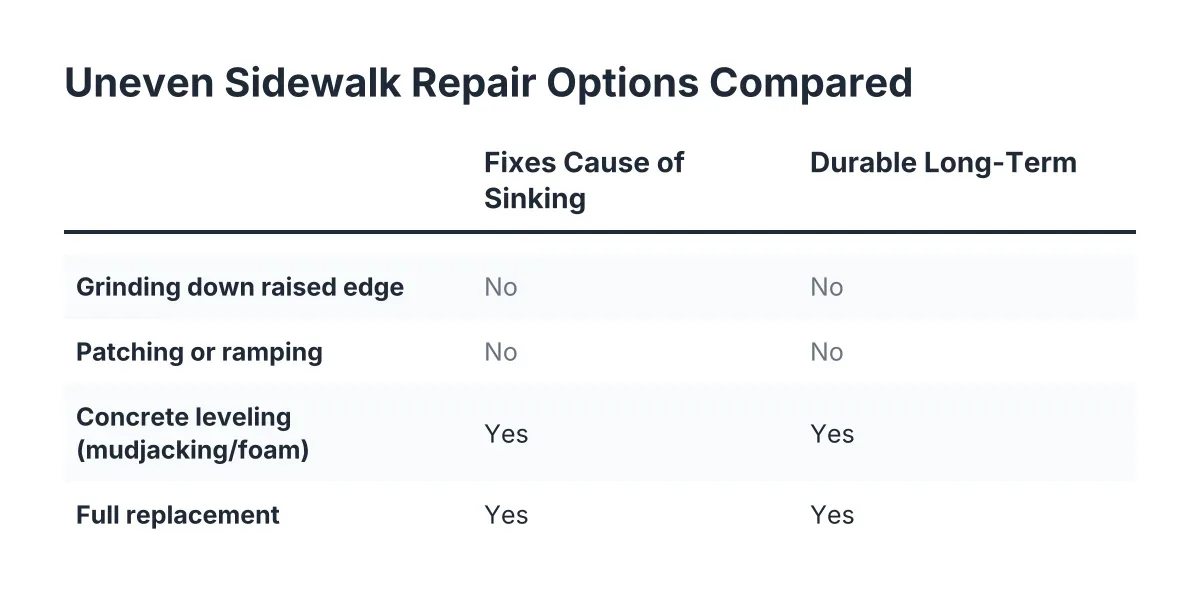
You have four realistic ways to fix an uneven sidewalk, and they are not equal. Here is how they stack up for a seller on a deadline.
Grinding down the raised edge
A contractor grinds the high lip flush so shoes stop catching. It is cheap and quick, and it removes the immediate tripping hazard. However, it does nothing about why the slab moved. If the panel keeps settling, the lip comes back, and grinding removes concrete you cannot put back. Think of it as a smoothing measure, not a repair.
Patching or ramping with surface material
Troweling a patch or a small ramp over the lip smooths the transition. Keeping that ramp long and its slope consistent makes it safer; a short, steep patch can become its own trip hazard. The catch is durability. A surface patch bonded on top of old concrete tends to chip or crack off as the slab expands and contracts through Iowa's freeze-thaw cycles. A sharp-eyed inspector may also recognize it as cosmetic.
Self-leveling concrete has the same limits outdoors. It is designed for interior floors, and manufacturer instructions typically require the concrete surface to be mechanically profiled before the leveler goes down, according to Lowe's (Self-Leveler Plus installation guide). On an exterior walkway, it is a temporary fix at best.
Concrete leveling (mudjacking or polyurethane foam)
This is the middle path most sellers land on. Concrete leveling works by drilling small holes in the sunken slab, pumping a lifting material underneath to raise and stabilize it, then patching the holes to blend with the surface, according to Wikipedia. Mudjacking pumps a cement-based slurry; polyurethane injection pumps an expanding foam. Both lift the existing slab back to grade.
The appeal for a pre-listing seller is speed and cost. Most sidewalk leveling jobs take hours, not days, and the walk is usable the same day or the next. Nationally, mudjacking runs about $661 to $1,871, with most homeowners paying around $1,232, according to Angi. Small jobs may carry a minimum charge of about $500 even under 100 square feet, per Angi. Compare that to tearing out and repouring the same panels, which typically costs several times more and adds cure time you may not have before closing.
Full replacement
If a slab is crumbling, shattered into pieces, or heaved beyond lifting, replacement is the honest answer. Leveling raises intact slabs; it cannot rebuild broken ones. A specialist should tell you plainly when a panel is past saving instead of lifting concrete that will not hold.
Step 5: Get the Right Contractor to Look at It
When you search sidewalk repair near me or concrete leveling companies near me, you will see national franchise names with templated city pages. For a sidewalk, you want someone who works these repairs on central Iowa's clay soils week in and week out, and who offers both mudjacking and foam so the method fits your slab instead of their sales script.
Ask each contractor these questions:
- Is this slab solid enough to lift, or does it need replacement?
- Which method fits here, mudjacking or foam, and why?
- Will you level the adjoining panels too, so the lift does not create a new lip where the raised slab meets its neighbor?
- What happens to the drilled holes and cracks afterward?
- How soon can I walk on it, and how soon can you schedule?
Question three is the one most homeowners miss. A proper settlement repair often includes panels beyond the obviously sunken one, because lifting only the visible slab can leave a fresh trip hazard at the next joint. Good sidewalk and walkway leveling treats the run of concrete as a whole, not one square at a time.
Step 6: Pair the Lift with Crack Repair and Cleanup
Leveling closes the gap under the slab, but it does not erase cracks on the surface. Have the contractor fill cracks after the lift. Crack filling keeps water from seeping under the slab and refreezing, which is what re-sinks concrete in Iowa winters. It also makes the walkway read as maintained rather than patched when a buyer walks up.
Set expectations honestly here. A leveled slab will not look factory new. Drill holes get patched to blend closely with the surface, and after a lift one side of a panel may sit slightly higher than the other. That is normal, and a marked improvement over a stepped tripping hazard beats chasing perfection.
Step 7: Document the Repair for Your Buyer and Inspector
For a pre-listing seller, paper matters as much as concrete. Suppose a homeowner in Beaverdale gets an inspection report flagging a one-inch lip on the front walk three weeks before closing. In that scenario, the smart play is a leveling repair within the week, plus a dated invoice describing what was done, which slabs were lifted, and the method used.
Hand that invoice to your realtor. When the buyer's inspector re-walks the property, a level walkway with documented professional repair reads as a maintained home, not a patched-over problem. It also cuts off the renegotiation conversation before it starts. As a bonus, the money is not wasted; concrete leveling projects can recoup 70% to 90% of their cost in added home value, according to Angi.
Will leveling pass inspection? Inspectors flag conditions, not methods. If the trip hazard is gone, the slabs are stable, and drainage is handled, there is nothing left to flag. What fails re-inspection is a cosmetic patch over a slab that is still moving.
When to Bring in a Professional Instead of Guessing
If the sidewalk connects to a sunken porch, cracked steps, or sloping floors inside the house, stop and get a professional inspection before any cosmetic fix. Widespread settling can point to soil movement under the foundation itself, and that is a bigger conversation than one walkway. A concrete leveling specialist can tell you whether you are looking at a simple sunken slab or a symptom of something larger, and an honest one will say so either way.
For most Des Moines sellers, though, an uneven sidewalk is exactly what it looks like: a slab that settled on clay soil and needs to come back up. Measured against the risk of a fall, a failed inspection, or a buyer asking for a price cut, a few hours of leveling is the cheap option.
If you need concrete leveling, Des Moines Concrete Leveling Pros can help.
Prefer to talk it through? Call +15155828701 — a quick call is usually the fastest way to get a straight answer for your situation.