Why Des Moines Sidewalks Sink: Clay Soil, Freeze-Thaw, and Concrete Leveling
If your walkway has a sunken slab and a raised edge waiting to catch someone's toe, you are not dealing with bad luck. You are dealing with central Iowa's soil. Concrete leveling fixes the symptom, but understanding why Des Moines sidewalks sink helps you fix it in a way that lasts, whether you are prepping a house for sale or keeping a rental property safe for tenants. This guide walks through the cause, the liability risk, the repair options, and how to keep the fix from failing on you.
The Real Reason Des Moines Sidewalks Sink
Most sunken sidewalks in the Des Moines metro come down to two forces working together: expansive clay soil and the freeze-thaw cycle. Neither one cares how well the concrete was poured. A perfect slab on bad soil still sinks.
Central Iowa sits on heavy clay. Clay soil swells when it gets wet and shrinks when it dries out. Through a wet spring and a dry August, the ground under your walkway can change volume more than once. Every swell and shrink cycle shifts the base your concrete rests on. Over years, the slab loses uniform support and starts to tilt or drop.
Then winter piles on. Water works its way under and around the slab, freezes, and expands. Ice heaves the concrete up. When the thaw comes, the slab settles back down, but rarely into the same position. Repeat that cycle every Iowa winter and you get sections of sidewalk sitting at different heights, cracks opening between them, and a tripping hazard where two panels meet.
Water is the common thread in both problems. A downspout dumping next to the walkway, a gutter overflowing onto the slab, or a yard graded toward the house all feed the clay and the freeze-thaw cycle. That matters later, because the same water that sank the slab can sink it again after a repair if nobody redirects it.
Why a Sunken Walkway Gets Worse, Not Better
Uneven concrete does not stabilize on its own. Once a slab cracks and settles, the gaps widen over time. Wider gaps let in more water. More water washes out more soil underneath and feeds more freeze-thaw movement. The problem compounds.
For example, a half-inch offset between two sidewalk panels this fall can become an inch or more after two winters. What starts as a cosmetic annoyance becomes a flagged item on a home inspection report, or a tenant's twisted ankle.
That timeline matters for two kinds of readers in particular:
- Sellers with a closing date. An inspector will flag a raised sidewalk edge as a trip hazard. Buyers read that line and start doing math on the whole house. Fixing it before listing is cheaper than negotiating over it after inspection.
- Landlords with tenants walking that path daily. A tenant, a mail carrier, or a visitor who trips on your walkway is a liability problem, not just a repair problem. In many cities, including parts of the Des Moines metro, the adjacent property owner carries responsibility for keeping the public sidewalk in safe repair. Waiting for a code notice or an injury claim is the expensive route.
Either way, the math points the same direction. The slab will not fix itself, and the price of the fix tends to grow with the gap.
How Concrete Leveling Lifts a Sunken Slab
Concrete leveling raises a sunken slab back to its original height instead of tearing it out and pouring new. According to Wikipedia, the process works by drilling small holes in the sunken slab, pumping a lifting material underneath to raise and stabilize it, then patching the holes to closely match the original surface.
The lifting material is where the choices come in. In the Des Moines market, two methods do most of the work:
Mudjacking (also called slab jacking) pumps a slurry of soil, water, and cement under the slab. It is the traditional method. It handles heavy slabs well, and it tends to cost less per job. The slurry is heavy, though, so on soft clay that is already struggling, the added weight is worth discussing with your contractor.
Polyurethane foam injection pumps an expanding foam under the slab through smaller holes. The foam is lightweight, cures fast, and adds little load to the soil below. Cure time is often minutes rather than a day, which matters when a closing date or a lease turnover is on the calendar. It typically costs more than mudjacking for the same area.
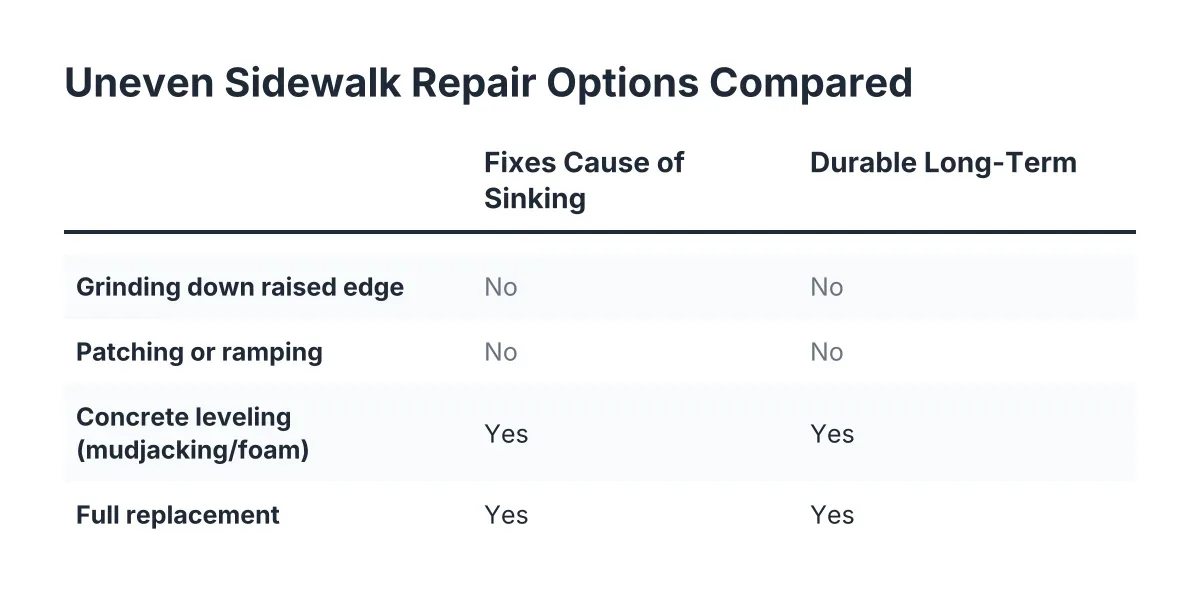
Neither method is automatically better. Slab condition, load, cure time, and budget decide it. A cracked-but-intact sidewalk panel that dropped an inch is a strong candidate for either. A slab shattered into small pieces is not a leveling candidate at all; that one needs replacement, and an honest contractor will say so on site.
What About Self-Leveling Concrete on a Sidewalk?
Self-leveling concrete is a compound poured on top of a slab to smooth it out, and it is mostly an indoor product. Manufacturer instructions typically require the concrete surface to be mechanically profiled before the leveler goes on, according to Lowe's installation guidance for Self-Leveler Plus, and safety guidance from Sakrete calls for a respirator when mixing because the dry powder is hazardous to breathe.
Outdoors, it is a weak fit for Des Moines. Exterior slabs absorb moisture and expand and contract through every freeze-thaw cycle, so a thin overlay tends to chip or crack off within a season or two. For a sidewalk trip hazard, an overlay is a temporary patch at best. Lifting the slab from underneath addresses the actual problem: lost support.
What Sidewalk Leveling Costs Compared to Replacement
Concrete leveling costs a fraction of replacement because you keep the existing slab. According to HomeAdvisor, mudjacking runs $3 to $6 per square foot and comes in 25% to 50% less than replacing a concrete slab entirely. Angi and HomeAdvisor data put the national average concrete leveling cost at $1,174, with a typical range of $630 to $1,723.
For a small sidewalk job, be aware of minimums. According to Angi, small mudjacking jobs may carry a minimum charge of around $500 even when the affected area is under 100 square feet. A single sunken panel will not be priced by the square foot alone.
A few site conditions can push the number up:
- Fences or landscaping that block equipment access
- Underground drainage pipes near the slab
- Concrete that was previously torn out and repoured
- Adjoining slabs that also settled and need lifting together
If you are selling, there is a return-on-investment angle worth knowing. According to Angi, mudjacking and concrete leveling projects can recoup 70% to 90% of their cost in added home value. That does not mean the repair pays for itself in the sale price, but it beats the alternative: a buyer's agent using an inspection flag to ask for a credit larger than the repair would have cost.
Suppose a seller in Beaverdale has a closing set for six weeks out, and the inspection report flags two sunken sidewalk panels with a one-inch offset. In that scenario, a leveling job might run a few hundred to roughly a thousand dollars depending on access and slab size, take a morning, and clear the flagged item. A full tear-out and repour of the same panels would cost multiples of that, involve permits and cure time, and leave fresh gray concrete that does not match the rest of the walk. For a pre-listing repair, leveling is usually the sane path when the slab is intact.
Will Leveled Concrete Pass a Home Inspection?
A properly leveled walkway addresses what inspectors flag: the height offset that creates a tripping hazard. Inspectors are looking for the condition, not the repair method. If the panels sit flush and the surface is stable, a slab that was lifted reads the same as a slab that never sank. There is no rule that a mudjacked sidewalk fails where a replaced one passes.
Two caveats keep this honest. First, leveling fixes elevation, not appearance. Existing cracks stay visible unless you add crack filling or crack repair, and patched drill holes are small but present. Most buyers do not blink at a hairline crack in a flush sidewalk; they blink at a raised edge. Second, no contractor can promise concrete will never move again. Natural settling and unseen soil conditions can shift even a well-leveled slab over time, so keep your repair paperwork to show buyers exactly what was done and when.
For landlords, the same logic applies to city sidewalk programs. If the city flags your frontage during a sidewalk inspection sweep, leveling that brings offsets back within tolerance typically resolves the notice at a lower cost than the city's replacement contractor. Confirm the specifics with your city's public works department, because tolerance thresholds and repair-approval rules vary by municipality.
Getting the Job Done on a Deadline
Concrete leveling is one of the faster repairs a homeowner can schedule, which is why it fits pre-listing timelines and lease turnovers. Here is a realistic sequence when a closing date or a tenant complaint is driving the schedule:
- Document the problem. Photograph the offsets with a tape measure in frame. This helps the contractor quote accurately and gives you a record for buyers or your own liability file.
- Get a site visit, not a phone quote. Slab condition determines whether lifting is even possible, and nobody can judge that from a photo alone.
- Ask which method fits and why. A specialist should explain the mudjacking versus foam decision in terms of your slab's condition, the load it carries, cure time, and cost. If the answer is one-size-fits-all, get a second opinion.
- Schedule around cure time. Foam-lifted slabs can usually take foot traffic almost immediately. Mudjacked slabs may need a day or so before heavy loads. Either fits inside a normal pre-listing window in 2026 scheduling terms; the constraint is usually the contractor's calendar, not the cure.
- Bundle the small stuff. If the crew is already on site, crack filling on adjacent panels and step leveling at the porch often add modest cost while cleaning up the whole approach to the front door. Curb appeal is the point when you are listing.
Searching for concrete raising near me or sidewalk leveling near me will surface both local specialists and national franchise pages. The useful filter is whether the company works on Des Moines clay every week and can talk plainly about it, or whether their page reads the same for Des Moines as it does for Denver.
Keeping the Slab Level After the Repair
Leveling restores support, but it does not change your soil or your drainage. If water keeps flowing under the slab, it will keep washing out soil, and the slab can settle again. The repair holds when the homeowner handles the water. That part is on you, and it is not complicated:
- Extend downspouts so they discharge away from walkways and the driveway, not beside them
- Fix leaky or overflowing gutters before the next freeze
- Grade soil and mulch beds so surface water drains away from concrete, not toward it
- Seal cracks and joints promptly so meltwater cannot pour through to the base
- Watch for burrowing pests, which hollow out support the same way water does
For a landlord, this checklist is worth building into seasonal walkthroughs across every property. Sidewalk and walkway leveling is a repeatable fix across a rental portfolio, and catching a quarter-inch offset in October is cheaper than lifting a two-inch drop in April after the freeze-thaw cycle has done its work. The same walkthrough catches the downspout that came loose and started feeding the clay under unit two's front walk.
The Bottom Line for Des Moines Walkways
Des Moines sidewalks sink because expansive clay shifts under them and Iowa winters heave them, and both forces run on water. A sunken walkway is a worsening trip hazard, a liability exposure, and an inspection flag, and none of those improve with time. Lifting the slab from underneath fixes the elevation at a fraction of replacement cost, usually in a single visit, and controlling the water afterward is what makes the fix last.
If your slab is intact and the offset is the problem, leveling is the practical answer. If the slab is crumbling, badly cracked into pieces, or sitting on soil with a drainage problem nobody has solved, bring in a professional to assess it before you spend money; some slabs need replacement, and it is better to hear that up front than after a failed lift.
If you need concrete leveling, Des Moines Concrete Leveling Pros can help.
Prefer to talk it through? Call +15155828701 — a quick call is usually the fastest way to get a straight answer for your situation.