Self-leveling Concrete Terms Explained: A Plain-English Glossary
If you're getting quotes to fix a sunken driveway or a cracked garage floor in Des Moines, the jargon piles up fast. This self leveling concrete glossary breaks down the terms you'll hear from contractors, see on estimates, and read in product descriptions. Each entry gives you a plain definition first, then explains why it matters when you're comparing quotes or talking to a provider. Read it once and you'll be able to ask sharper questions and spot the difference between a real fix and a cover-up.
- Self-leveling Compound: pourable mix that flattens itself
- Concrete Leveling: lifting a sunken slab back into place
- Mudjacking: pumping a mud slurry under a slab
- Polyurethane Foam Injection: lifting slabs with expanding foam
- Slab Jacking: the umbrella term for lifting slabs
- Settling: soil sinking under your concrete
- Void: an empty gap under a slab
- Substrate: the surface a product is poured onto
- Primer: a bonding coat applied before the pour
- Cure Time: how long before the surface is usable
- Feather Edge: thinning a product to almost nothing
- Resurfacing: a new thin layer over old concrete
- Crack Filling: sealing cracks so water stays out
- Tripping Hazard: an uneven edge that catches feet
- Expansive Clay Soil: soil that swells and shrinks with moisture
- Freeze-Thaw Cycle: winter's push and pull on concrete
- Flowability: how easily a mix spreads on its own
- Pinning or Drilling Pattern: the holes used to lift a slab
Products and Materials
These are the materials themselves, the stuff that goes into or under your concrete. A self leveling concrete glossary has to start here, because most confusion begins with what the product actually is.
Self-Leveling Compound: Terms in Your Glossary
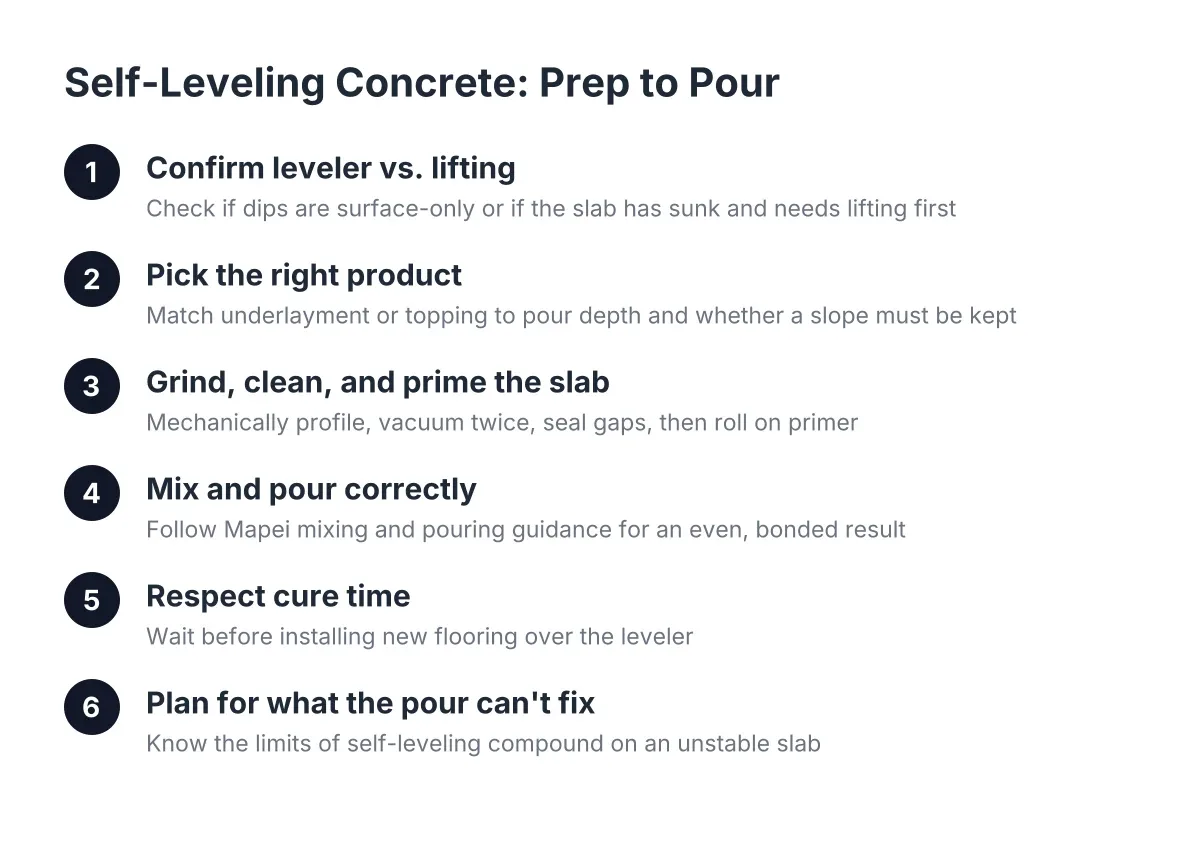
A self-leveling compound is a cement-based mix that pours like thick pancake batter and spreads out flat on its own before hardening. Contractors use it to smooth out dips, low spots, and rough patches on a concrete floor, often before installing tile or flooring. It fixes an uneven surface, but it does not lift a slab that has sunk into the ground. If a provider suggests self-leveling concrete for your garage floor, ask whether the problem is the surface or the soil underneath. Our cost guide for self-leveling concrete walks through what drives the price.
Polyurethane Foam Injection
Polyurethane foam injection is a leveling method where a contractor pumps expanding foam through small holes drilled in the slab. The foam fills the empty space underneath, expands, and pushes the slab back up. It cures fast, often within a day, and the drill holes are smaller than mudjacking holes. It usually costs more per job than mudjacking, so a provider should explain why your slab needs it.
Primer
A primer is a liquid bonding coat applied to old concrete before a self-leveling compound is poured on top. Without it, the new layer can peel away from the old floor like a bad sticker. If a quote for floor smoothing skips prep and primer, that is a shortcut that shows up later as cracking or delamination. It is a small line item that protects the whole job.
Methods and Repairs
These terms describe how the work actually gets done.
Self-Leveling Concrete and Concrete Leveling in Practice
Concrete leveling means raising a sunken concrete slab back to its original position instead of tearing it out and pouring new. It covers several methods, including mudjacking and foam injection. It costs less than replacement and takes hours instead of days. For a Des Moines driveway or sidewalk that has settled, leveling is usually the first option worth pricing.
Mudjacking
Mudjacking is a leveling method where a slurry of water, soil, and cement gets pumped under a sunken slab through drilled holes to push it back up. It is the older, heavier-material cousin of foam injection, and it works well for many driveways and walkways. The drill holes are larger than foam holes, and the material adds weight to soil that may already be soft. A good provider will tell you plainly whether mudjacking or foam fits your slab based on its condition, the load it carries, and how fast you need to use it.
Slab Jacking
Slab jacking is the general trade term for lifting any sunken concrete slab from below, whatever material does the pushing. Mudjacking and foam injection are both types of slab jacking. If one quote says slab jacking and another says concrete lifting, they may describe the same work. Ask each provider what material they pump and why, so you compare the same thing.
Resurfacing
Resurfacing means applying a thin new layer of cement-based material over old concrete to give it a fresh, uniform surface. It hides stains, small pits, and surface wear, but it cannot lift a slab or stop settling. Think of it as new paint on a wall, not a new wall. If your slab is sunken, level it first; resurface after, if you still want the cosmetic upgrade.
Crack Filling
Crack filling means sealing cracks in concrete with a flexible or rigid filler so water cannot get through. It matters more than it looks, because water that slips through a crack washes out the soil below and freezes in winter, making the crack worse. In central Iowa, crack repair after leveling is what keeps the fix from undoing itself. If a leveling quote does not mention sealing the cracks, ask why.
Feather Edge
A feather edge is the technique of thinning a leveling or resurfacing product down to almost nothing where it meets the existing floor. It makes the repair blend in instead of leaving a visible step or ridge. Not every product can feather without crumbling, so contractors sometimes use a separate patch mix at the edges. A provider who mentions feathering is thinking about how the finished floor will look and feel underfoot.
What's Going On Under Your Slab
Most sunken concrete in the Des Moines metro traces back to what the soil is doing, not what the concrete did wrong.
Settling
Settling means the soil under a concrete slab has compressed or washed away, letting the slab sink. It shows up as one corner of a driveway dropping, a sidewalk panel tipping, or steps pulling away from the porch. Settling gets worse on its own, because a tilted slab funnels more water to the low side. Catching it early usually means a simpler, cheaper lift.
Void
A void is an empty pocket of space under a concrete slab where soil used to be. Water erosion, poor compaction during construction, and burrowing animals all create voids. A slab over a void may look fine until enough weight cracks it. Filling voids is a core part of both mudjacking and foam injection, and a provider should check for them before quoting.
Expansive Clay Soil
Expansive clay soil is soil that swells when wet and shrinks when dry, moving whatever sits on top of it. Much of central Iowa sits on this kind of clay, which is why so many Des Moines driveways and patios settle unevenly. A wet spring puffs the soil up; a dry August shrinks it back down, and your slab rides that motion until something cracks or sinks. A local provider should be able to explain how your yard's drainage feeds the problem.
Freeze-Thaw Cycle
A freeze-thaw cycle is the repeated freezing and melting of water in and under concrete through the winter. Water expands about nine percent when it freezes, so trapped moisture pries cracks wider and heaves slabs up, then drops them when it thaws. Iowa winters run this cycle over and over, which is why cracks left unsealed in fall look worse by spring. It is the main reason crack filling and good drainage matter as much as the lift itself.
Tripping Hazard
A tripping hazard is any raised or sunken edge in a walkway where one slab sits higher than the next. Even a small lip can catch a shoe, and it is the most common reason homeowners call about sidewalk leveling. Beyond safety, an uneven walkway can become a liability question if a visitor falls. Leveling the low slab, or grinding a minor lip, removes the hazard without replacing the concrete.
Reading a Quote
These are the terms that show up on paper when a provider hands you an estimate.
Cure Time
Cure time is how long a material needs to harden before you can walk or drive on the repaired surface. Foam injection often cures within hours, mudjacking slurry can need a day or more, and poured compounds vary by product and thickness. Cure time affects your life directly: it decides when the car goes back in the garage. Any quote should state it clearly, and it is fair to ask twice if it does not.
Substrate
A substrate is the existing surface that a new material gets applied to, like the old concrete floor under a fresh leveling pour. The condition of the substrate decides how well the new layer sticks. A dusty, oily, or crumbling substrate needs cleaning or grinding first, which adds prep time to the job. When a quote lists surface prep, that is the substrate work, and it is worth paying for.
Flowability
Flowability describes how easily a mixed compound spreads out and finds its own level before it starts to set. High flowability means the material seeks out low spots without a lot of troweling. It matters because a mix that sets too fast or flows poorly leaves ridges and low spots, defeating the point of the product. It is why leveling floors is a timed, practiced job rather than a simple pour.
Pinning or Drilling Pattern
A drilling pattern is the planned layout of small holes a contractor drills through a slab to pump lifting material underneath. More holes in the right spots means an even lift; too few means one edge rises while another stays sunken. Foam holes are typically dime-sized, while mudjacking holes are closer to a coin you would notice. Ask how the holes get patched, because a tidy patch job is the sign of a careful crew, whether the job is in Des Moines proper or out in Waukee.
Using Self-Leveling Concrete Glossary Terms
What this self leveling concrete glossary gives you is the ability to read an estimate line by line and know what you are paying for. When a provider says foam versus mudjacking, or resurfacing versus leveling, you can now ask the follow-up question that matters: is this fixing the surface, or fixing the soil? That one question, asked plainly, tells you fast whether you are talking to a specialist or a script.
If you need concrete leveling, Des Moines Concrete Leveling Pros can help.
Prefer to talk it through? Call +15155828701 — a quick call is usually the fastest way to get a straight answer for your situation.