
Concrete Settling and Soil — Complete Guide
If your driveway, walkway, or patio keeps sinking, the concrete itself is rarely the problem. The soil underneath it is. This guide explains the soil and drainage forces behind concrete settling in the Des Moines metro, from poorly compacted fill soil in new subdivisions to downspouts that wash out the ground under your slabs. You will also learn how to sort out foundation problems vs settling, so you spend money on the right repair the first time. By the end, you will understand why concrete keeps sinking and what to pair with leveling so it stays put.
What You'll Find in This Guide
- Foundation Problems vs. Settling: Which Is Right for You?
- How Much Does Concrete Settling Repair Cost?
- Concrete Settling and Soil Terms Explained: A Plain-English Glossary
Why New Des Moines Subdivisions Have a Fill Soil Problem
Here is the pattern we see constantly across the metro. A homeowner in a subdivision built in the last five to fifteen years notices the driveway sinking near the garage. Or the front walkway drops at the porch, and the patio tilts toward the house. The concrete itself looks fine. However, it is riding on soil that was never ready to carry it.
When builders grade a new lot, they cut soil from high spots and fill low spots. That moved soil is called fill. To support concrete long term, fill needs compaction in thin layers, with the right moisture content, using the right equipment. In practice, production home building moves fast. As a result, the soil around foundations, in utility trenches, and under future driveways often gets backfilled loosely and left to settle on its own.
That settling takes years. Loose fill can compress for a decade or more as it consolidates under its own weight, rainfall, and the load of your slabs. This is why a driveway poured on day one can look perfect at closing and sit two inches low by year six. The concrete did not fail. The soil compaction under the slab simply never existed in the first place.
Central Iowa's Clay and Foundation Settling Problems
Beyond loose fill, our native soil works against you too. Much of central Iowa sits on expansive clay, which swells when wet and shrinks when dry. According to the USDA Natural Resources Conservation Service, soil properties like shrink-swell potential vary lot by lot, and you can look up your own parcel in their Web Soil Survey. In a wet spring, clay under your slab expands. During an August drought, it shrinks and pulls away, leaving voids the slab sinks into.
If some of these terms feel unfamiliar, our plain-English glossary of settling and soil terms breaks down fill, compaction, voids, and the rest without the jargon. For now, the key point is simple. New construction plus loose fill plus expansive clay is the exact recipe for repeat concrete settling, and it describes a huge share of Des Moines-area subdivisions.
Drainage, Downspouts, and Freeze-Thaw: How Water Moves Soil
Soil problems set the stage, but water does the actual damage. Nearly every sunken slab we lift in the metro traces back to water moving soil where it should not go. Understanding that flow is the difference between fixing your concrete once and fixing it every few years.
Start with your downspouts. A single downspout can dump hundreds of gallons against your foundation during one Iowa thunderstorm. If it discharges next to a walkway or driveway, that water saturates the soil beneath the slab and washes fine particles away. Over time, erosion carves out a void, and the slab settles into it. A downspout causing sunken concrete is one of the most common patterns we find, and it is also one of the cheapest to correct. Extending the discharge six to ten feet away from slabs often stops the cycle.
Grading matters just as much. When the ground slopes toward your house instead of away from it, every rain pushes water under your concrete. Similarly, gaps and open joints between slabs act like funnels. Water pours through, softens the subgrade, and each pass of a car tire pumps a little more soil out. This is why we treat crack filling and joint sealing as part of leveling, not an afterthought.
Freeze-Thaw Cycles Do the Heavy Lifting
Then winter arrives. Des Moines swings through dozens of freeze-thaw cycles each cold season. Water trapped in the soil under a slab freezes, expands, and heaves the concrete upward. When it thaws, the slab drops back down onto soil that has lost structure. Repeat that thirty times a winter and you get the classic freeze-thaw concrete damage pattern: slabs that pitch, rock, and drop a little more every spring.
This is also why timing matters for repairs. Lifting a slab without addressing the drainage causing the concrete settling means paying for the same fix twice. The good news is that leveling remains far cheaper than tearing out and repouring. According to HomeAdvisor, mudjacking runs 25% to 50% less than replacing a slab entirely. For a realistic look at what your specific situation might cost, see our guide to concrete settling repair costs.
Foundation Problems vs Settling: Getting the Diagnosis Right
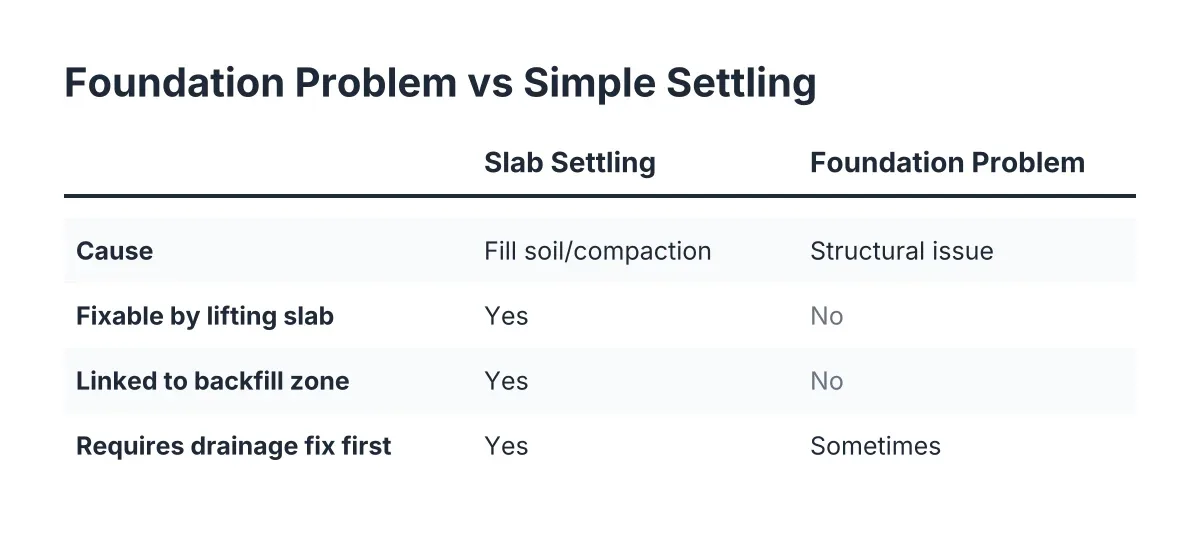
Before you spend anything, you need to know which problem you actually have. Foundation problems vs settling is the single most important distinction in this entire topic, because the two issues involve different causes, different repairs, and wildly different price tags. Confusing them costs Des Moines homeowners real money in both directions.
To put it simply, slab settling means a piece of exterior or interior flatwork has sunk. Think driveways, sidewalks, patios, garage floors, and steps. These slabs carry only their own weight plus foot and vehicle traffic. When the soil beneath them washes out or compresses, they drop. Leveling lifts them back into place by filling the void underneath, whether with a mudjacking slurry or polyurethane foam.
Foundation problems, by contrast, involve the structure holding up your house. Warning signs include stair-step cracks in basement walls, doors that stop latching throughout the home, sloping interior floors, and walls that bow inward. Those symptoms call for a structural contractor and often an engineer, not a slab-leveling crew.
Why the Franchise Sales Pitch Muddies This
Here is where local knowledge matters. The national franchise networks that advertise in Des Moines often sell foundation-scale solutions for slab-scale problems, because that is what their trucks carry. However, a sunken sidewalk panel does not need helical piers. It needs the void underneath filled and the water source corrected. That said, the reverse mistake is worse. If you level a garage floor while ignoring a genuinely failing foundation wall behind it, you have wasted money and lost time.
Our full breakdown of foundation problems vs. settling walks through the specific symptoms that point each direction, so you can walk into any estimate knowing what you are dealing with. As a rule of thumb, if the movement lives in flatwork and the house itself feels solid, you are almost certainly looking at settling. Additionally, settled flatwork repairs stay affordable. Angi and HomeAdvisor data put the national average concrete leveling cost at $1,174, with a typical range of $630 to $1,723. That is a fraction of structural foundation work, which is exactly why the correct diagnosis matters so much.
What Actually Stops Concrete From Settling Again
Lifting a slab fixes the symptom; stopping recurrence requires addressing soil and water together. A specialist assesses not just how far concrete dropped, but why—because the cause determines whether the repair holds.
A slab that sank from consolidated construction fill may need only one lift; the soil has largely finished settling. However, a slab sinking from an active erosion channel beneath a downspout will sink again within seasons, no matter how well lifted. The repair plan must include rerouting water, sealing entry joints, and then lifting the slab.
A complete fix around Des Moines homes typically pairs leveling with these steps: extend downspouts away from flatwork, correct grading so water sheds rather than pools beside slabs, fill cracks and seal joints between slabs to prevent subgrade water infiltration, and choose the right lifting material. Mudjacking suits large, heavy slabs where cost per square foot matters. Polyurethane foam works for situations needing lighter material, smaller injection holes, or same-day use.
The payoff is substantial. Beyond restoring safe, level surfaces, concrete leveling projects can recoup 70% to 90% of their cost in added home value. More importantly, proper diagnosis breaks the sink-lift-sink cycle that frustrates owners of newer homes. Because central Iowa's fill soils and clay behave predictably, a contractor who understands them can tell you honestly whether your concrete needs lifting, drainage fixes, or both. That plain answer separates a soil-literate local specialist from a template sales pitch.
Ready to Get Started?
If your concrete keeps sinking and you want a straight answer about why, we are happy to look at the soil, the water, and the slabs together. Des Moines Concrete Leveling Pros lifts and levels concrete across the metro using both mudjacking and polyurethane foam, and we will tell you plainly which one fits your situation. Reach out for an honest assessment before you pay for a repair that only treats the symptom.