Sidewalk Leveling Cost in Des Moines: Freeze-Thaw Pricing and Timeline
If your home inspection just flagged a sunken sidewalk slab, you need two numbers fast: what it costs to fix and how many days it takes. This guide covers sidewalk leveling cost in Des Moines, why our freeze-thaw winters push slabs out of place, and how to schedule sidewalk leveling before closing to get it done and documented before your closing date. No vague "call for a quote" runaround, just the pricing factors that actually move the number here in central Iowa.
You will also see what makes one quote higher than another, why leveling beats replacement on both price and timeline when you are selling, and what to hand your buyer's inspector so the repair holds up under a second look.
Why Des Moines Sidewalks Sink: Freeze-Thaw and Clay Soil
Des Moines sidewalks sink for two local reasons that a national franchise template will never explain well. First, central Iowa sits on expansive clay soil. Clay swells when it soaks up spring rain and shrinks hard in a dry August. That constant movement opens gaps under sidewalk slabs.
Second, our winters run dozens of freeze-thaw cycles. Water gets under a slab through an open joint or crack. It freezes, expands, and heaves the concrete up. Then it thaws and the slab drops back down, but not always into the same spot. Repeat that from November through March, year after year, and a slab that was flush in 2019 sits an inch low in 2026.
The result is the classic Des Moines sidewalk problem: one panel dropped below its neighbor, creating a lip that catches toes. Inspectors call it a tripping hazard. Buyers call it a red flag. Either way, it lands in the inspection report, and now it is your problem to fix before closing.
The good news is that a sunken slab is usually not a broken slab. If the concrete itself is sound, it does not need to be torn out. It needs to be lifted back into place, which costs a fraction of replacement and takes hours instead of days.
What Sidewalk Leveling Costs in Des Moines
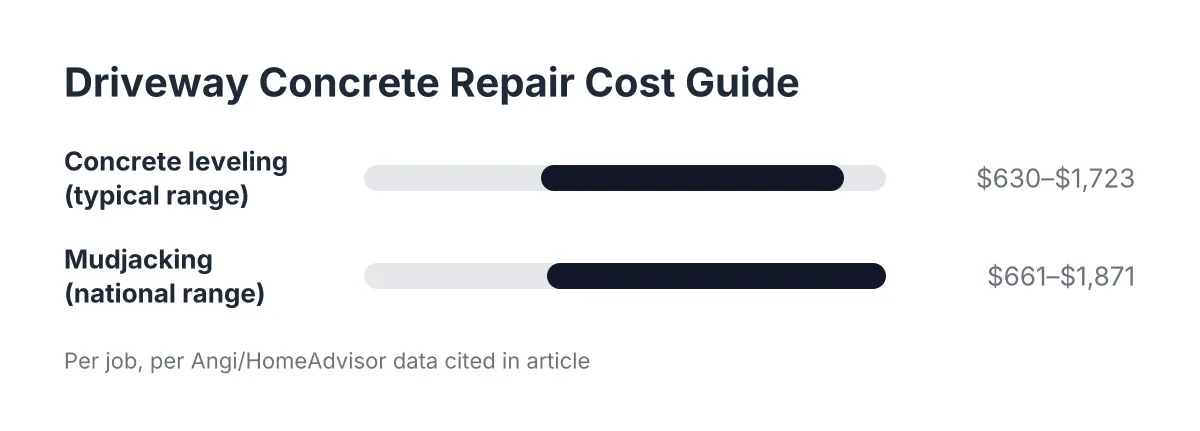
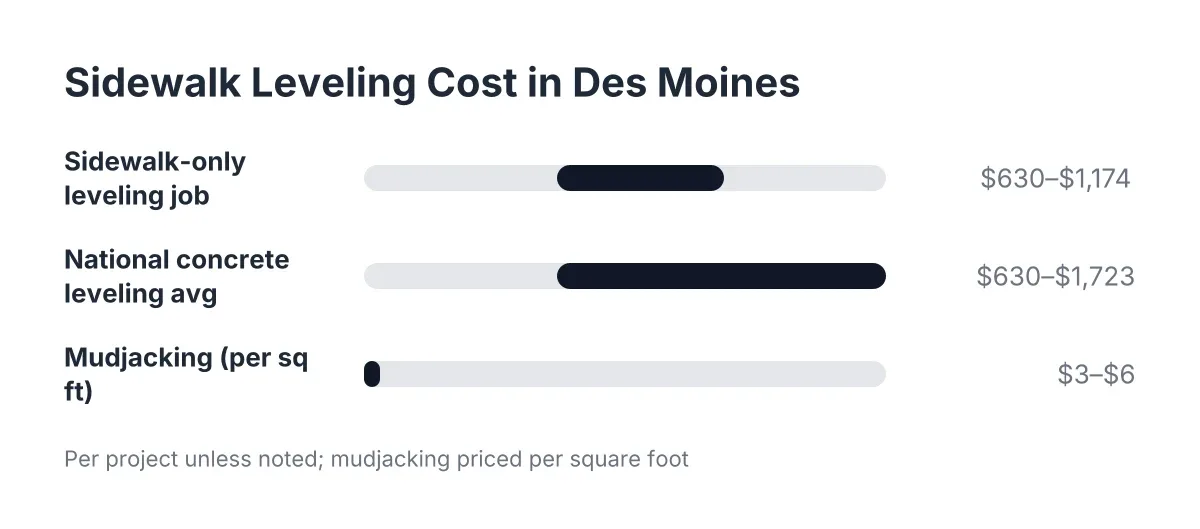
Sidewalk leveling in Des Moines typically runs a few hundred dollars for one or two sunken panels, and most residential sidewalk jobs land well under the cost of tearing out and repouring the same section. Nationally, according to Angi and HomeAdvisor data, the average concrete leveling cost is $1,174, with a typical range of $630 to $1,723.
Keep in mind that national average covers everything from a single sidewalk panel to a full driveway. A sidewalk-only job usually sits at the low end of that range. Sidewalk slabs are small, they carry light loads, and crews can often lift several panels in one visit.
Here is the comparison that matters most for a seller. According to HomeAdvisor, mudjacking costs $3 to $6 per square foot and runs 25% to 50% less than replacing a concrete slab entirely. For a standard sidewalk panel of about 25 square feet, the math favors leveling by a wide margin. Replacement also means demolition, hauling, forming, pouring, and a cure time measured in days to weeks. Leveling means a crew, a few drilled holes, and slabs you can walk on the same day.
One more number worth knowing before you decide whether to fix or negotiate: according to Angi, mudjacking and concrete leveling projects can recoup 70% to 90% of their cost in added home value. For a pre-listing seller, that is close to break-even before you even count the deals saved by a clean inspection report.
How Leveling Compares to Other Fixes
- Concrete leveling or mudjacking: lifts the existing slab back to grade, lowest cost, fastest, same-day use in most cases.
- Grinding: shaves down the raised lip, cheap, but leaves the slab low and does nothing about the void underneath.
- Replacement: highest cost, longest timeline, and usually unnecessary if the slab is intact.
- Self-leveling concrete: an overlay product for indoor floors, not a fix for a sunken exterior sidewalk. More on that below.
What Drives Sidewalk Leveling Cost Up or Down
Sidewalk leveling cost depends on five things: how many slabs sank, how big the void is underneath, what material lifts the slab, what obstacles sit in the work area, and what extra repair work rides along with the lift. Two neighbors on the same street can get different quotes because of these factors, not because one contractor is gouging.
First, the number of slabs. Leveling is priced by area, not as one flat fee, because material and time scale with the square footage being corrected. One sunken panel is a small job. Six panels along the front walk plus the porch approach is a bigger one, though the per-panel price often drops when the crew is already set up.
Second, the void size. Freeze-thaw heaving and clay shrinkage can hollow out a surprising amount of space under a slab. A slab that dropped half an inch needs far less lifting material than one that dropped three inches over a washed-out corner. Nobody knows the exact void size until the pumping starts, which is why honest quotes explain the material variable up front.
Third, the lifting material. Mudjacking pumps a cement-based slurry under the slab. Polyurethane foam injection uses expanding foam through smaller holes. Both work by the same principle: drill holes in the sunken slab, pump material beneath it to raise and stabilize it, then patch the holes to closely match the original surface, as Wikipedia describes the process. Mudjacking usually costs less per job. Foam typically costs more but uses smaller holes and cures fast. For a light-duty sidewalk panel, either can be the right call; the slab's condition and your timeline decide it.
Fourth, obstacles. Equipment stages in one spot, usually the street or driveway, for the whole job. A sidewalk panel behind a fence, near underground drainage pipes, or wedged between previously repoured sections takes more setup and care. Hoses run through a gate or around landscaping add time, and time is money.
Fifth, ancillary work. Crack filling, joint sealing, and driveway concrete crack repair often get quoted alongside the lift. They add to the total, but for a seller they are usually worth it. A leveled slab with a sealed joint keeps water out, which is what protects the repair through the next freeze-thaw season and keeps a buyer's inspector satisfied.
Sidewalk Leveling Before Closing: A Realistic Pre-Listing Scenario
Suppose a homeowner in Beaverdale is three weeks from closing. The inspection report flags two sunken sidewalk panels, each dropped about an inch, plus a hairline crack in the driveway near the apron. In that scenario, a typical crew could lift both panels and fill the crack in a single morning visit.
As an illustrative estimate, that job might land in the $400 to $900 range depending on void size and material, well inside a typical pre-listing budget and far below the several thousand dollars a replacement bid would run. The seller gets an invoice describing the work, photos of the leveled panels, and a walkway that no longer trips the buyer's agent on the way to the front door. That paperwork matters as much as the concrete; more on that in the timeline section.
Freeze-Thaw Damage and the Repair Calendar
Timing matters in Des Moines because our seasons change what is possible and what it costs. If you are selling on a deadline, here is how the calendar affects sidewalk leveling and scheduling in central Iowa.
Spring is the busy season. Winter's freeze-thaw cycles do their damage from December through March, and homeowners discover it all at once when the snow melts. Slabs that heaved in January settle unevenly in April. If your listing goes live in spring, book the leveling early; you are competing for schedule slots with every other homeowner who just found a new lip in their walkway.
Summer and early fall are the easiest windows. The ground is stable, cure conditions are good, and crews have more flexibility. If your closing lands between May and October, scheduling is rarely the bottleneck.
Late fall is the deadline season. Getting slabs leveled and joints sealed before the ground freezes protects the repair through winter and removes the tripping hazard before ice makes it worse. A sunken panel under snow is a liability question waiting to happen.
Winter leveling is possible in many conditions but depends on the ground and the material. Frozen soil and a frozen slab change what a crew can do. However, if your inspection lands in January and your closing is in February, do not assume you are stuck; ask. Foam-based lifting in particular handles cold better than most sellers expect.
How Fast You Can Close After the Repair
For most sidewalk leveling jobs, the answer is days, not weeks. Here is a realistic sequence for a seller working against a closing date:
- Site visit and quote: usually a short appointment where the estimator measures the sunken panels and checks slab condition.
- The work itself: most sidewalk jobs finish in a single visit, often in a few hours.
- Usable surface: leveled slabs typically handle foot traffic the same day; mudjacking slurry needs some cure time before heavy loads, while foam cures within minutes to hours.
- Documentation: an invoice describing the repair, plus your own before and after photos, goes into your seller's disclosure packet.
Therefore, even a tight three-week window between inspection response and closing usually leaves room for the repair, with margin for weather delays.
Will a Leveled Sidewalk Pass the Buyer's Inspection?
A properly leveled sidewalk addresses exactly what inspectors flag: the height difference between panels that creates a tripping hazard. Inspectors note uneven concrete and trip lips; they do not require that a slab be new, only that it be safe and functional. Lifting the panel flush with its neighbors removes the finding.
That said, be straight with yourself about what leveling fixes and what it does not. Leveling corrects elevation. It does not erase existing cracks, though crack repair can be done in the same visit, and it does not restore a slab that is crumbling or broken into small pieces. If a panel is shattered rather than sunken, replacement of that panel is the honest answer, and a good specialist will tell you so instead of pumping material under concrete that cannot hold together.
The strongest move for a seller is documentation. Keep the invoice, note the date and the method used, and take clear photos. When the buyer's inspector walks the property, a documented professional repair reads as a maintained home. An obvious patch job with no paper trail invites questions and renegotiation.
One honest limitation: leveling returns the slab to grade, but it cannot change the clay soil under your yard. Long-term, the repair lasts when water stays away from the slab. Point downspouts away from the walkway, fix overflowing gutters, and keep soil graded to shed water. Those habits, which you can note for the buyer, are what keep a leveled sidewalk level through future freeze-thaw seasons.
Cheap Fixes, DIY Kits, and When They Backfire
Search for cheap concrete leveling options and you will find concrete leveling kit listings and videos of homeowners lifting slabs with hardware-store foam. Before a closing, think hard before going that route. A DIY lift that cracks the slab or raises it unevenly can turn a $500 professional leveling job into a full panel replacement, because a damaged slab is harder to lift correctly later. That is the worst possible trade a seller can make three weeks before an inspection re-check.
Self-leveling concrete deserves its own caution, because sellers searching for a fast fix find it constantly. A self leveling concrete floor product is an overlay compound made for flattening interior floors before flooring goes down, not for raising a sunken exterior slab. It is also fussier than the bag suggests. Manufacturer instructions typically require the concrete surface to be mechanically profiled before the leveler goes on, according to the Lowe's Self-Leveler Plus installation guide. Priming matters too; Ardex notes that primer on porous concrete reduces air bubbles rising from the floor into the compound. In addition, Sakrete advises wearing a respirator when mixing, since the dry powder is hazardous to breathe. Poured over an outdoor sidewalk, the overlay cracks with the first freeze-thaw cycle, and now the inspector sees a failed patch on top of a sunken slab.
Where does DIY make sense? Small cosmetic patching. Filling a hairline surface crack or patching a chipped step edge is a reasonable homeowner task and can tidy up curb appeal cheaply, though how long it lasts depends on prep and technique. The line to draw is simple: cosmetic surface repairs, maybe; lifting a slab, hire it out.
Getting Quotes That Hold Up: Questions to Ask
You have a deadline, so make every estimate count. When you compare quotes for sidewalk leveling before closing, ask each contractor these questions and compare the answers side by side:
- Is the price based on square footage and expected material, and what happens if the void is bigger than expected?
- Mudjacking or polyurethane foam for this slab, and why? A specialist should explain the fit based on slab condition, load, cure time, and cost, not push one method for every job.
- What is the cure time before the walkway takes foot traffic?
- Does the quote include crack filling or joint sealing, or are those separate line items?
- Will the drill holes be patched to blend with the existing surface?
- Can the work be documented with an invoice describing method and date, for my disclosure packet?
A contractor who answers these plainly is a contractor whose repair will read well to a buyer's inspector. One who dodges the material question or quotes a suspiciously round number without measuring anything is guessing, and you do not have time for guesses.
Also weigh who is quoting. A concrete leveling specialist prices sidewalk lifts as their core work. A general foundation company may treat a two-panel sidewalk as a small add-on and price it accordingly, or steer the conversation toward bigger structural work you did not ask about. For a pre-listing repair, you want the focused fix, done fast, documented well.
The Bottom Line for Des Moines Sellers
Sidewalk leveling cost in Des Moines comes down to slab count, void size, material, obstacles, and any crack repair bundled in. For most sunken sidewalk panels, leveling costs a fraction of replacement, finishes in a single visit, and clears the tripping hazard finding on your inspection report with days to spare before closing.
Freeze-thaw cycles and clay soil caused the problem, so build the fix around them: level the slabs, seal the joints and cracks so water stays out, and document everything for the buyer. Fixed, sealed, and papered, a sunken sidewalk becomes a one-line note in your disclosure instead of a bargaining chip at the closing table.
If you need concrete leveling, Des Moines Concrete Leveling Pros can help.
Prefer to talk it through? Call +15155828701 — a quick call is usually the fastest way to get a straight answer for your situation.