Driveway Concrete Repair Cost Per Hole: Drilling, Injection, and Plugging
If you're getting ready to list your house and an inspector or realtor just flagged your sunken driveway, you need real numbers, not a sales pitch. Most articles about driveway concrete repair cost stop at a vague national range and tell you to "get three quotes." This one goes deeper. We're going to break the job down the way a leveling crew actually sees it: hole by hole. Drilling, injecting material under the slab, lifting it, and plugging the holes. Once you understand what each step involves, you can read any quote and know whether it's fair.
That matters when you're on a closing timeline. You don't have weeks to guess. You need to know what a fair price looks like for a sunken driveway or walkway in Des Moines, and you need to know it before the buyer's inspector shows up.
Why Concrete Leveling Is Really a Per-Hole Job
Every concrete leveling method works the same basic way. According to Wikipedia, concrete leveling works by drilling holes into the sunken slab, pumping a lifting material beneath it to raise and stabilize the slab, then patching the holes to closely match the original surface. That's the whole job in one sentence. Drill, pump, lift, plug.
So when a contractor walks your driveway, they're not just eyeballing square footage. They're counting slabs, estimating how many holes each slab needs, and guessing at the size of the void underneath. A single sunken sidewalk square might need two or three holes. A driveway slab that has dropped two inches at the garage might need six or more, spaced out so the lift comes up evenly instead of cracking the slab.
Most companies quote by the square foot or by the job, not literally by the hole. However, the hole count is what drives their number behind the scenes. More holes means more drilling time, more material, and more patching. Understanding that lets you compare quotes on substance instead of just picking the middle number.
What Each Step of the Job Actually Involves
Here's what happens on leveling day, step by step. None of this is mysterious, and knowing it helps you ask better questions when you're comparing bids before your listing goes live.
Step 1: Drilling the holes
The crew drills a pattern of holes through the settled slab. With mudjacking, the holes are larger, usually about the size of a soda can. With polyurethane foam injection, the holes are smaller, closer to the size of a penny. The crew places holes where the slab has dropped most and spaces them so the lift spreads evenly.
Hole size matters to you as a seller for one simple reason: appearance. Smaller holes patch cleaner and are harder to spot from the curb. Larger mudjacking holes still get patched, but a sharp-eyed buyer walking the driveway may notice them. Neither is a defect; they're just visible evidence of a repair you'll likely disclose anyway.
Step 2: Injecting the lifting material
Next comes the pump. With mudjacking, the crew pumps a slurry of sand, cement, and water under the slab. The slurry fills the void, and as pressure builds, the slab rises. With polyurethane, the crew injects a liquid polymer through ports in the small holes; the foam expands under the slab and lifts it back into place.
The material is where the cost difference between the two methods lives. Mudjacking slurry is cheap per gallon, so filling a big void costs less in material. Polyurethane foam costs more per pound, but it needs smaller holes, weighs less on soft soil, and cures fast enough to drive on the same day. For a seller with showings scheduled, that cure time can be worth the premium.
Step 3: Plugging and patching the holes
Finally, the crew fills each hole with a concrete patch mixed to sit flush with the surrounding surface. Fresh patch material won't perfectly match twenty-year-old weathered concrete, and no honest contractor will tell you it will. Over a season or two it blends in. Right after the job, it looks like a clean, deliberate repair, which is exactly what a buyer's inspector wants to see: a known problem, properly fixed.
How Driveway Concrete Repair Costs Break Down by the Numbers
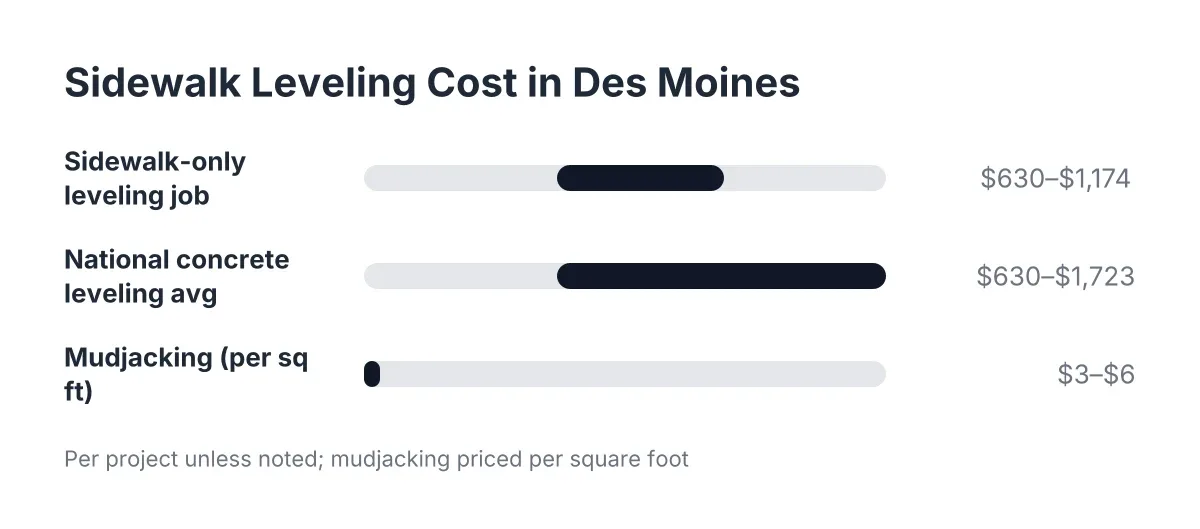
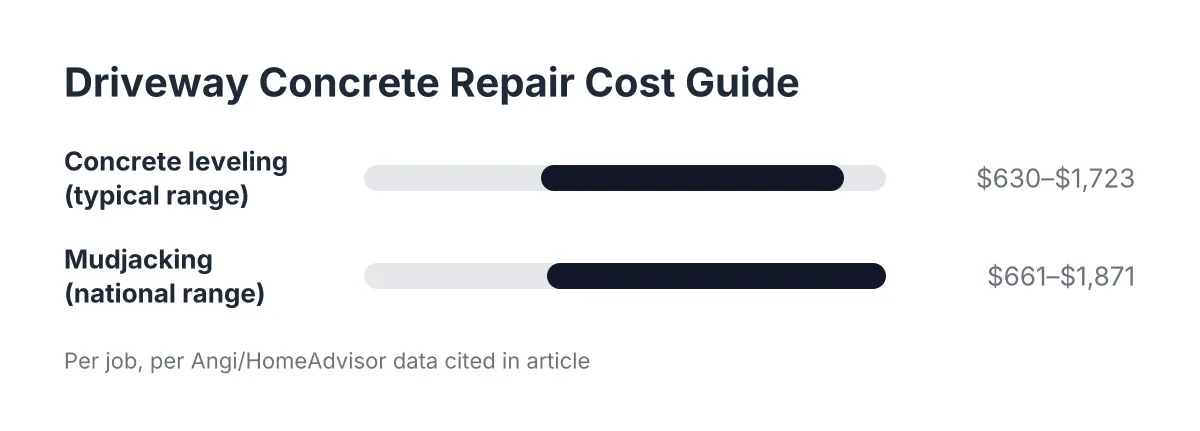
A typical driveway leveling job in the Des Moines area lands well under the cost of tearing out and repouring. According to Angi and HomeAdvisor data, the national average concrete leveling cost is $1,174, with a typical range of $630 to $1,723. For mudjacking specifically, Angi reports a national range of $661 to $1,871, with most homeowners paying around $1,232.
Put that against replacement and the math gets clear fast. According to HomeAdvisor, mudjacking costs $3 to $6 per square foot and runs 25% to 50% less than replacing a concrete slab entirely. A full driveway concrete replacement cost can run several times that once you add demolition, hauling, gravel base, rebar, and new concrete. If your slab is structurally sound and just sunken, leveling is almost always the cheaper path before a sale.
Here's roughly where the money goes on a leveling job, framed in per-hole terms:
- Drilling: Labor and equipment time. More holes and thicker slabs mean more drilling time.
- Material: Slurry or foam pumped through each hole. Bigger voids under the slab eat more material, and this is usually the largest variable.
- Lifting labor: The skill portion. Raising a slab evenly without cracking it takes an experienced hand on the pump.
- Plugging and patching: Filling each hole flush. A small line item, but it scales with hole count.
- Mobilization: Getting the truck, pump, and crew to your address. This is why tiny jobs still carry a minimum charge.
That minimum charge surprises people. Even if your sidewalk needs only two holes, the crew still has to bring the same rig they'd bring for a whole driveway. Therefore, small jobs cost more per hole than big ones. If you have a sunken walkway and a settled driveway slab, having both leveled in one visit almost always beats two separate appointments.
What Makes One Driveway Cost More Than Another
Two driveways can look identical from the street and come back with different quotes. The reasons usually fall into a handful of factors, and knowing them helps you see whether a higher bid is padded or justified.
First, the size of the void underneath the slab. In central Iowa, expansive clay soils swell when wet and shrink when dry, and freeze-thaw cycles open gaps under slabs over years. A slab that has settled two inches may hide a large hollow space, and every cubic foot of that space gets filled with paid material.
Second, the number of slabs involved. A driveway is usually several slabs separated by joints. Each settled slab needs its own hole pattern, so a driveway with three sunken panels costs more than one with a single low corner.
Third, access and obstacles. Leveling equipment typically stages in one place, usually the street or driveway, for the whole job. If the crew has to run hoses through a fenced yard, around landscaping, or past underground drainage lines to reach a back patio, the job takes longer and costs more. Slabs that adjoin the settled one, or concrete that was repoured over an old repair, also complicate the lift.
Fourth, extras beyond the lift itself. Crack filling, crack repair, and joint sealing are common add-ons that protect the repair by keeping water from washing out the soil again. They raise the total above the bare leveling price, but for a pre-listing seller they're often worth it; sealed joints and filled cracks read as "maintained" to a buyer, while open cracks read as "neglected."
Comparing Driveway Concrete Repair Cost: Mudjacking, Foam, and Self-Leveling
There are three fixes people search for before a sale, and they solve different problems. Picking the right one is the difference between a repair that helps your listing and money spent on the wrong thing.
Mudjacking
Mudjacking, also called slab jacking, is the traditional method: bigger holes, cement slurry, lower material cost. It shines on driveways with large voids where foam material costs would stack up. The trade-offs are larger patched holes and a longer cure before you can park on the slab. For a driveway that just needs to sit level and look sound at inspection, mudjacking is often the budget pick.
Polyurethane foam injection
So how much does polyurethane concrete lifting cost compared to mudjacking? Foam generally runs higher for the same slab, mostly because the material itself costs more per unit than cement slurry. In exchange, you get penny-sized holes that patch nearly invisibly, same-day use of the surface, and less weight added to soil that's already settling. Sellers with showings on the calendar often find that trade worth making.
Self-leveling concrete
Self-leveling concrete is a different tool for a different problem. It's a pourable compound that smooths an uneven surface; it does not lift a sunken slab or fill the void underneath. It's mostly an interior product for garage floors and basements before flooring goes down. If you're pricing a garage floor project, a self leveling concrete calculator from a product manufacturer can estimate bags needed, but know the prep is real work. Per the Lowe's Self-Leveler Plus installation guide, manufacturer instructions typically require mechanically profiling the concrete surface before applying the leveler. Ardex notes that priming porous concrete also reduces air bubbles rising into the compound, and Sakrete advises wearing a respirator when mixing because the dry powder is hazardous to breathe. In short: it's a legitimate DIY product for indoor smoothing, and the wrong answer for a sunken driveway.
That covers the honest limits of concrete leveling diy in general. Renting the pumps and rigs that lift exterior slabs isn't practical for a one-time job, and an uneven lift can crack a slab that was otherwise fine. Crack filling and interior floor smoothing are reasonable weekend projects; lifting a driveway is not.
A Realistic Pre-Listing Scenario, Hole by Hole
Suppose a homeowner in Beaverdale is listing in six weeks. The inspection-style walkthrough her agent arranged flagged two issues: a sidewalk square sunk an inch at the front walk, creating a tripping hazard, and a driveway slab settled toward the garage. She's worried a buyer's inspector will flag both and that the buyer will demand a credit far bigger than the actual repair.
In that scenario, a leveling crew might drill two or three holes in the sidewalk square and five or six across the driveway slab, pump material until both surfaces sit flush, then patch every hole the same afternoon. Based on the national figures above, a combined job like that would plausibly land somewhere in the mid hundreds to low thousands, a fraction of what a driveway concrete replacement cost calculator would show for tearout and repour. She'd be back to parking in the garage within a day or two with mudjacking, or the same evening with foam.
Compare that against the alternative: leaving it. Buyers and their inspectors notice sunken concrete, and repair credits requested at negotiation often exceed the real cost of the fix. According to Angi, mudjacking and concrete leveling projects can recoup 70% to 90% of their cost in added home value. For a seller, the practical return is often better than that number suggests, because the fix removes a negotiation lever entirely.
One honest caveat: leveling fixes settled slabs, not broken ones. If your driveway is crumbling, cracked into small pieces, or the settling traces back to a drainage or foundation problem, lifting the slab treats a symptom. A reputable local contractor should tell you that on the spot, and in those cases replacement or drainage work is the right call even on a tight timeline.
How to Read a Quote Like a Contractor
When the estimates come in, ignore the bottom line for a minute and look at what's underneath it. Use this checklist to compare bids on substance:
- Which slabs are included? Confirm the quote covers every flagged section: driveway panels, walkway squares, and steps if applicable.
- Which method, and why? Ask whether they're proposing mudjacking or polyurethane, and what about your slab drove that choice. A specialist should explain the fit in plain terms: slab condition, load, cure time, and cost.
- What happens to the holes? Patching should be included, not an add-on. Ask what the patches will look like.
- Are crack repair and joint sealing included? These protect the lift from washing out and clean up the slab's appearance before photos and showings.
- How soon can you use the surface? Foam is usually same-day; slurry needs longer. Match cure time to your showing schedule.
- Is there a minimum job charge? If yes, ask what else could be leveled in the same visit to get full value from the mobilization.
However, be cautious with any bid that's dramatically lower than the others. Underfilling the void keeps material costs down and gets the slab level for the photos, but a half-filled void invites the slab to settle again, sometimes before closing. A too-low driveway concrete repair cost estimate often means less material, not more efficiency.
What This Means for Your Sale Timeline
For most Des Moines sellers, the numbers point one direction. If the slab is intact and just sunken, leveling costs a fraction of replacement, finishes in a day, and turns an inspection red flag into a documented repair. Get quotes early, ask about hole count and material, and have the work done before the buyer's inspector walks the property rather than after.
Keep the paperwork. A dated invoice describing the driveway leveling and crack filling gives you something concrete to hand a buyer who asks about the patched holes. A flagged defect scares buyers; a fixed and documented one usually doesn't. That's the whole point of spending this money weeks before you list instead of negotiating over it days before you close.
If you need concrete leveling, Des Moines Concrete Leveling Pros can help.
Prefer to talk it through? Call +15155828701 — a quick call is usually the fastest way to get a straight answer for your situation.