
Polyurethane Foam Concrete Lifting — Complete Guide
If your driveway has sunk, your sidewalk has heaved, or your patio tilts toward the house, you have probably come across concrete lifting with foam in your research. This method injects expanding polyurethane foam beneath a sunken slab to raise it back to level, and it has become one of the two main professional options alongside traditional mudjacking. For Des Moines homeowners, the choice matters because central Iowa's expansive clay soils and freeze-thaw cycles are exactly the conditions that cause slabs to settle in the first place. This guide explains what foam lifting is, how it compares to mudjacking, and how to judge whether it fits your slab, so you can talk to any contractor with confidence instead of guesswork.
What You'll Find in This Guide
Prefer to have a pro handle it? Polyurethane foam concrete leveling is one call away.
How Concrete Lifting with Foam Actually Works
To put it simply, foam lifting raises a sunken slab from underneath instead of replacing it. A technician drills small holes through the concrete, usually about the diameter of a penny. Then they inject a two-part polyurethane that reacts and expands beneath the slab. As the foam expands, it fills the voids in the soil and generates lift. The slab rises in small, controlled increments until it sits level again. Finally, the technician patches the injection holes with a cement compound.
The physics is straightforward. Your slab did not fail; the soil under it did. Central Iowa sits on clay-heavy soils that swell when wet and shrink when dry. Add freeze-thaw cycles, downspouts that dump water next to the slab, or soil that was poorly compacted during construction, and the ground beneath your concrete loses volume. The slab then settles into the gap. Foam lifting replaces that lost support with a rigid, lightweight material that resists water and will not wash out the way loose soil can.
Why Homeowners Search for Lifting Concrete with Foam
You may have seen this technique called polyjacking, polyurethane foam concrete leveling, foam jacking, or concrete jacking with foam. All of these names describe the same core process. The branding varies, but the method does not. If the terminology in your quotes feels like alphabet soup, the plain-English glossary of foam lifting terms sorts out what each phrase actually means.
Two practical traits drive the interest. First, cure time is short. Polyurethane foam reaches most of its strength within minutes, which means you can usually walk or drive on the slab the same day in typical residential situations. Second, the material is light. Cured foam weighs far less than the sand-and-cement slurry used in mudjacking, so it adds very little new load to soil that has already proven unstable. For a slab sitting on soft or saturated ground, that weight difference can matter.
That said, foam is not automatically the right answer for every slab. The condition of the concrete, the number and pattern of cracks, the load the slab carries, and the cause of the settling all affect which method fits. A badly shattered slab may not be a good candidate for lifting by any method. The rest of this guide walks through those trade-offs.
Foam Lifting vs. Mudjacking: Choosing the Right Method
Mudjacking and foam lifting solve the same problem in different ways. Mudjacking pumps a slurry of sand, cement, and water through larger drilled holes to raise the slab. Foam lifting injects expanding polyurethane through smaller holes. Both methods can produce a level slab when the concrete is a sound candidate. However, the differences show up in weight, cure time, hole size, and cost.
Weight is the clearest contrast. Mudjacking slurry is dense, which gives it real pushing power but also adds load to the soil below. Foam is a fraction of that weight. As a result, foam often suits slabs over soft or moisture-prone soil, where adding mass could invite more settling. On the other hand, mudjacking's density can be an advantage under heavily loaded slabs, and its material cost is typically lower.
Cure time differs too. Mudjacking slurry needs time to set before the slab can take traffic, often a day or more depending on conditions. Foam cures within minutes. For a driveway you need to park on tonight, that speed is a genuine benefit rather than a sales line.
Questions Worth Asking Any Contractor
Regardless of which method a contractor recommends, ask why. A good answer references your specific slab: its condition, what sits on it, what the soil is doing, and where the water goes. Ask how they will address the cause of the settling, not just the symptom. For example, if a downspout has been washing out the soil under your walkway, lifting the slab without redirecting that water invites a repeat. Additionally, ask what happens if the slab cracks during lifting, how they patch the injection holes, and whether they put their workmanship terms in writing.
Be cautious of anyone who pitches one method for every situation. Foam and mudjacking each have a legitimate place, and the honest answer sometimes depends on slab thickness, access, and budget. In practice, a specialist who offers both can match the method to the problem instead of matching the problem to the only tool on the truck. If a quote uses terms you do not recognize, the foam lifting glossary can help you decode it before you sign anything.
One more point on scope. Lifting a slab is not the same as foundation repair. Concrete lifting with foam addresses settled flatwork such as driveways, sidewalks, patios, steps, and garage floors. Structural foundation settlement is a different problem with different solutions, so make sure the diagnosis matches the symptom.
Cost, Longevity, and Whether Foam Fits Des Moines Conditions
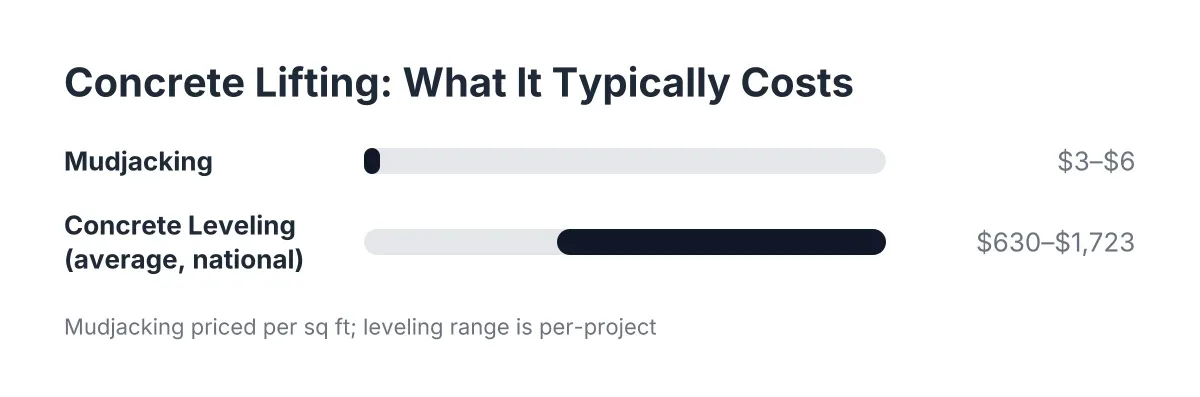
Cost is usually the first question, and the honest answer is that it depends on the size of the sunken area, how far the slab has dropped, how much void sits underneath, and how easy the slab is to access. Published national figures give useful context. According to Angi and HomeAdvisor data, the national average concrete leveling cost is $1,174, with a typical range of $630 to $1,723. Additionally, HomeAdvisor reports that mudjacking runs 25% to 50% less expensive than replacing a concrete slab entirely. Foam lifting generally costs more per job than mudjacking because the material is pricier, but it still sits well below full replacement in most cases. Keep in mind that small jobs can carry minimums; Angi notes that small mudjacking projects may face a minimum charge of around $500 even for areas under 100 square feet.
The value case goes beyond the invoice. A sunken walkway is a trip hazard, a tilted driveway sheds water toward your foundation, and uneven steps are a daily risk for kids and older visitors. Fixing these issues protects both safety and resale. In fact, Angi reports that concrete leveling projects can recoup 70% to 90% of their cost in added home value.
What Central Iowa Soil Means for Your Slab
Local conditions shape both the problem and the fix. Much of the Des Moines metro sits on clay-rich soils that expand when saturated and contract during dry spells. You can explore the soil types under your own lot through the USDA's Web Soil Survey, a free tool from the Natural Resources Conservation Service. Layer Iowa's freeze-thaw cycles on top of that movement and you get the classic pattern: slabs that heave in winter, settle in spring, and drift further out of level each year.
This is where the lightweight nature of concrete lifting with foam earns its keep locally. Because cured foam adds minimal load and resists water, it tends to hold up well over soil that cycles between wet and dry. However, no lifting method can overcome unmanaged drainage. Whichever method you choose, deal with gutters, downspouts, and grading at the same time. Otherwise the same water that sank the slab once will work on it again.
When Foam Is Not the Answer
Foam lifting works on slabs that are structurally sound enough to move as a unit. If your concrete has crumbled into many small pieces, is severely spalled, or has deteriorated from decades of de-icing salt, replacement or resurfacing may serve you better. Similarly, a slab that settled because of a plumbing leak or an active erosion problem needs that root cause fixed first. A trustworthy assessment starts with why the slab sank, then matches the repair to that answer.
Ready to Get Started?
Des Moines Concrete Leveling Pros lifts and levels sunken driveways, sidewalks, patios, steps, and garage floors for homeowners across the Des Moines metro and its surrounding communities. We work with both polyurethane foam injection and traditional mudjacking, and we explain plainly which method fits your slab and why. Call us or send a request, and we will take a look at your concrete and walk you through your options.