Does Homeowners Insurance Cover Concrete Leveling? A Des Moines Claim Guide
You noticed a sunken slab, a cracked walkway, or a driveway that dropped an inch since spring. Now you are asking the question that matters before you pay anyone a dime: does homeowners insurance cover concrete leveling? The honest answer is that it depends on what caused the damage, and most of the thin, generic pages you will find online never get past that. This guide goes further. It explains how adjusters think about concrete damage, when a claim has a real shot, when it does not, and how to get an estimate that reads well in a claim file instead of getting kicked back for more information.
This is written for Des Moines and the surrounding communities, where expansive clay soils and hard freeze-thaw cycles do most of the damage we see. That local detail matters more than you might think, because the cause of your sunken concrete is the whole ballgame when insurance gets involved.
Does Homeowners Insurance Cover Sunken or Cracked Concrete?
Homeowners insurance covers concrete damage only when a sudden, accidental event caused it, such as a burst pipe washing out soil under a slab or a vehicle impact. It does not cover gradual settling, soil movement, or normal wear. Most sunken driveways and sidewalks in Des Moines fall into the second category, so most claims for routine settling get denied.
That sounds discouraging, but it is not the end of the story. The dividing line is the cause of loss, which is the term your adjuster will use. Insurance policies are built around "perils," meaning specific events that cause damage. Covered perils typically include things like fire, windstorms, falling trees, and sudden water discharge from plumbing. Excluded causes typically include earth movement, settling, shrinking, bulging, and expansion of pavements and slabs.
Here is why that matters for your situation. If your driveway sank slowly over five years because central Iowa clay expands when wet and shrinks when dry, that is settling, and your policy almost certainly excludes it. However, if a water line under your garage slab broke last month and the escaping water washed the soil out from under the concrete, the cause is sudden and accidental. That claim is worth filing.
The same logic runs through every related question homeowners ask. Does homeowners insurance cover water damage? Yes, when it is sudden, like a burst pipe; no, when it is slow seepage. Does homeowners insurance cover foundation issues? Usually not for settling, sometimes yes for a covered peril like a plumbing failure. Concrete follows the same rule. The event gets covered. The slow decline does not.
The Causes Adjusters Look For, and How Each One Plays Out
Your adjuster's first job is to name the cause of loss. Before you file anything, walk through this list honestly, because it predicts how your claim will go.
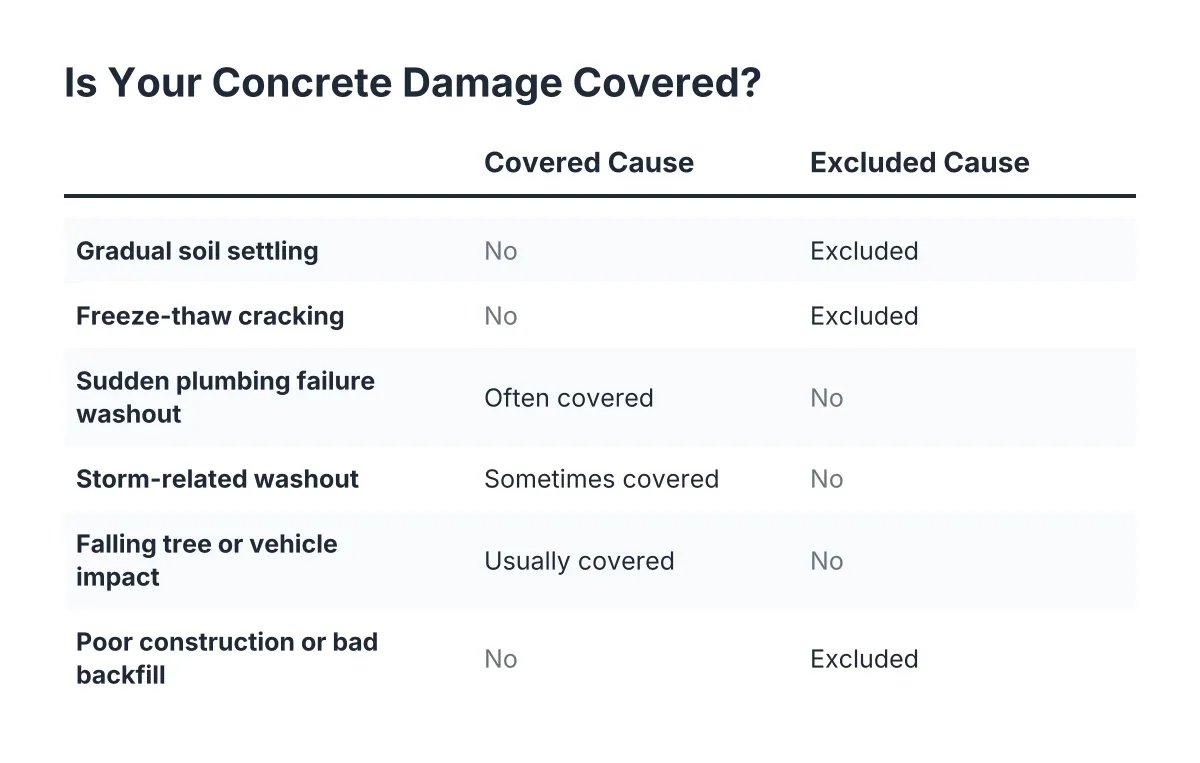
- Gradual settling from soil movement. The most common cause in the Des Moines metro, and the least likely to be covered. Expansive clay soils shift with moisture, and slabs poured on them sink over time. Nearly every policy excludes this.
- Freeze-thaw damage. Central Iowa winters push water into cracks, freeze it, and pry the concrete apart. Insurers treat this as gradual weathering, which is excluded as wear and tear.
- Sudden plumbing failure. A broken supply line or sewer line that washes out soil under a slab is a sudden discharge of water. This is often a covered peril, and it is the most common path to an approved concrete claim.
- Storm-related washout. If a specific, dateable storm eroded the soil under your walkway, you may have a claim, though many policies exclude surface water and flooding. Flood damage generally requires separate flood insurance.
- Falling tree or vehicle impact. A tree that cracks your driveway during a windstorm, or a delivery truck that breaks a slab, is a sudden event. These are usually covered, subject to your deductible.
- Poor original construction or bad backfill. Excluded from homeowners insurance, though a builder warranty may apply on newer homes.
Notice the pattern. Every covered scenario has a date, an event, and a mechanism you can point to. Every denied scenario is a slow process with no single moment when the damage happened. Frame your situation in those terms before you call your carrier, because the way you describe the loss in that first call gets written into the claim file.
When Filing a Sunken Slab Insurance Claim Makes Sense
File a claim when three things line up: a sudden identifiable cause, damage that clearly followed that cause, and a repair cost meaningfully above your deductible. If any of the three is missing, filing usually costs you more than it returns, because claims stay on your record whether they pay or not.
Consider the deductible math first. According to Angi and HomeAdvisor data, the national average concrete leveling cost is $1,174, with a typical range of $630 to $1,723. If your deductible is $1,000 or $2,500, which is common in 2026, a straightforward driveway leveling job may not clear it at all. In that case, filing gains you nothing and adds a claim to your history.
The math changes when concrete damage is part of a bigger loss. Suppose a homeowner in Beaverdale has a water line burst under the garage floor. The plumber's bill, the water cleanup, and the garage floor leveling together might run several thousand dollars in that scenario. Now the combined loss clears the deductible easily, and the concrete lifting becomes one line item in a claim that is already justified. That is the situation where knowing how to document slab work pays off.
For small landlords, the calculation has one more layer. Say you own three rentals across Des Moines and a tenant reports a sidewalk panel that dropped after a sewer line failure. The tripping hazard is a liability exposure, so you want it fixed fast regardless of coverage. Fix first if safety demands it, but photograph everything before the crew arrives, keep the broken pipe if the plumber pulls it, and get the cause in writing. You can file the claim after the hazard is gone, as long as the documentation exists.
One honest caution: filing multiple small claims across rental properties can raise your premiums or complicate renewals. For jobs near the deductible, many landlords are better off paying out of pocket and saving claims for real losses. An insurance agent can walk you through how your specific carrier treats claim frequency; that is worth a phone call before you file.
What Homeowners Insurance Covers on Concrete Versus What It Excludes
Homeowners insurance treats concrete under two parts of the policy. Attached structures like a garage floor or front steps fall under dwelling coverage. Detached flatwork like driveways, sidewalks, and patios usually falls under other structures coverage, which is typically capped at ten percent of your dwelling limit. Both apply only when a covered peril caused the damage.
Understanding which bucket your slab sits in helps you read your own policy. Pull out your declarations page and look for these sections:
- Coverage A, Dwelling. Covers the house and attached concrete, such as an attached garage floor or steps built into the foundation.
- Coverage B, Other Structures. Covers detached items, including driveways, walkways, patios, and detached garage slabs.
- Exclusions. Look for the earth movement exclusion and the wording on "settling, cracking, shrinking, bulging, or expansion" of pavements, patios, and foundations. This clause is why routine settling claims fail.
- Water damage provisions. These separate sudden discharge, which is covered, from seepage, flooding, and surface water, which are not.
While you have the policy out, note whether it pays replacement cost or actual cash value on other structures. Does homeowners insurance cover replacement cost on a driveway? Some policies do, some depreciate flatwork by age. On a 25-year-old driveway, that difference can cut a payout in half, and it is worth knowing before you build expectations.
How Insurance Can Cover Concrete Leveling Repairs
One more point in your favor: concrete leveling is the budget-friendly repair, not the expensive one. According to HomeAdvisor, mudjacking runs $3 to $6 per square foot and costs 25% to 50% less than replacing a slab entirely. Adjusters like repairs that restore function at the lowest reasonable cost. When insurance will cover concrete leveling, an estimate for slab lifting is an easier approval than an estimate for full tear-out and repour, so leveling works with the claims process rather than against it.
How to Build a Claim-Ready File Before the Adjuster Arrives
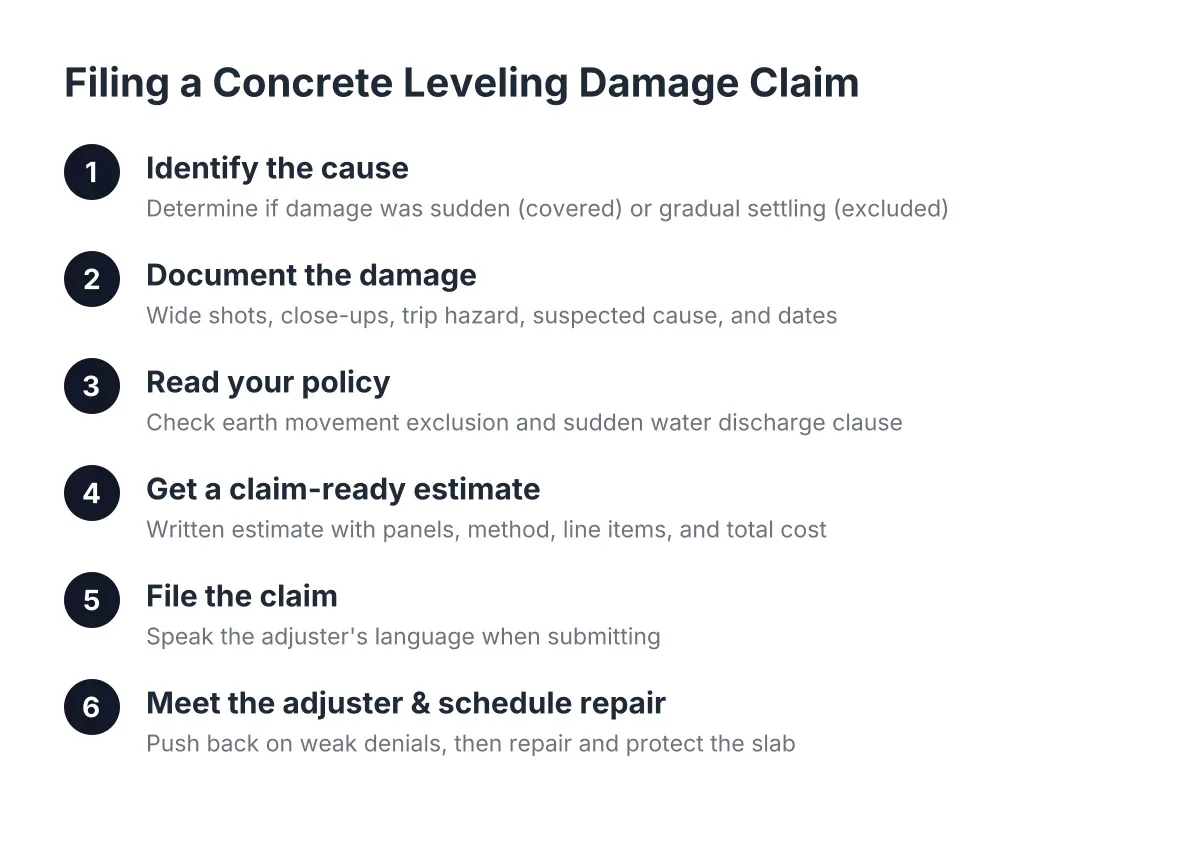
Adjusters approve what they can verify. Your job between now and the inspection is to hand them a file that answers their questions before they ask. Here is the sequence that works.
First, document the cause, not just the damage. Twenty photos of a cracked driveway prove damage exists; they say nothing about why. Photograph the broken pipe, the washout channel in the soil, the fallen limb, or the void under the slab edge. If a plumber found the failed line, get their invoice to state the failure, the date discovered, and the location relative to the slab.
Second, establish a timeline. Note when you last saw the concrete level and when you first noticed the drop. A slab that sank between two dateable observations, right after a pipe burst, reads as sudden. A slab that "has been getting worse for years" reads as settling. Tell the truth, but tell it with dates.
Third, get a written repair estimate that speaks the adjuster's language. A text message that says "driveway lift, call for price" will stall your claim. A claim-ready mudjacking quote for an adjuster should include:
- The property address and the specific slabs affected, such as "two driveway panels nearest the garage, approximately 120 square feet"
- Measured settlement, for example "sunken 1.5 inches at the garage-side joint, creating a tripping hazard at the sidewalk"
- The proposed method, whether mudjacking or polyurethane foam injection, and why it fits this slab
- Line items for the full scope: slab lifting, crack repair, crack filling or caulking of joints, and any adjoining panels that must be raised to match grade
- A stated opinion on the likely cause where the contractor can observe it, such as visible soil washout consistent with a plumbing leak
That last point deserves a word. A leveling contractor cannot rule on your coverage; only your carrier can. But a specialist who works Des Moines clay every week can tell the difference between slow seasonal settling and a fresh washout, and putting that observation in writing gives your adjuster something concrete to evaluate.
Fourth, do not alter the scene before inspection when you can avoid it. If there is no safety hazard, leave the slab as-is until the adjuster sees it or approves photos as sufficient. If a tripping hazard forces immediate repair, photograph thoroughly, keep all invoices, and notify your carrier before the work happens.
Fifth, use the right words when you file. Report the event, then the damage: "A supply line burst under our garage on March 12 and washed out the soil; the slab has since dropped an inch." Do not open with "my concrete has been settling," because settling is the word your exclusion clause uses. You are not gaming the system; you are describing the actual cause accurately instead of letting a vague description sink a valid claim.
Why Leveling Only the Sunken Panel Can Undercut Your Claim
A repair scope that covers only the obviously sunken slab often leaves a lip where the raised panel meets its neighbors, which recreates the tripping hazard the repair was meant to fix. Adjusters and contractors both know this, so a proper estimate frequently includes adjoining panels, and you should expect that.
For example, suppose one sidewalk panel on a rental property dropped two inches after a storm washout. Lifting that panel back to its original height might leave a half-inch edge against the next panel, which settled a quarter inch on its own over the years. A complete repair brings the run back to an even walking surface, and the estimate should say so panel by panel. This is normal scope, not padding, and a written explanation of it helps the adjuster approve the full amount instead of trimming it.
Ancillary work belongs in the estimate too. Crack repair and joint caulking after lifting are not extras; open cracks and joints let water back under the slab and restart the washout cycle. Many providers will not stand behind a leveling repair without the joints sealed, so leaving caulking out of the claim scope just means you pay for it separately later. Obstacles like fences, buried drainage lines, or previously repoured sections can also add cost, and they should appear as line items rather than surprises.
One thing to know going in: even a properly leveled slab can settle again over time from natural soil movement or causes nobody can see. No honest contractor promises otherwise, and no insurance policy covers future settling. What you control is drainage, and that is the next section.
If the Claim Is Denied, Here Is Your Path Forward
A denial is common for concrete claims, and it is not always final. Read the denial letter closely and check which exclusion the carrier cited. If they called it settling but you have plumber documentation of a sudden pipe failure, you can request reconsideration and submit the evidence. Carriers reverse denials when new documentation changes the cause of loss, and a detailed contractor estimate with observed washout noted can be part of that package.
If the denial stands, the fallback math is still manageable. Concrete leveling exists precisely because it beats replacement on cost. Small jobs may carry a minimum charge of about $500 even under 100 square feet, according to Angi, so bundling several settled slabs into one visit often makes sense, especially for a landlord with more than one problem panel. And the money is not wasted even from an investment angle; Angi reports that mudjacking and concrete leveling projects can recoup 70% to 90% of their cost in added home value.
Then protect the repair so you never fight this battle twice. Long-term success depends on keeping water away from the slab:
- Extend downspouts so they discharge past the edge of the concrete, not beside it
- Fix gutters that leak or overflow onto flatwork
- Grade soil and landscaping so water drains away from slabs, not under them
- Watch for burrowing animals that open voids beneath concrete
Skipping this upkeep is the most common reason a leveled slab sinks again. The lift fixes the symptom; drainage control removes the cause you can actually control.
Straight Answers to the Questions Des Moines Homeowners Keep Asking
Is concrete leveling covered by insurance if the driveway just sank on its own? No. Gradual settling from soil movement is excluded under nearly every homeowners policy. Coverage requires a sudden event as the cause.
Is "concrete leveling" even the right term for my claim? Yes, and it has synonyms your adjuster will recognize: concrete lifting, slab jacking, and mudjacking all describe the same category of repair. Concrete leveling works by drilling holes into the sunken slab, pumping a lifting material beneath it to raise and stabilize it, then patching the holes to closely match the original surface, according to Wikipedia. Your estimate can use any of these terms as long as the scope is specific. One clarification worth making with your adjuster: this is a repair that reuses your existing slab, not a tear-out and repour, which is a common misunderstanding that inflates expectations on both sides. Note that self-leveling concrete is a different product for smoothing interior floors, not for lifting sunken exterior slabs, so keep that term out of a lifting claim.
Will a local company actually help with the paperwork? A specialist should, at minimum, give you a written, itemized estimate with measurements, method, and scope that an adjuster can evaluate without a follow-up call. That document is the backbone of concrete leveling insurance claims, and asking for it up front is a fair test of any contractor you are considering. Getting more than one estimate is smart anyway; it gives your adjuster comparable numbers and gives you confidence in the recommended method.
Should I try to fix it myself first and claim it later? No. DIY leveling attempts can damage the slab, make professional leveling harder, and in the worst case force full replacement instead of repair. It also destroys the evidence your adjuster needs to see.
What about related damage from the same event? Ask your adjuster about the whole loss, not just the concrete. Does homeowners insurance cover plumbing repairs themselves, the water damage cleanup, or mold remediation if water sat under the slab? The answers vary by policy, but a covered peril often opens the door to more than the flatwork, and it all belongs in one claim.
The bottom line for a Des Moines homeowner or small landlord: identify the cause honestly, run the deductible math, and build the file before you file. When the cause is sudden, documentation wins claims. When the cause is settling, skip the claim, get an itemized leveling estimate, and fix the drainage so the repair holds. Either way, you avoid the worst outcome, which is paying twice for the same slab.
If you need concrete leveling, Des Moines Concrete Leveling Pros can help.
Prefer to talk it through? Call +15155828701 — a quick call is usually the fastest way to get a straight answer for your situation.